New Ministry Is "Good"
pp. 18-19 · Read in the full issue
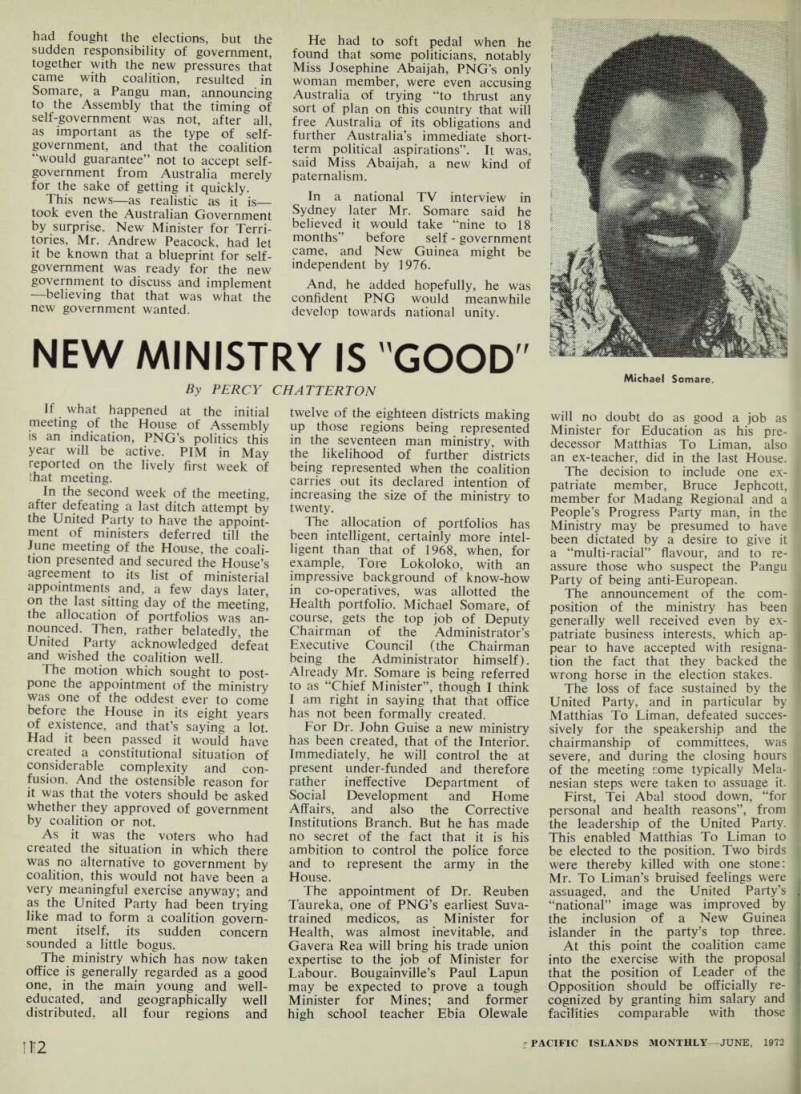
By Percy Chatterton
If what happened at the initial meeting of the House of Assembly is an indication, PNG’s politics this year will be active. PIM in May reported on the lively first week of that meeting.
In the second week of the meeting, after defeating a last ditch attempt by the United Party to have the appointment of ministers deferred till the June meeting of the House, the coalition presented and secured the House’s agreement to its list of ministerial appointments and, a few days later, °n the last sitting day of the meeting, the allocation of portfolios was announced. Then, rather belatedly, the United Party acknowledged defeat and wished the coalition well.
The motion which sought to postpone the appointment of the ministry was one of the oddest ever to come before the House in its eight years of existence, and that’s saying a lot.
Had it been passed it would have created a constitutional situation of considerable complexity and confusion. And the ostensible reason for it was that the voters should be asked whether they approved of government by coalition or not.
As it was the voters who had created the situation in which there was no alternative to government by coalition, this would not have been a very meaningful exercise anyway; and as the United Party had been trying like mad to form a coalition government itself, its sudden concern sounded a little bogus.
The ministry which has now taken office is generally regarded as a good one, in the main young and welleducated, and geographically well distributed, all four regions and
twelve of the eighteen districts making up those regions being represented in the seventeen man ministry, with the likelihood of further districts being represented when the coalition carries out its declared intention of increasing the size of the ministry to twenty.
The allocation of portfolios has been intelligent, certainly more intel ligent than that of 1968, when, for example, Tore Lokoloko, with an impressive background of know-how in co-operatives, was allotted the Health portfolio. Michael Somare, of course, gets the top job of Deputy Chairman of the Administrator’s Executive Council (the Chairman being the Administrator himself).
Already Mr. Somare is being referred to as “Chief Minister”, though I think I am right in saying that that office has not been formally created, For Dr. John Guise a new ministry has been created, that of the Interior, Immediately, he will control the at present under-funded and therefore rather ineffective Department of Social Development and Home Affairs, and also the Corrective Institutions Branch. But he has made no secret of the fact that it is his ambition to control the police force and to represent the army in the House.
The appointment of Dr. Reuben Taureka, one of PNG’s earliest Suva trained medicos, as Minister for Health, was almost inevitable, and Gavera Rea will bring his trade union expertise to the job of Minister for Labour. Bougainville’s Paul Lapun may be expected to prove a tough Minister for Mines; and former high school teacher Ebia Olewale
will no doubt do as good a job as Minister for Education as his pre decessor Matthias To Liman, also an ex-teacher, did in the last House.
The decision to include one ex patriate member, Bruce Jephcott, member for Madang Regional and a People’s Progress Party man, in the Ministry may be presumed to have been dictated by a desire to give it a “multi-racial” flavour, and to re assure those who suspect the Pangu Party of being anti-European.
The announcement of the com position of the ministry has been generally well received even by ex patriate business interests, which ap pear to have accepted with resigna tion the fact that they backed the wrong horse in the election stakes.
The loss of face sustained by the United Party, and in particular by Matthias To Liman, defeated succes sively for the speakership and the chairmanship of committees, was severe, and during the closing hours of the meeting come typically Mela nesian steps were taken to assuage it.
First, Tei Abal stood down, “for personal and health reasons”, from the leadership of the United Party.
This enabled Matthias To Liman to be elected to the position. Two birds were thereby killed with one stone; Mr. To Liman’s bruised feelings were assuaged, and the United Party’s “national” image was improved by the inclusion of a New Guinea islander in the party’s top three.
At this point the coalition came into the exercise with the proposal that the position of Leader of the Opposition should be officially re cognized by granting him salary and facilities comparable with those
enjoyed by members of the AEG.
Clearly, the coalition was out to secure an orderly parliament by help ing to restore the UP’s self-esteem.
This was sound political sense in any setting, and particularly in a Melanesian setting, and it was a matter for surprise that the Admini strator, generally so perceptive, should have chosen this occasion to express reservations about a move which would, he felt, entrench the West minster system, a system which, after all, the administration of which he has long been a member and is now the head has been ramming down our throats since 1964.
The suitability of the Westminster system for Papua New Guinea may well be questioned, but it would be difficult to choose a more unsuitable moment for doing so, and it is difficult to see why the recognition of the leader of the Opposition should do more to entrench the system than the appointment of a Westminster-style ministry.
Anyway, that’s it till the House meets again in June and really gets down to the job of governing.