the new
pp. 17-18 · Read in the full issue
A knife into the new government
Selfish people with “cranky talk and wild ideas” were trying to stir up trouble against the new govern ment in the New Guinea Highlands, said PNG’s new Minister for Agri culture, lambakey Okuk, in Port Moresby in May. But, warned Okuk, if the new National Coalition Gov ernment collapsed, it would set back PNG’s political development “many years”.
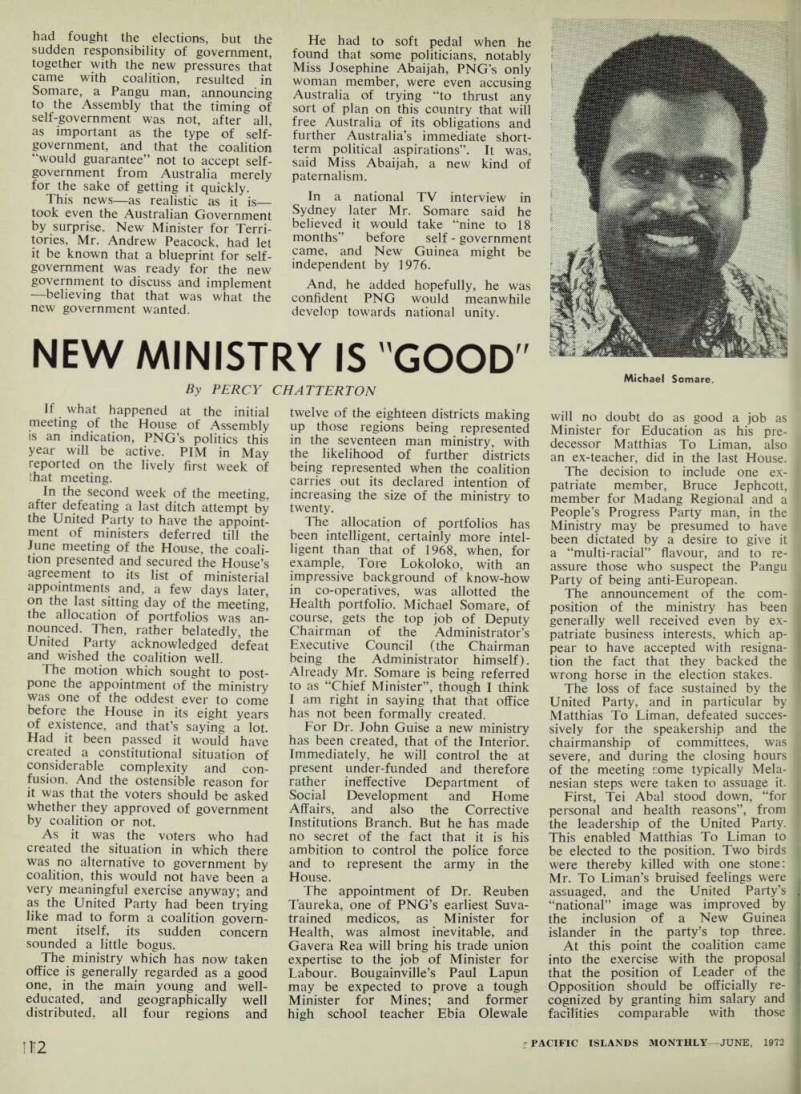
The warning was warranted. In April, following general elections, the Pangu, National and People’s Pro gress parties, with some like-minded people, formed PNG’s first govern ment, and under its Chief Minister, Sepik politician Michael Somare, it has already started to make a good fist of the thankless task. But prob lems of law and order have given the government its first real headache. A few days before Okuk’s statement Somare himself, in a PNG-wide broadcast, said some members of the coalition had been threatened with death if they did not leave the coalition.
The trouble is in the Highlands, stronghold of supporters of the United Party, which now forms the parliamentary Opposition. In some areas, notably around the Chimbu where Okuk comes from, locals fear that election of the new government means that Australia is about to withdraw, which it isn’t. In Kundi awa, the first raising of the new PNG flag beside the Australian flag was popularly suspected of being the cause of the drop in world coffee prices—which happened to take place about the same time.
At Kundiawa in April native ex servicemen asked (in vain) that the New Guinea flag not be allowed to fly alongside the Australian flag for Anzac Day services. And at Kundiawa in May there were mass native demonstrations against Okuk and others who were said to have “betrayed” the Highlanders. One of the organisers was a man who re cently tore down a PNG flag, saying he preferred the Australian flag to fly in the Chimbu.
The Highlanders were, in fact, tilting at windmills.
“Self-government now” was cer tainly the platform on which Pangu
ad f° u £ht the elections, but the sudden responsibility of government, together with the new pressures that came with coalition, resulted in bomare, a Pangu man, announcing to the Assembly that the timing of self-government was not, after all, as important as the type of selfgovernment, and that the coalition would guarantee not to accept selfgovernment from Australia merely for the sake of getting it quickly.
This news—as realistic as it is took even the Australian Government by surprise. New Minister for Territories, Mr. Andrew Peacock had let it be known that a blueprint for selfgovernment was ready for the new government to discuss and implement believing that that was what the new government wanted.
He had to soft pedal when he found that some politicians, notably Miss Josephine Abaijah, PNG’s only woman member, were even accusing Australia of trying “to thrust any sort of plan on this country that will free Australia of its obligations and further Australia’s immediate short term political aspirations”. It was, said Miss Abaijah, a new kind of paternalism, T , . a natlona l TV interview in ?y<!“ey I . ater Mr - Somare said he believed it would take “nine to 18 months ” before self-government ? ame ’ and New Guinea might be independent by 1976.
And, he added hopefully, he was confident PNG would meanwhile develop towards national unity.
Michael Somare.