a way out of the woods
pp. 105-107 · Read in the full issue

Fiji company looks for a way out of the woods
While Fiji’s building industry bumbles along with its outrageously high costs (in relation to its depressingly inefficient labour), Union Woods (Fiji) Ltd., the public company forced into receivership by the Fiji Development Bank, is scouting around for more capital.
The managing director, Mr. David Blake, has appealed to the 700 local shareholders for more money to enable it to get back on its feet, They could do this, he says, by buying 25c shares or advancing loans to the company.
“There is no doubt in my mind, and working without wages for the company for nearly five months is proof of my feeling, that if you invest a little more, your company will go ahead, be very profitable and never look back again,” he told shareholders in a circular.
He told PIM in April that the company, which has a Nausori factory manufacturing mainly parquet flooring, had suffered because architects had shown no interest in pushing the product.
“No, I honestly don’t know why they will not push it. Some have said they’d like to see it proved first, which I can understand, others have said they’ve had bad experience with overseas parquet, and therefore can’t recommend ours,” he declared.
“We’ve had very few orders locally.
Those we have had have been the result of extremely hard selling on our part. We’ve done several houses, a few offices and the Suva Motors showroom floor.”
Like many of Fiji’s problems, the company’s difficulties resulted largely from last year’s dock strike. (In April, there were whispers that an other strike was looming, coinciding with the end of the present wage agreement between dockworkers and the shipping companies.) “The strike caused a five-month delay in the delivery of machinery to the factory last year and the cost of local timber used by the factory had doubled,” explained Mr. Blake. “We therefore lost a big Australian order for parquet.”
The starting delays left the corn pany without working capital and it defaulted in the fifth repayment of its loan from the Fiji Development Bank, from which it had borrowed $51,500. (Some $139,000 had also come from local shareholders.) In February the FDB appointed an accountant as the company’s receiver and manager, Fiji’s building industry swarms with disturbing stories, many of them con cerning small firms who’ve over reached themselves and had to close down, frequently in the midst of construction.
While Union Woods is having
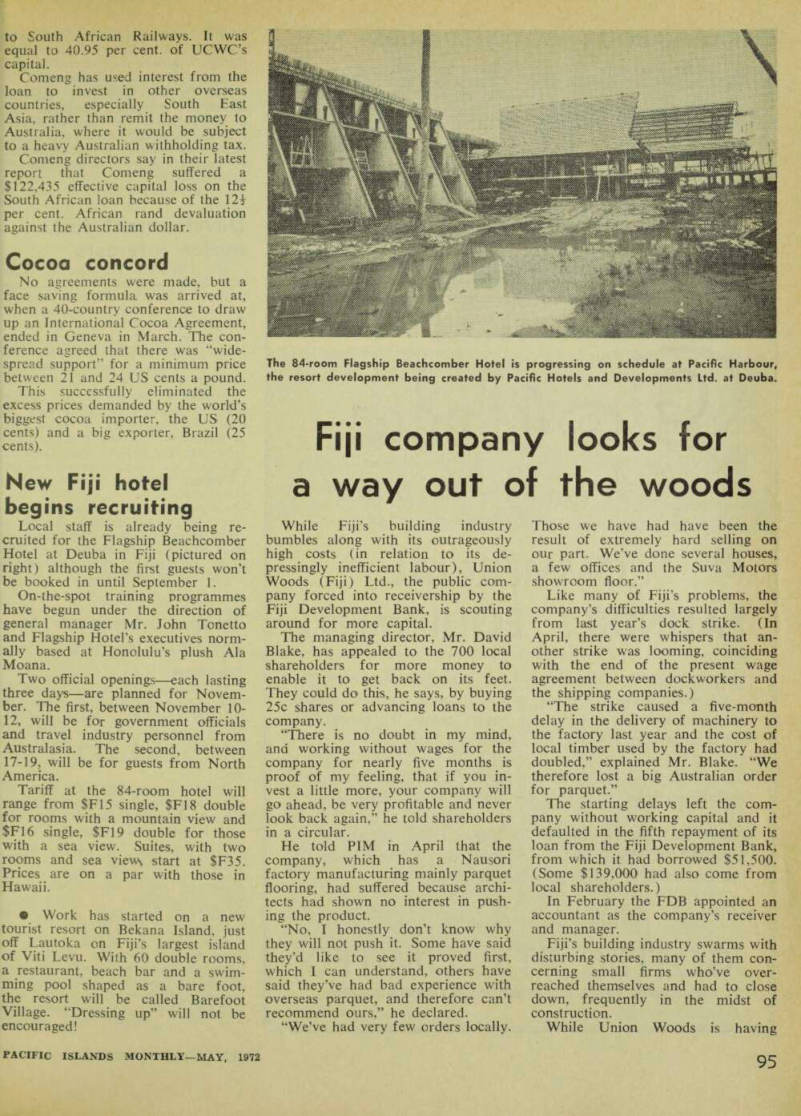
The 84-room Flagship Beachcomber Hotel is progressing on schedule at Pacific Harbour, the resort development being created by Pacific Hotels and Developments Ltd. at Deuba.
Cheap Labour—Botched Jobs
trouble, other companies building offices and individuals building homes have to wait, literally, months for such basic items as paints, tiles, door knobs and light fittings to arrive from overseas.
Some contractors employ such cheap labour—paying, sometimes, less than 20c an hour—that the job is inevitably botched. It costs the home builder twice as much in the end, because he must find, if he can, a skilled worker to correct the mistakes.
Crooked walls and uneven floors are expected from some contractors. Yet, because of the demand, they con
tinue to get work.
The serious lack of skilled labour looks like continuing for many years to come, according to figures col lected by Dr. Ormond Pickard, chair man of the Apprentice Council Award Scheme.
A building trade survey had re vealed a shortage of 1,600 skilled workers. The fact that of the 600-650 apprentices in training only about 70 were from the building trade indi cated how much more remained to be done.
Similar surveys have been con ducted into the auto service industry,
electrical and hotel needs. The short ages of skilled people in these indus tries and services was reflected in the poor service often encountered.
Overall, Fiji has only 600-650 apprentices in training compared with a work force of approximately 57,000. Although there are about 3,500 employers in Fiji, only about 40 support the Apprentice Council Award Scheme.
Development links
major interests
The proposed $ll million hotel and offices complex for W. R. Car penter & Company Limited in Suva will bring together the resources of Carpenters and Mainline Corporation.
A new joint company called Mainline Millers Constructions (Fiji) Ltd. has been formed as an equal partnership between the two parent organisations.
It will be responsible for further major building projects in Fiji, in cluding a resort hotel for Noahs Ltd. at Korolevu. The new company will take over the building operations of Millers Ltd., which is at present the Carpenter subsidiary for all construc tion work.
Carpenters and Mainline are al ready closely associated, having a cross-representation on the boards of each other’s parent company. Capital of the new joint venture company is initially to be $250,000.
Tonga oil search to
continue minus
partner
The consortium of oil companies forming the group which sank two wells in Tonga in a vain search for oil has agreed to continue the search, but one partner, Tonga Shell NV Ltd., has withdrawn from the agree ment.
This was announced on April 15 after consortium representatives met King Taufa’ahau Tupou and had talks with leaders of the Tongan Govern ment.
Tonga Shell’s manager, Mr. Alan Jackson, has declined to give any reason for the withdrawal but said it was a step which was taken reluc tantly and only after serious con sideration of all the facts.
The facts, apparently, would be those contained in the technical re ports of what the abortive drilling of a few months ago revealed. It was stated at the time the second well at Hofoa on Tongatapu was aban doned that geological data obtained
through the drilling operations would be studied in Europe.
It looks, therefore, as if at least one group of experts is not very opti mistic about Tonga’s chances of be coming the Kuwait of the South Pacific.
The withdrawal of Tonga Shell NV Ltd. leaves in the consortium BP of New Zealand, Aquitaine of Australia, Ampol Exploration of Australia, Republic Mineral Corporation of Texas, and Gulf Oil of Australia.
These have agreed to continue the search under a reduced concession of 4,000 square miles. They have asked for a temporary suspension of a year from the annual obligations so that they can find other partners for the venture.
No jet age joy
for BSI expats.
The jet age may have arrived in the Solomons but in one aspect of communications many residents are going to be considerably worse off.
Prior to the Air Pacific BAC One- Eleven being introduced on scheduled services there were three flights a week bringing in the much-sought after mail bags. Now there are only two flights a week, and, partly due to an economy drive with the post md telecommunications services in Britain, there is only one UK mail per week.
As can be expected the 900 or so expatriates from the UK now working in the Solomons are not exactly jumping for joy at being included in rhe international jet routes.
There is little anyone can do about cœrcing Air Pacific to change its mind, but it is just possible that pressure can be brought to bear on the British Foreign and Commonwealth Office, who in turn may have a word to say to Britain’s Postmaster- General.
It is a far-ranging shot, but one government official has been moved sufficiently to put pen to paper on the subject in no uncertain terms.
Now action in the form of a circular for the attention of Britain’s Secretary of State, presumably sup ported by all and sundry, has been despatched by the Solomons Director of Education, Alan House.
As one expatriate wife was heard to comment: “So this is what they call progress. As the planes get bigger and the travelling times shorter it won’t be long before the Solomon Islander will have to resort to sea mail as in the olden days.”