short approach
pp. 104-105 · Read in the full issue
Western Samoa's short approach to tourist traffic
From Felise Va’A
With the opening of the new Faleolo airport on April 21, Western Samoa could be said to have come of age in the modern world of com munications. But not quite.
When the airport was opened on tnal date, it had a sealed runway of 5,000 feet in length and 500 feet in width. When finally completed an extra 500 feet will have been added to the length as well as a 900 feet stopway at each end.
Thus, although big enough to handle Polynesian Airlines’ HS74Bs as well as Fiji’s BACllls, it would not be capable of taking the big Air New Zealand and PanAm jets that frequent the Taf u n a Inter national Airport in American Samoa.
A lot more work will have to be carried out at Faleolo before it will be capable of taking the big jets. In that case, Western Samoa cannot truthfully be said to have joined the international fraternity which includes Fiji, American Samoa, Tahiti and others.
Western Samoa’s attitude, therefore, to international communication is largely a lukewarm one. Two major considerations have to be taken into account. The government fears undue encroachment of Western civilisation into the country and it believes in a controlled tourist industry.
As to the first point, there is an
almost superstitious fear of Western civilisation the significance of which many Samoans find hard to under stand. The faaSamoa is still the thing. There is also the concern that Western civilisation may harm the morals and society of Samoans.
Hence culturally, the Samoans prefer a kind of isolationism—but is this practical?
On the second point, there is much to be said for a controlled tourist industry. But control usually comes only after the point of saturation has been reached. The tourist apparatus must first be allowed to grow un hampered either by social or govern ment restrictions. Control must come when it can be seen that the country can no longer afford to absorb more tourists. To call for controlled tourism and try to develop it at the same time is hypocrisy of the worst sort.
It is a good sign, however, that many hotels are being planned for Samoa. A start will soon be made on the Hadley hotel at Taumesina while the Casino and Tiafau hotels have already been started. Hotels are being planned for Lefaga and Mt. Vaea and perhaps there are a few others.
Right now Aggie Grey’s Hotel is taking care of most of the tourists and the rest are being absorbed by the old Casino, the Apian Way, the
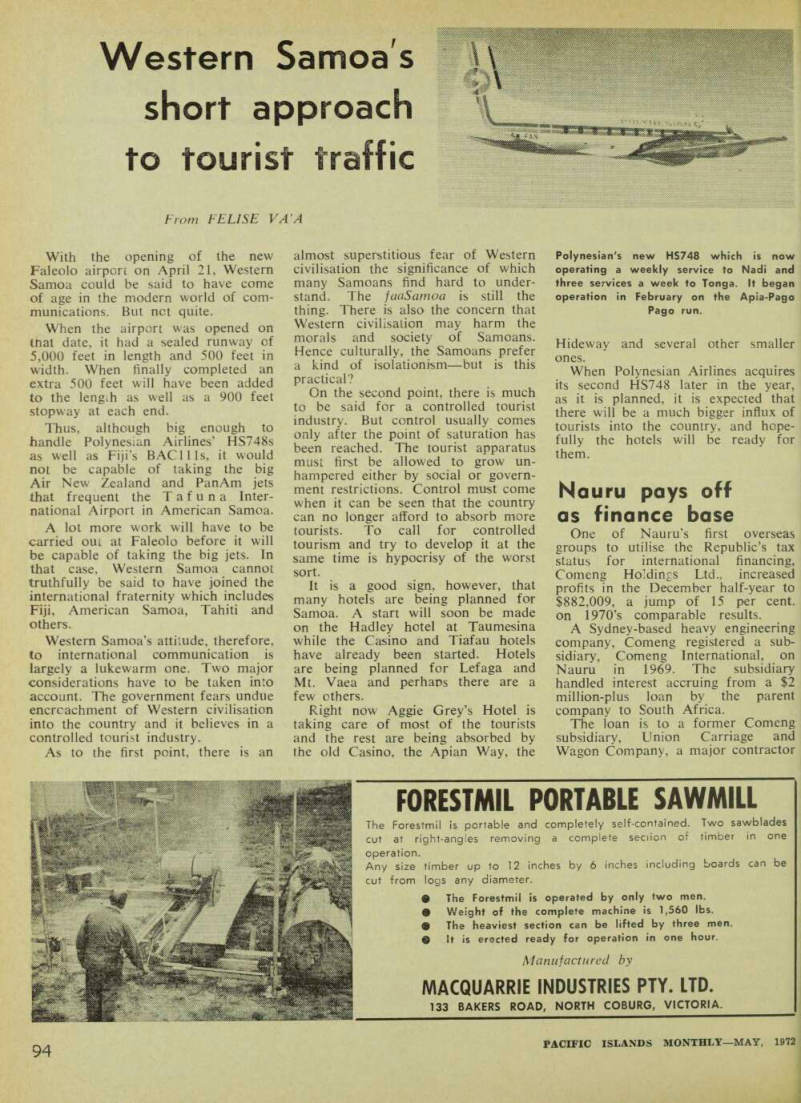
Polynesian's new HS74B which is now operating a weekly service to Nadi and three services a week to Tonga. It began operation in February on the Apia-Pago Pago run.
Hideway and several other smaller ones.
When Polynesian Airlines acquires its second HS74B later in the year, as it is planned, it is expected that there will be a much bigger influx of tourists into the country, and hope fully the hotels will be ready for them.
Nauru pays off
as finance base
One of Nauru’s first overseas groups to utilise the Republic’s tax status for international financing, Comeng Holdings Ltd., increased profits in the December half-year to $882,009, a jump of 15 per cent, on 1970’s comparable results.
A Sydney-based heavy engineering company, Comeng registered a sub sidiary, Comeng International, on Nauru in 1969. The subsidiary handled interest accruing from a $2 million-plus loan by the parent company to South Africa.
The loan is to a former Comeng subsidiary, Union Carriage and Wagon Company, a major contractor
to South African Railways. It was equal to 40.95 per cent, of UCWC’s capital.
Comeng has used interest from the loan to invest in other overseas countries, especially South East Asia, rather than remit the money to Australia, where it would be subject to a heavy Australian withholding tax.
Comeng directors say in their latest report that Comeng suffered a $122,435 effective capital loss on the South African loan because of the 12i per cent. African rand devaluation against the Australian dollar.
Cocoa concord
No agreements were made, but a face saving formula was arrived at, when a 40-country conference to draw up an International Cocoa Agreement, ended in Geneva in March. The con ference agreed that there was “wide spread support” for a minimum price between 21 and 24 US cents a pound.
This successfully eliminated the excess prices demanded by the world’s biggest cocoa importer, the US (20 cents) and a big exporter, Brazil (25 cents).
New Fiji hotel
begins recruiting
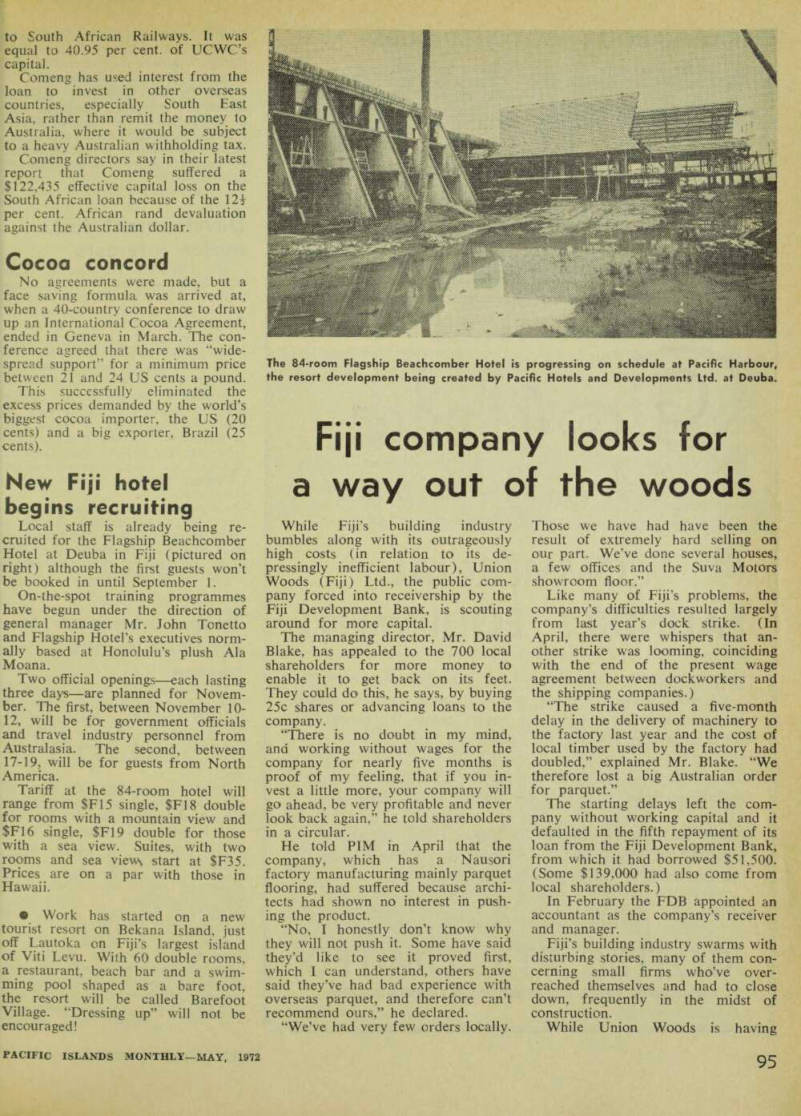
Local staff is already being re cruited for the Flagship Beachcomber Hotel at Deuba in Fiji (pictured on right) although the first guests won’t be booked in until September 1.
On-the-spot training programmes have begun under the direction of general manager Mr. John Tonetto and Flagship Hotel’s executives norm ally based at Honolulu’s plush Ala Moana.
Two official openings—each lasting three days—are planned for Novem ber. The first, between November 10- 12, will be for government officials and travel industry personnel from Australasia. The second, between 17-19, will be for guests from North America.
Tariff at the 84-room hotel will range from SFIS single, SFIB double for rooms with a mountain view and SFI6 single, SFI9 double for those with a sea view. Suites, with two rooms and sea views start at SF3S.
Prices are on a par with those in Hawaii. ® Work has started on a new tourist resort on Bekana Island, just off Lautoka on Fiji’s largest island of Viti Levu. With 60 double rooms, a restaurant, beach bar and a swim ming pool shaped as a bare foot, the resort will be called Barefoot Village. “Dressing up” will not be encouraged!