Tropicalities
pp. 89-91 · Read in the full issue

H-Bomb Islands
Are Still An
Explosive Issue
The people of Bikini and Eniwetok want to return to their nuclear-torn islands. More than 25 years ago, the people of the two American-admini stered atolls were uprooted from their homes. Since then, their atolls have been drastically altered by a series of nuclear test explosions.
Eniwetok is located in the north western Marshall Islands about 1,060 miles south-east of Guam. For 12 years it was used by the Americans as a site for nuclear bomb ex periments. More recently, the coral atoll has been used as an “impact area” for test missiles launched from California.
About 140 people originally left the island and, with their families, they now number about 280. They began demands to return home after hearing unofficially that the island was no longer being used by the military.
The US Air Force has denied this, claiming a continuing need for the island, where a token group of less than a dozen military men now live.
Despite the Air Force attitude, the people of Eniwetok, who now live on the island of Ujelang, are deter mined to return.
An advertisement, which has been running since December 28 in the Marshall Islands newspaper Micro nitor, states; “We, the representatives and leaders of the displaced people of Eniwetok, are making public notice of our intention to return to our island before the end of 1972.”
The islanders have asked to return to their homes before. In October, 1968, 200 of them massed together on a government ship to protest about a food shortage on Ujelang and demonstrated their anxiety to return to Eniwetok.
The government sent $22,000 worth of emergency food to the
islanders. This action, plus assurances that their case would be considered, caused the people to drop their demands temporarily.
This time, the islanders have hired an attorney to help them get back home. The attorney, Mr. Dennis Olsen, says the islanders “are deadly serious in what they say about returning and nothing short of direct military intervention will stop them.”
On Bikini 190 miles east of Eniwetok, the situation is somewhat different. Like the Eniwetokese, the former residents of Bikini have been away from their island for a quarter of a century. Unlike their neighbours, however, when they are allowed to return they will be the beneficiaries of an extensive rehabilitation pro gramme which government officials say will leave them with a “model island.”
Since November, 1948, the dis lodged islanders, who now number about 300, have been living on Kili, a small island that was previously un inhabited because it could not sustain life. One problem with Kili is that it lacks a safe lagoon for fishing—a major form of sustenance for the people. Also, during the winter months, the island is inaccessible to supply ships and therefore isolated from the outside world.
In 1969, the Bikinians demanded Sioo million from the Americans in return for damage inflicted on their atoll. No reply was received.
Instead, in March, 1970, the US government officially made Bikini a trust territory. This came in the midst of a three million dollar resettlement programme designed to clean up the atoll, restore food crops annihilated by the nuclear blasts, construct housing and repatriate the people.
Much of the work has now been
completed but no word has been given about when the displaced people can return. Meanwhile, like the people of Eniwetok, the Bikinians are restless. For both groups, the effect of the long wait on their culture and traditions has been devastating.
Acl m i nistratrix
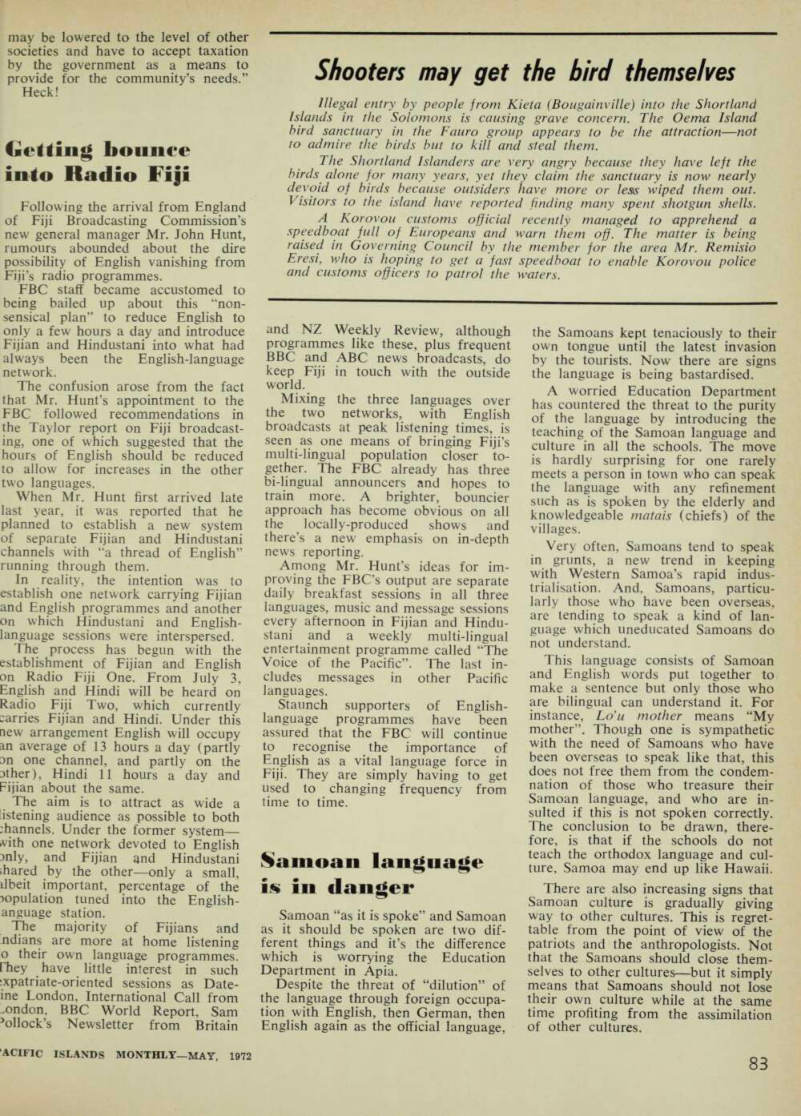
Mele Luani’s latest job is typing out ships’ manifests—for the time being anyway. For Mele (36), from Nukualofa, is working her way through the host of duties associated with shipping agency administration at Burns Philp’s head office in Sydney.
Mele is “on loan” for 12 months from the Tonga Shipping Agency (now the Pacific Navigation Com pany) office in Nuku’alofa where she worked for two years before coming to Sydney in January. “If I can, I want to cover all the aspects of this type of work before I return,” said Mele last month.
Captain Hill-Willis, manager of the Agency and Nukualofa’s harbour master, arranged Mele’s transfer so that she could gain more experience.
Burns Philp’s Sydney office manager, Mr. Monty Stobo, said: “We were only too happy to oblige.”
Agatha played up
in the Cooks
Banana plantations in the southern Cook Islands were extensively damaged when hurricane Agatha raged across the area from March 22-24. Aitutaki reported all banana
Tongan Mele Luani at work in Sydney.
See her story below.
palms destroyed, Mitiaro 85 per cent., Rarotonga 75 per cent., Atiu 40 per cent, and Mauke 20 per cent.
Aitutaki took the worst beating.
In addition to the destruction of bananas, the Resident Agent reported that between 80 and 90 per cent, of orange trees, 75 per cent, breadfruit trees, 60 to 80 per cent, of arrowroot, 40 per cent, of coconuts and 20 per cent, of tarotarua were destroyed.
Aitutaki houses lost 40 per cent, of their iron roofing; 90 per cent, of houses built of native material were blown down, and 90 per cent, damage occurred to power poles and wiring.
On March 28, MV Manutai left Rarotonga for Aitutaki with a cargo of food and building material. One of the passengers was Mr. Pat Yala, builder and quantity surveyor of Public Works, sent to assess damage to government buildings and carry out urgent repair work.
A special stamp issue for hurricane relief was made on March 30 when the Post Office placed on sale, besides three Easter stamp denominations, three other definitive denominations overprinted with a surtax to provide funds for hurricane relief.
“You can forget about Aitutaki bananas for nine months,” Premier Albert Henry told banana marketeers in New Zealand by radio telephone after a damage survey had been made of the group.
'Don’t degrade us 9
appeal on Pitcairn
“We hope such degradation never comes to Pitcairn”, runs a line in the islanders newsletter, Pitcairn Mis cellany. What degradation? Taxation, says the Miscellany.
Some of the Pitcairners are worried that their public work system may fail, forcing them to impose taxes.
The scheme works this way: The men have two categories of work—Paid Work and Public Work. The former is work normally done for the gov ernment such as well-digging, road making or school painting and the pay is 28c an hour.
But, for Public Work, which seems to differ little from Paid Work, there is no pay. By law, on the ringing of the island’s bell in peals of three strokes, the men turn out for tasks set by the Internal Committee, usually work on the famous longboats or on road maintenance. The latest stint of Public Work was being done in March.
“One never knows,” says Pitcairn Miscellany, “but should the system of Public Work ever fail for one reason or another, Pitcairn Island
may be lowered to the level of other societies and have to accept taxation by the government as a means to provide for the community’s needs.”
Heck!
Getting bounce
into Radio Fiji
Following the arrival from England of Fiji Broadcasting Commission’s new general manager Mr. John Hunt, rumours abounded about the dire possibility of English vanishing from Fiji’s radio programmes.
FBC staff became accustomed to being bailed up about this “non sensical plan” to reduce English to only a few hours a day and introduce Fijian and Hindustani into what had always been the English-language network.
The confusion arose from the fact that Mr. Hunt’s appointment to the FBC followed recommendations in the Taylor report on Fiji broadcast ing, one of which suggested that the hours of English should be reduced to allow for increases in the other two languages.
When Mr. Hunt first arrived late last year, it was reported that he planned to establish a new system of separate Fijian and Hindustani channels with “a thread of English” running through them.
In reality, the intention was to establish one network carrying Fijian and English programmes and another on which Hindustani and English language sessions were interspersed.
The process has begun with the establishment of Fijian and English on Radio Fiji One. From July 3, English and Hindi will be heard on Radio Fiji Two, which currently carries Fijian and Hindi. Under this new arrangement English will occupy an average of 13 hours a day (partly an one channel, and partly on the ather), Hindi 11 hours a day and Fijian about the same.
The aim is to attract as wide a listening audience as possible to both channels. Under the former system— vith one network devoted to English anly, and Fijian and Hindustani ihared by the other—only a small, ilbeit important, percentage of the jopulation tuned into the English anguage station.
The majority of Fijians and Indians are more at home listening o their own language programmes, fhey have little interest in such ixpatriate-oriented sessions as Date ine London, International Call from -ondon, BBC World Report, Sam s ollock’s Newsletter from Britain
and NZ Weekly Review, although programmes like these, plus frequent BBC and ABC news broadcasts, do keep Fiji in touch with the outside world.
Mixing the three languages over the two networks, with English broadcasts at peak listening times, is seen as one means of bringing Fiji’s multi-lingual population closer to gether. The FBC already has three bi-lingual announcers and hopes to train more. A brighter, bouncier approach has become obvious on all the locally-produced shows and there’s a new emphasis on in-depth news reporting.
Among Mr. Hunt’s ideas for im proving the FBC’s output are separate daily breakfast sessions in all three languages, music and message sessions every afternoon in Fijian and Hindu stani and a weekly multi-lingual entertainment programme called “The Voice of the Pacific”. The last in cludes messages in other Pacific languages.
Staunch supporters of English language programmes have been assured that the FBC will continue to recognise the importance of English as a vital language force in Fiji. They are simply having to get used to changing frequency from time to time.
Samoan language
is in danger
Samoan “as it is spoke” and Samoan as it should be spoken are two dif ferent things and it’s the difference which is worrying the Education Department in Apia.
Despite the threat of “dilution” of the language through foreign occupa tion with English, then German, then English again as the official language,
the Samoans kept tenaciously to their own tongue until the latest invasion by the tourists. Now there are signs the language is being bastardised.
A worried Education Department has countered the threat to the purity of the language by introducing the teaching of the Samoan language and culture in all the schools. The move is hardly surprising for one rarely meets a person in town who can speak the language with any refinement such as is spoken by the elderly and knowledgeable matais (chiefs) of the villages.
Very often, Samoans tend to speak in grunts, a new trend in keeping with Western Samoa’s rapid indus trialisation. And, Samoans, particu larly those who have been overseas, are tending to speak a kind of lan guage which uneducated Samoans do not understand.
This language consists of Samoan and English words put together to make a sentence but only those who are bilingual can understand it. For instance, Lo’u mother means “My mother”. Though one is sympathetic with the need of Samoans who have been overseas to speak like that, this does not free them from the condem nation of those who treasure their Samoan language, and who are in sulted if this is not spoken correctly.
The conclusion to be drawn, there fore, is that if the schools do not teach the orthodox language and cul ture, Samoa may end up like Hawaii.
There are also increasing signs that Samoan culture is gradually giving way to other cultures. This is regret table from the point of view of the patriots and the anthropologists. Not that the Samoans should close them selves to other cultures—but it simply means that Samoans should not lose their own culture while at the same time profiting from the assimilation of other cultures.