Book Reviews
pp. 83-87 · Read in the full issue
Volumes
To Be
Built Upon
The Cyclopedia of Fiji, Samoa, Tonga, Tahiti and the Cook Islands, published in Sydney in 1907, has been a much-loved and frequently invalu able curiosity in PlM’s library for 40 years. It laid claim to be a “com plete historical and commercial review” of those islands, and of Fiji in particular—“a compendium of Statistics and Data concerning the Group never yet compiled or brought together in a Single Publication”.
In fact some of its Statistics and Data were outdated before the volume reached its subscribers, but the vast quantity of information that remained made the brave enterprise worth while, for it was true that such a wealth of information on the Islands, outdated or updated, had never been brought together before.
That “togetherness” gave that volume its purpose.
So it is, I think, with another green-bound Islands’ cyclopedia that has followed 65 years later—the three volume Encyclopaedia of Papua and New Guinea, just released by the Melbourne University Press in asso ciation with the University of Papua and New Guinea and with the added financial help of a number of Aus-
tralian firms, organisations, and gov ernment departments.
In some things it is already out dated. The very name of the Terri tory of Papua and New Guinea has been officially changed since the en cyclopaedia’s publication; there is now no “and”, and it is not now known as the “Territory”. A big number of the New Guinea ministers whose biographies are listed have dis appeared from the political scene as a result of the February elections; the Australian Minister of Territories has been replaced by another; the composition of the House of Assembly has been altered; Fiji Air ways has changed its name to Air Pacific; some of the contributors have changed their titles and positions; etc., etc.
But such details are of little moment while Pigs continue to be pigs, Fishes and Leeches are still fishes and leeches, and Fungi, Flies and Forests chanee little. Here for the first time is PNG togetherness— Agriculture, Art, Beetles, Bougain ville, Crocodiles, Currency, Education,
through to External Relations, Financial Institutions and Food, and on to Marsupials, Material Culture, Sport, G. A. V. Stanley, Vegetation and World War 11. About one and a quarter million words, photographs, line drawings, and a lift-out map of Papua New Guinea containing the only colour in the book with the exception of the picture of Papua New Guinea’s new flag.
The absence of colour is noticeable especially in the sections on fishes and butterflies, and there is also a dearth of black and white illustrations for a work so extensive. The appearance is thus predominantly one of printer’s type; it lacks the immediate eye appeal of a World Book Encyclo paedia, but then, its publishing budget would hardly have been a fraction of a World Book, or the World Book*s print figure.
One can only admire MUP and the work’s general editor, Peter Ryan, for their bravery in tackling such a work at all, considering the compara tively restricted demand.
The general editor is well aware
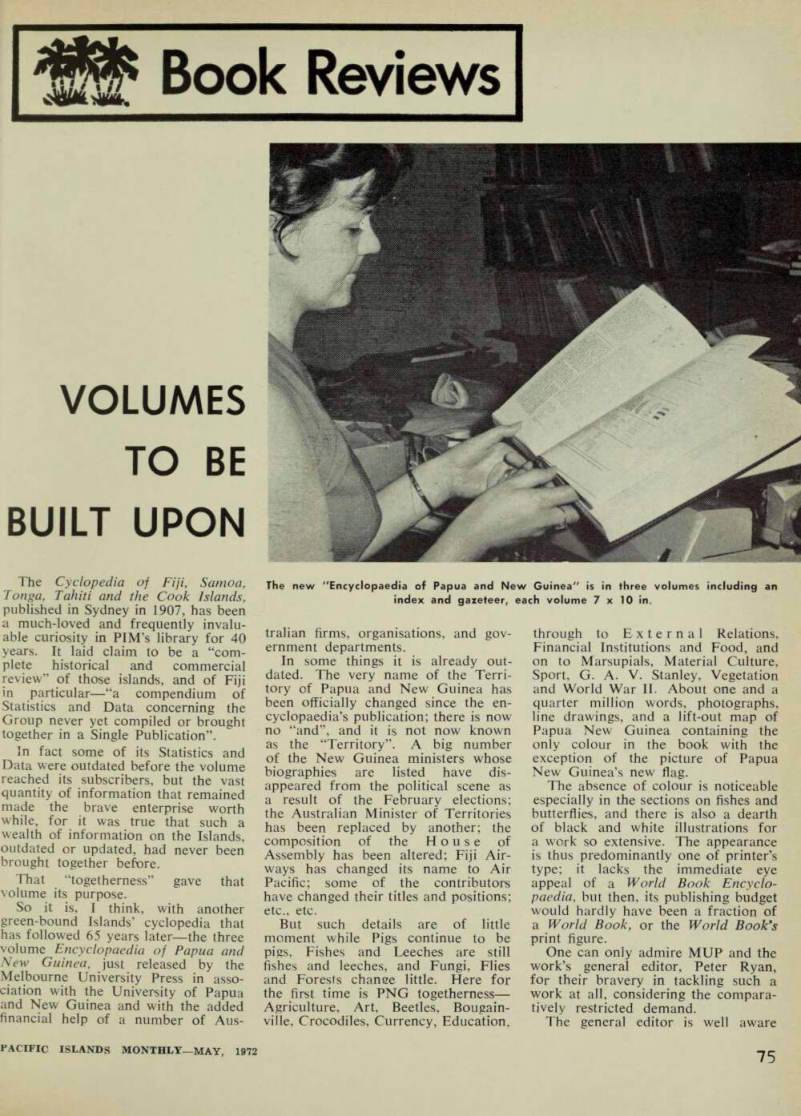
The new "Encyclopaedia of Papua and New Guinea" is in three volumes including an index and gazeteer, each volume 7 x 10 in.
that, as he puts it in his introduction, “neither knowledge nor history stands still obligingly while an encyclopaedia records them, frozen and motionless in some unreal instant of time . . . and in some departments of life in Papua New Guinea the rate of change is bewildering”. Now that the work is out it can be built upon, while filling an important need mean while.
What has been brought together is uniquely a work on Papua New Guinea. Where else would pigs rate two whole pages and string figures a page and a half? Where else would land tenure rate as much space as languages?
The editor’s decision to allow his contributors to pass judgment on occasions on matters on which they are qualified to speak, is a success.
Nowhere in my extensive browsing did I feel that a writer was pushing his opinions down my throat; rather I felt I was getting valuable advantage from informed opinion.
Thus Stefan Wurm, in a most read able account of the development and current use of Pidgin English, appears to be quite in order in attempting to predict its future development with the following comment: “There seems o be little reason for questioning the serious candidature of Pidgin for be coming the future national language af an independent New Guinea aation. In the light of recent history, t seems unlikely that a newly emerging nation will be willing to adopt the language of its former alien -ulers as its national language, though it may accept this, at least for a aeriod, as the official language, es pecially in matters like higher educa ion, top level administration and ■elations with the outside world.”
Peter Ryan himself, in a clear ac count of how World War II affected PNG, expresses an opinion, and some criticism, on the “poititless” mopping jp operations by Australian forces in Vew Guinea at a time when the fapanese could just as well have been dlowed to die of sickness or starva ion in small pockets. He says there s sufficient evidence now to believe t likely that the Australian troops vere kept in the field because General Sir Thomas Blarney, the Australian n command, wanted to continue in command of a large army in the field:
and because Blarney and Prime Minister Curtin “were at least partly under the influence of a small but persuasive group of Australian in tellectuals who foresaw, or thought they foresaw, a wider and more powerful Australian presence in the Pacific in the coming peace”. Such is the stuff of history, and this is the place for it.
The account of education policy, particularly its development under the late W. C. Groves, and Hasluck, is typical of the kind of information to be found that is both informative and fascinating. The section on gambling is another example of information made readable.
Of course, there are errors and omissions. In the biographies there is Malinowski but not Mead—l can’t even find her in the cross index. The section on goldfields gives an account of the early days of Edie Creek and Bulolo, but fails to mention that vast latter-day goldfield at Panguna, where Bougainville Copper Pty. Ltd. is taking out what it has estimated to be 500,000 oz of gold a year in conjunction with its copper. That figure is in fact mentioned in a separate part of the book, under the Bougainville Copper Project.
Under the heading of exploration,
nobody has mentioned the work of the Akmana mining expedition, which seems to have been first into the Highlands and first to bring out Highlands wigs. PIM published an account 12 months ago.
One notices factual errors here and there, as for example the date of PlM’s birth, given as 1930 in one place and as 1932 somewhere else (it was 1930), And I would have been glad to have seen a more detailed index, as one has the feeling there are riches of knowledge locked up under unlikely headings.
On the other hand the extensive bibliography created by the decision to give every worthwhile article its own, is a great asset.
One could continue with high praise and minor criticism, but the important fact is that this is now the reference work on Papua New Guinea, and it can only improve.
Let’s hope that constant demand will enable the publishers to update it with reasonable promptness, and that it will never become the curiosity of the old Cyclopedia of Fiji, much loved as that volume may have been. —Stuart Inder.
(Encyclopaedia Of Papua And
NEW GUINEA. Melbourne University Press.
Three volumes including index, $50.)