Letter
pp. 36-37 · Read in the full issue
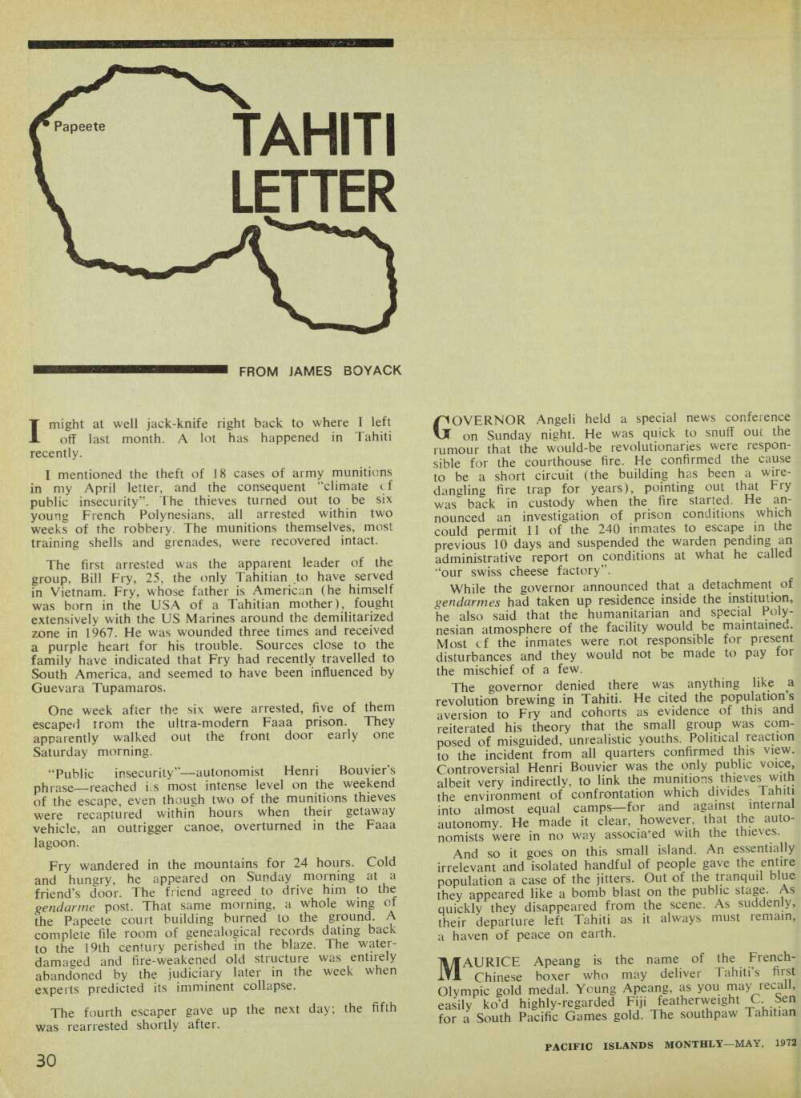
Tahiti
From James Boyack
I might at well jack-knife right back to where I left off last month. A lot has happened in Tahiti recently.
I mentioned the theft of 18 cases of army munitions in my April letter, and the consequent “climate of public insecurity”. The thieves turned out to be six young French Polynesians, all arrested within two weeks of the robbery. The munitions themselves, most training shells and grenades, were recovered intact.
The first arrested was the apparent leader of the group, Bill Fry, 25, the only Tahitian to have served in Vietnam. Fry, whose father is American (he himself was born in the USA of a Tahitian mother), fought extensively with the US Marines around the demilitarized zone in 1967. He was wounded three times and received a purple heart for his trouble. Sources close to the family have indicated that Fry had recently travelled to South America, and seemed to have been influenced by Guevara Tupamaros.
One week after the six were arrested, five of them escaped rrom the ultra-modern Faaa prison. They apparently walked out the front door early one Saturday morning.
“Public insecurity”—autonomist Henri Bouvier’s phrase—reached i s most intense level on the weekend of the escape, even though two of the munitions thieves were recaptured within hours when their getaway vehicle, an outrigger canoe, overturned in the Faaa lagoon.
Fry wandered in the mountains for 24 hours. Cold and hungry, he appeared on Sunday morning at a friend’s door. The friend agreed to drive him to the gendarme post. That same morning, a whole wing of the Papeete court building burned to the ground. A complete file room of genealogical records dating back to the 19th century perished in the blaze. The water damaged and fire-weakened old structure was entirely abandoned by the judiciary later in the week when experts predicted its imminent collapse.
The fourth escaper gave up the next day; the fifth was rearrested shortly after.
GOVERNOR Angeli held a Special news conference on Sunday night. He was quick to snuff out the rumour that the would-be revolutionaries were respon sible for the courthouse fire. He confirmed the cause to be a short circuit (the building has been a wire dangling fire trap for years), pointing out that Fry was back in custody when the fire started. He an nounced an investigation of prison conditions which could permit 11 of the 240 inmates to escape m the previous 10 days and suspended the warden pending an administrative report on conditions at what he called “our swiss cheese factory”.
While the governor announced that a detachment of gendarmes had taken up residence inside the institution, he also said that the humanitarian and special Poly nesian atmosphere of the facility would be maintained.
Most cf the inmates were not responsible for present disturbances and they would not be made to pay for the mischief of a few.
The governor denied there was anything like a revolution brewing in Tahiti. He cited the populations aversion to Fry and cohorts as evidence of this and reiterated his theory that the small group was com posed of misguided, unrealistic youths. Political reaction to the incident from all quarters confirmed this view.
Controversial Henri Bouvier was the only public voice, albeit very indirectly, to link the munitions thieves with the environment of confrontation which divides Tahiti into almost equal camps—for and against internal autonomy. He made it clear, however, that the auto nomists were in no way associated with the thieves.
And so it goes on this small island. An essentially irrelevant and isolated handful of people gave the entire population a case of the jitters. Out of the tranquil blue they appeared like a bomb blast on the public stage. As quickly they disappeared from the scene. As suddenly, their departure left Tahiti as it always must remain, a haven of peace on earth.
MAURICE Apeang is the name of the French- Chinese boxer who may deliver Tahiti’s first Olympic gold medal. Young Apeang, as you may recall, easily ko’d highly-regarded Fiji featherweight C. Sen for a South Pacific Games gold. The southpaw Tahitian
has the equipment to go very far in ring warfare. He has a tough, cold-eyed approach to the ring. His hands are fast, and he wallops. Most of his victories come before the limit. His natural boxing skills open the door for a devastating arsenal of punishing jabs and uppercuts. This ring instinct usually closes the door to the approach of all but the most level-headed opposition. Apeang went to France early this year to sharpen his talents. He scored six straight victories without a defeat. His ccmpetLion was first rate, and he earned himself a place on the French national boxing team. During a televised card matching France with feared Czechoslovakia, Apeang easily decisioned a 100-fight Iron Curtain amateur.
The Tahitian hero was steaming towards the French amateur championship when hepatitis downed him in early March. He was back on his feet a month later, but his championship aspirations will be curtailed by a month of convalescence, AH the same, Apeang has been pre-selected for the French Olympic team, and French boxing experts still call him the best feather weight in the Republic.
Another Tahitian boxer is one fight away from the French amateur heavy-weight championship. Sou'h Pacific Games gold medallist Maco Nena, also ex patriated to France, decked Frenchman Pierre Brisson five times this month in their semi-final brut for the title. The Chartres boxer’s trainer called a halt to the massacre before the end of the third round. Nena wi.l encounter the current champion Alain Victor at the md of April. The Tahitian may already own the crown.
He beat Victor in Papeete two years ago.
TEAN Pierre Blanc is a 30-year-old French Army sergeant-major with a cool head. He retained his aresence of mind during a forced swim of 16 hours ifter he was accidentally carried into the ocean by a itrong lagoon current. Jean Pierre and a friend had lonned face mask and fins to hunt for shells in the s aea lagoon one afternoon recently. The sergeant-major lid not notice that the current was slowly movirg him owards the open sea. When he did notice, it was too ate. He was in the mouth of the passage, waves crashing on either side of him.
Help, in the form of a Papeete tugboat, did not each the area in which Jean Pierre was floating until ifter nightfall. The swimmer had already been in the yater four hours.
“I don’t swim very well,” Jean Pierre admitted.
Luckily, I had those fins on. They kept me afloat and aved my life.” As the tug cruised back and firth hrough the night, Jean Pierre tried to stay near the reef.
Vhen the tug neared him* he would swim towards it. )n each occasion the vessel chugged by without spotting lim. He realised that rescue would be possible only iter daybreak.
A helicopter joined the search force at dawn, but ie courageous Frenchman had decided not to wait any anger to be picked up. He was getting tired and pre yed reef bruises to drowning. When he got onto the eef, he would cling to it for dear life. Which is what appened. He chose what appeared to be the least .irbulent part of the reef and gave his body up to the ods of the sea. Somewhat miraculously, he landed in ne piece, and was able to get a footing. Good fortune ad finally come his way. No monster waves hit as e gingerly moved along the reef. The reef took a artuitous bend toward the shore. He had only a mall distance to swim in the lagoon before he was shore.
FRANCE enforced the 12-mile limit in its Pacific territorial waters for the first time recently. The navy stopped and boarded two South Korean fishing trawlers operating illegally near the Marquesas. The Korean ships were ordered to Papeete once their agent here posted a 5U522,000 bond to guarantee their ap pearance. Each trawler captain was fined $7,700 after a brief court hearing. The cost to the trawlers was relatively small since the court was empowered to seize their entire fish cargoes and to confiscate all their fishing equipment. There was some local grumbling about the light fines. Some people viewed them as dejacto fishing licences. Local sceptics made the fol lowing calculation: there were 200 tons of fish in the two vessels. At a low-estimate price of 100 CEP per kilo, the cargo alone was worth more than SUS2I,OOO.
THE land has been cleared and foundations are being laid for TraveLodge Tahiti, a 200-rcom luxury hotel scheduled to open in 1974.
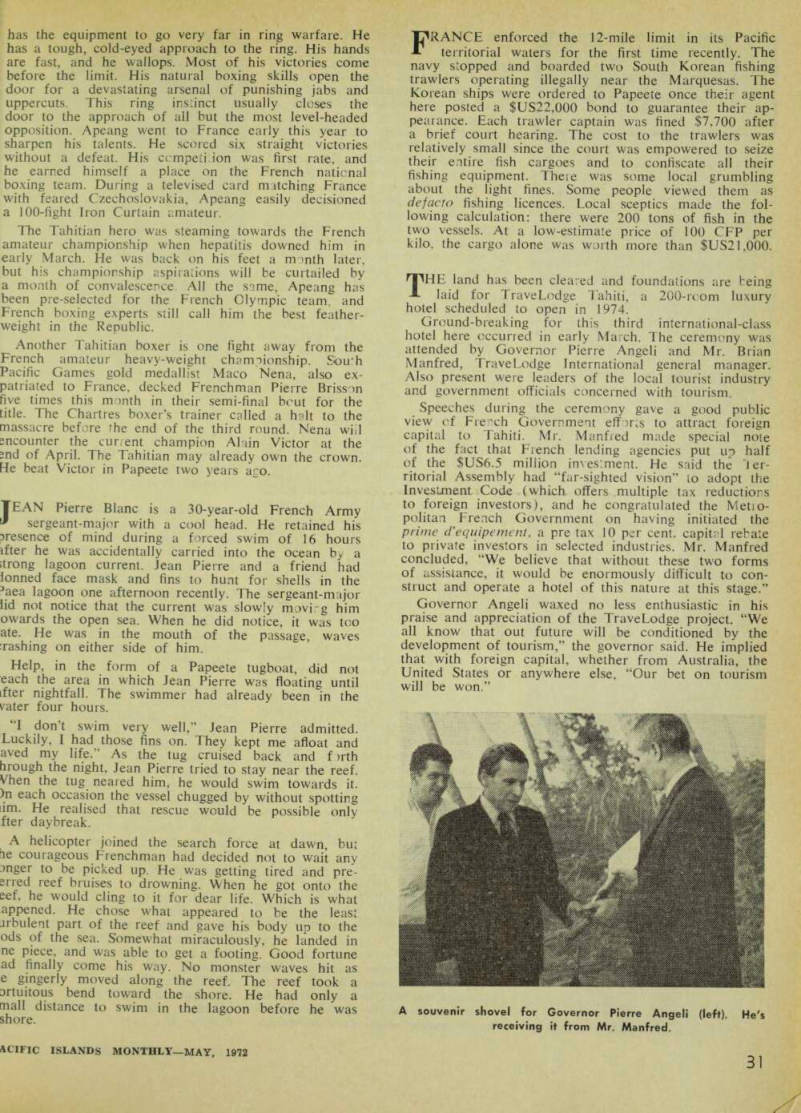
Ground-breaking for this third international-class hotel here occurred in early March. The ceremony was attended by Governor Pierre Angeli and Mr. Brian Manfred, TraveLodge International general manager.
Also present were leaders of the local tourist industry and government officials concerned with tourism.
Speeches during the ceremony gave a good public view of French Government efforts to attract foreign capital to Tahiti. Mr. Manfred made special note of the fact that French lending agencies put up half of the SUS6.S million investment. He said the ter ritorial Assembly had “far-sighted vision” to adopt the Investment Code (which offers multiple tax reductions to foreign investors), and he congratulated the Metio politan French Government on having initiated the prime d’equipement, a pre tax 10 per cent. capital rebate to private investors in selected industries. Mr. Manfred concluded, “We believe that without these two forms of assistance, it would be enormously difficult to con struct and operate a hotel of this nature at this stage.”
Governor Angeli waxed no less enthusiastic in his praise and appreciation of the TraveLodge project. “We all know that out future will be conditioned by the development of tourism,” the governor said. He implied that with foreign capital, whether from Australia, the United States or anywhere else, “Our bet on tourism will be won.”
A souvenir shovel for Governor Pierre Angeli (left). He's receiving it from Mr. Manfred.