Explosion!
pp. 34-35 · Read in the full issue
-boom time
in Noumea
New Caledonia Diary
with
Helen Rousseau
in Noumea
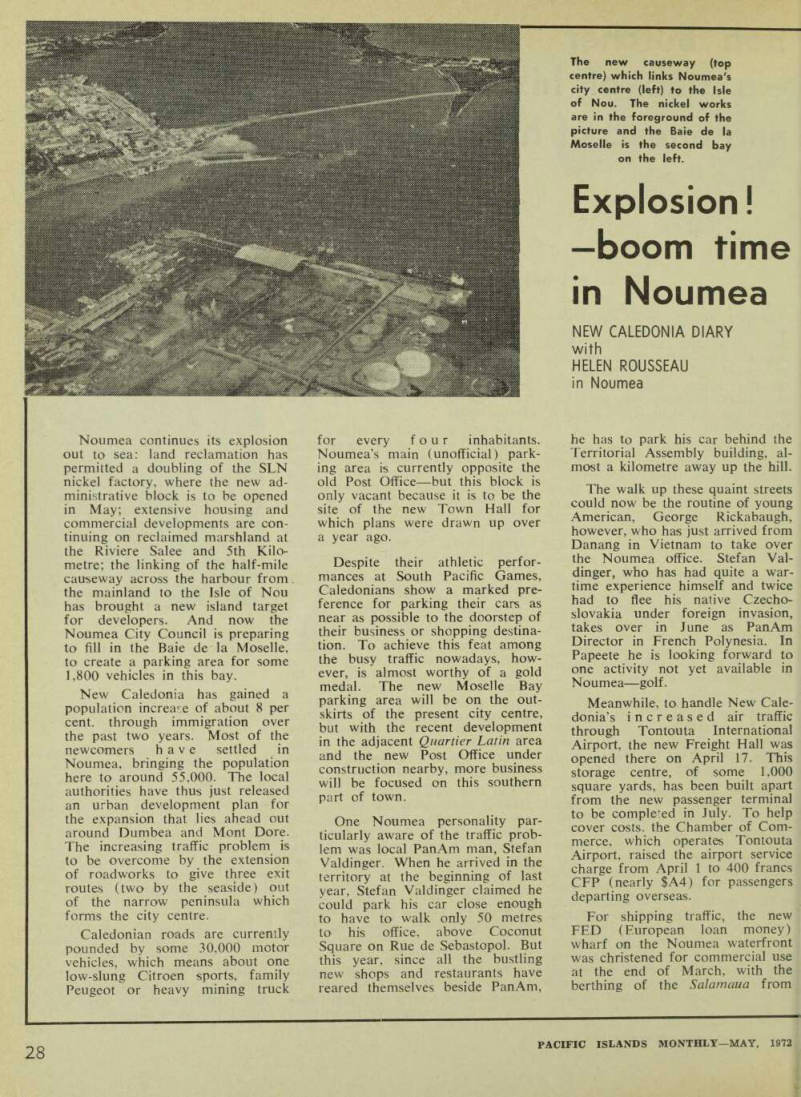
Noumea continues its explosion out to sea: land reclamation has permitted a doubling of the SEN nickel factory, where the new ad ministrative block is to be opened in May; extensive housing and commercial developments are con tinuing on reclaimed marshland at the Riviere Salee and sth Kilo metre; the linking of the half-mile causeway across the harbour from the mainland to the Isle of Nou has brought a new island target for developers. And now the Noumea City Council is preparing to fill in the Baie de la Moselle, to create a parking area for some 1,800 vehicles in this bay.
New Caledonia has gained a population increa c e of about 8 per cent, through immigration over the past two years. Most of the newcomers have settled in Noumea, bringing the population here to around 55,000. The local authorities have thus just released an urban development plan for the expansion that lies ahead out around Dumbea and Mont Dore.
The increasing traffic problem is to be overcome by the extension of roadworks to give three exit routes (two by the seaside) out of the narrow peninsula which forms the city centre.
Caledonian roads are currently pounded by some 30,000 motor vehicles, which means about one low-slung Citroen sports, family Peugeot or heavy mining truck
for every four inhabitants.
Noumea’s main (unofficial) park
ing area is currently opposite the old Post Office—but this block is only vacant because it is to be the site of the new Town Hall for which plans were drawn up over a year ago.
Despite their athletic perfor mances at South Pacific Games, Caledonians show a marked pre ference for parking their cars as near as possible to the doorstep of their business or shopping destina tion. To achieve this feat among the busy traffic nowadays, how ever, is almost worthy of a gold medal. The new Moselle Bay parking area will be on the out skirts of the present city centre, but with the recent development in the adjacent Quartier Latin area and the new Post Office under construction nearby, more business will be focused on this southern part of town.
One Noumea personality par ticularly aware of the traffic prob lem was local PanAm man, Stefan Valdinger. When he arrived in the territory at the beginning of last year, Stefan Valdinger claimed he could park his car close enough to have to walk only 50 metres to his office, above Coconut Square on Rue de Sebastopol. But this year, since all the bustling new shops and restaurants have reared themselves beside PanAm,
he has to park his car behind the Territorial Assembly building, al most a kilometre away up the hill.
The walk up these quaint streets could now be the routine of young American, George Rickabaugh, however, who has just arrived from Danang in Vietnam to take over the Noumea office. Stefan Val dinger, who has had quite a war time experience himself and twice had to flee his native Czecho slovakia under foreign invasion, takes over in June as PanAm Director in French Polynesia. In Papeete he is looking forward to one activity not yet available in Noumea—golf.
Meanwhile, to handle New Cale donia’s increased air traffic through Tontouta International Airport, the new Freight Hall was opened there on April 17. This storage centre, of some 1,000 square yards, has been built apart from the new passenger terminal to be completed in July. To help cover costs, the Chamber of Com merce, which operates Tontouta Airport, raised the airport service charge from April 1 to 400 francs CFP (nearly SA4) for passengers departing overseas.
For shipping traffic, the new FED (European loan money) wharf on the Noumea waterfront was christened for commercial use at the end of March, with the berthing of the Salamaua from
The new causeway (top centre) which links Noumea's city centre (left) to the Isle of Nou. The nickel works are in the foreground of the picture and the Baie de la Moselle is the second bay on the left.
Sydney. This wharf, on the inner harbour side of the causeway ex tensions, is 70 metres long and equipped to handle medium tonnage cargo and passenger vessels. As for the new deep water wharves on the outer har bour side of the causeway, the first was to be used by the Hamburg, at the end of April. Larger P. & O. passenger liners are expected to be able to berth in Noumea from the end of May, instead of anchor ing out amidstream. The second deep-water berth is scheduled for completion in mid-June.
Housing, roadworks, airport and harbour —all these infrastructure works are continuing in the terri tory to keep up with the first wave of migrants attracted by the iickel expansion plans, but the rig question still remains: when vill a second nickel company get ?°ing on the island? As far back is 1966, Paris had officially pro mised a second company was mder way, to break the present iroduction monopoly of the SLN Societe Le Nickel). As a result >f this promise, the Canadian :iant INCO joined with French aterests to constitute COFIMPAC, i March, 1969. Since then, no ;ss than four new groups have een presented to the Caledonians s likely candidates for building actones on the island.
Latest proposed venture is the Ihance of the United States Free ort Minerals Company (49 per mt. share) and the French state il concern Aquitaine (51 per snt.). This project to exploit aledonian lateritic nickel ore was inounced early in April, to co icide with the return to Noumea I Governor Louis Verger, who ad been absent for talks in Paris.
However, Caledonians point out at not one of the proposed new mtures has got off the planning >ards. COFIMPAC is now dead id the Canadians are still negoti ing with Paris. The announce ent of this fifth and latest oject has thus reinforced Cale mian mining circles in their sus cion that Paris is fearful for ilitical reasons to allow the anadians to enter New Cale ►nia.
April for Frenchmen was the onth of President Georges unpidou’s Referendum. The tion was asked to approve the
proposed enlargement of the Euro pean Common Market, to admit four new members, including Great Britain. Along with metro politan French, the Caledonians were called to register their sup port of Pompidou’s enlarged Europe policy, by voting OUI on Sunday, April 23.
From the outset, it was assumed m the Metropolitan French Ad ministration that the Autonomists would advocate a vote of NON.
Paris politicians thus began flying in to convince the Caledonian electorate; radio-telephone propa ganda speeches were relayed over Noumea radio and TV from Paris.
The local pro - Administration newspapers began to fire their attack upon the Autonomists.
Until suddenly the latter an nounced their intention not to fall into the trap of being again labelled “anti-French” and urged their members to vote OUI, in support of Caledonian membership of an enlarged EEC. (The EEC currently supplies 62 per cent, of the territory’s imports.) However, counting was expected to reveal that many Caledonians would vote to go fishing on Referendum Day, producing a high rate of absten tion.
Local political circles now be lieve that Territorial Election Day could be Sunday, September 10, since the Territorial Assembly was recently consulted by Paris over a proposal to prolong the current Assembly an extra two months, to that date. Official explanation was that this would then coincide with election day in French Poly nesia. The anti-autonomists sup ported the Paris-proposed election delay; the autonomists mustered enough support to outvote them by one man. However, it is the Paris parliament which determines the election date, so September 10 could well be a decisive day in the autonomist struggle.
In the meantime, the witch-hunt for ‘’‘anti-French” elements con tinues. Following the recall to Canberra of the Australian Consul in Noumea, one local paper, sup porting the Metropolitan French Administration, was still thirsting for victims and recalled that a certain autonomist Territorial Councillor (Gerald Rousseau) had recently advocated the teaching of English in primary schools. In a brilliant piece of logic syllogism,
the paper claimed this was sup porting evidence that Mr. Rousseau was “working for Australia”.
In the Melanesian community, the heir to a chief on Mare Island, French University-trained Nidoishe Naisseline, was defended by a lawyer flown in from Paris when he appealed against a March prison sentence of six months.
The militant young Melanesian was convicted for insulting a metropolitan French official visit ing the island. The official was the governor’s representative in the Loyalty Islands and the insult, bearing particular reference to the Frenchman’s uniform, was inter preted as an insult to French authority.
At a March hearing, Naisseline had been warmly greeted in court by Maurice Lenormand, a European leader of the Caledonian Front for Autonomy.
Meanwhile, the French Minister for Overseas Territories, Mr.
Pierre Messmer, is to visit New Caledonia for a week from May 19. From Noumea, Mr. Messmer is to fly for two days each to the New Hebrides and then the Wallis Islands, before returning to Paris on June 2.
There were signs of activity around Anse Vata Beach during the week beginning April 10. It was yet another session of the South Pacific Commission—this time the Planning Committee which met behind closed doors.
Its job was to draw up the three year work programme, approval, or disapproval, of which will form the main task for the Twelfth SP Conference and 35th Session of the Commission in Western Samoa in September.
Of course, Noumea had its usual share of organised conflict during April: over Easter basketball and soccer players flew in from the New Hebrides to play against the Caledonians. In the boxing ring, more Australians and New Zealanders punched it out with the locals, while middleweight Fijian Alipate Korovou had regained form and scored a KO victory in the fifth round against David Chadfield from New Zealand.
And all the while, just like the boxers, Noumea continues to thrust out and up, with even the ring of the sea proving no limit . . .