The Choice For The Fiji Voter
pp. 29-31 · Read in the full issue
The Known Or The Unknown
From SUE WENDT . in Suva
By the time Fiji people began casting their general election votes on April 15 two main alternatives had emerged; vote Alliance and know pretty much what to expect from the
next five years; vote NFP and hold onto your hats!
Or you could buck the sytem altogether by voting for one of the defectors from both parties, but that didn’t look like having any real effect on the election swing.
A personality cult had developed around the Prime Minister and Alliance Party leader, Ratu Sir Kamisese Mara. He conducted his campaign with characteristic dignity, and the quiet, quite unegotistical conviction that he is the best man to lead Fiji’s half million people just now.
“If you want me as your next Prime Minister, vote Alliance,” he said.
He indulged in no dramatics, called nobody names, skirted around his Alliance Party’s weaknesses (inability to control inflation, for one) with a statesman’s skill. He spoke of Peace, Progress and Pro sperity—the Alliance election slogan —as if he believed in them. No-one doubted that he did.
Blueprint for the immediate future, as envisaged by the Alliance, is the $375 million Development Plan Six, which takes Fiji up to 1975.
The plan, aiming to improve educa tion, transport and health facilities and in particular, assist rural dwel lers, is within the realms of pos
sibility. It involves slow, systematic progress. Nothing spectacular like the wildly ambitious promises of the National Federation Party cam paigners.
The NFP relied not on the vote catching image of leader Mr. Siddiq
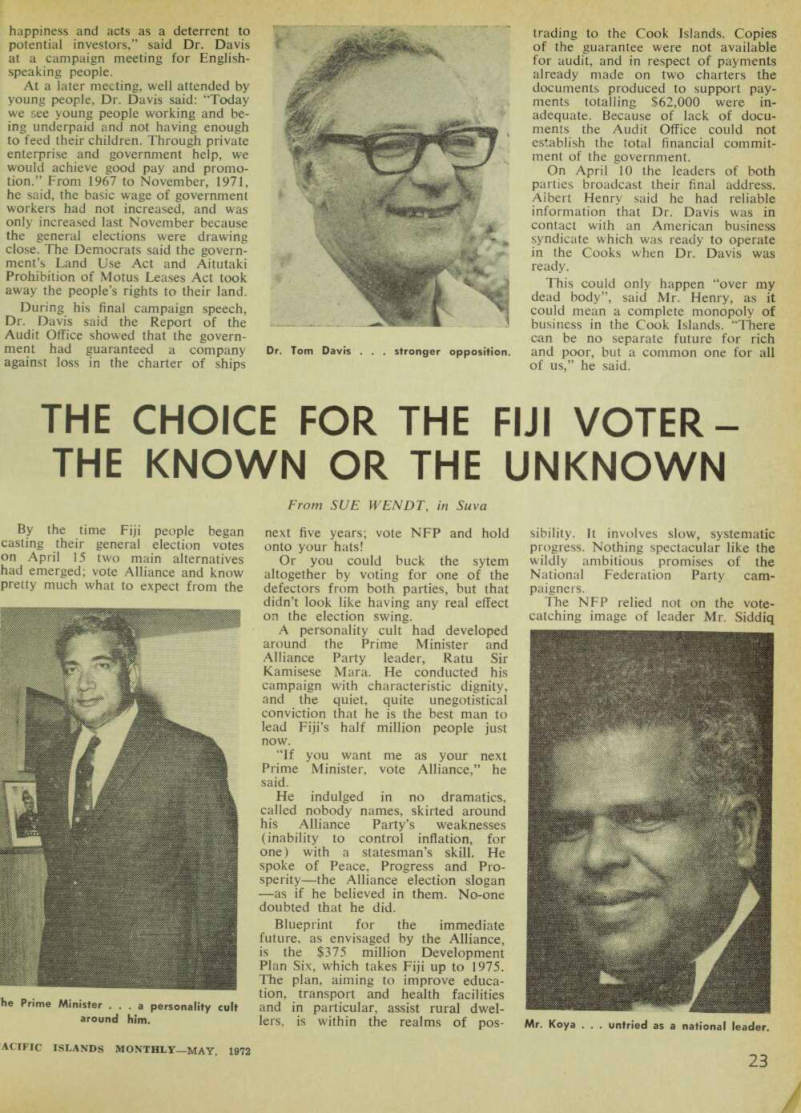
[?]he Prime Minister ... a personality cult around him.
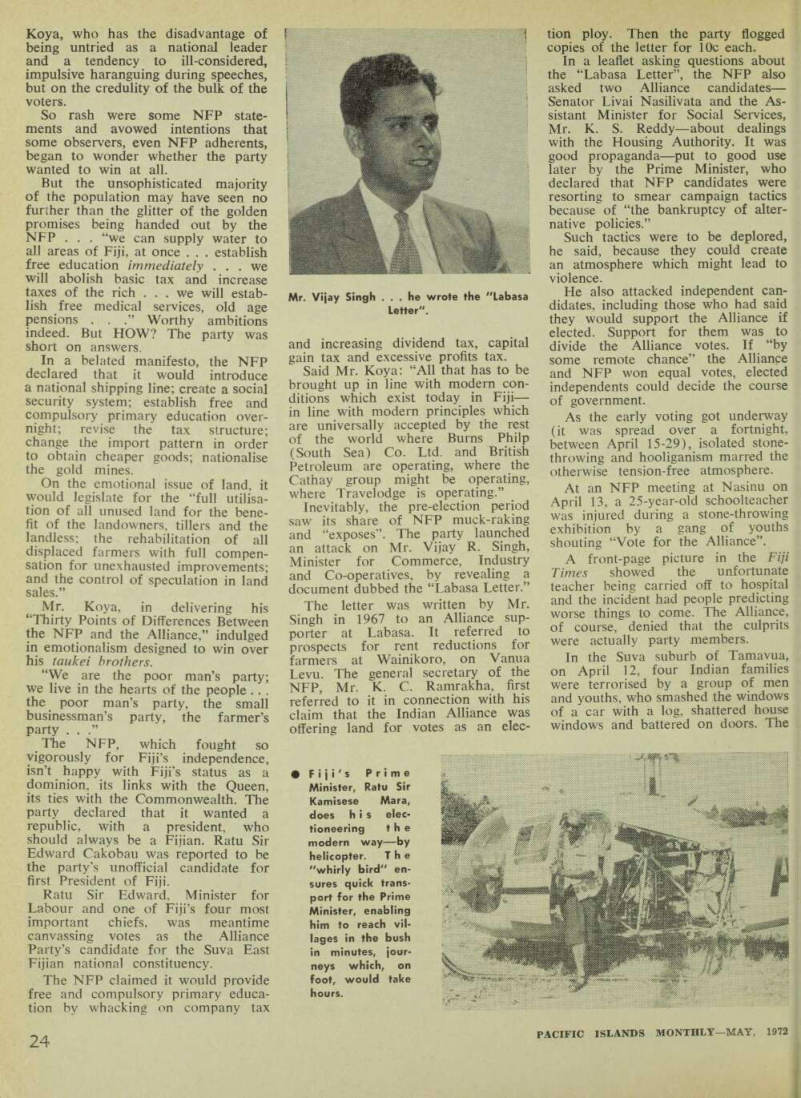
Mr. Koya . . . untried as a national leader.
Koya, who has the disadvantage of being untried as a national leader and a tendency to ill-considered, impulsive haranguing during speeches, but on the credulity of the bulk of the voters.
So rash were some NFP state ments and avowed intentions that some observers, even NFP adherents, began to wonder whether the party wanted to win at all.
But the unsophisticated majority of the population may have seen no further than the glitter of the golden promises being handed out by the NFP . . . “we can supply water to all areas of Fiji, at once . . . establish free education immediately ... we will abolish basic tax and increase taxes of the rich ... we will estab lish free medical services, old age pensions . . .” Worthy ambitions indeed. But HOW? The party was short on answers.
In a belated manifesto, the NFP declared that it would introduce a national shipping line; create a social security system; establish free and compulsory primary education over night; revise the tax structure; change the import pattern in order to obtain cheaper goods; nationalise the gold mines.
On the emotional issue of land, it would legislate for the “full utilisa tion of all unused land for the bene fit of the landowners, tillers and the landless: the rehabilitation of all displaced farmers with full compen sation for unexhausted improvements; and the control of speculation in land sales.”
Mr. Koya, in delivering his “Thirty Points of Differences Between the NFP and the Alliance,” indulged in emotionalism designed to win over his taukei brothers.
“We are the poor man’s party; we live in the hearts of the people .. . the poor man’s party, the small businessman’s party, the farmer’s party . . .”
The NFP, which fought so vigorously for Fiji’s independence, isn’t happy with Fiji’s status as a dominion, its links with the Queen, its ties with the Commonwealth. The party declared that it wanted a republic, with a president, who should always be a Fijian. Ratu Sir Edward Cakobau was reported to be the party’s unofficial candidate for first President of Fiji.
Ratu Sir Edward, Minister for Labour and one of Fiji’s four most important chiefs, was meantime canvassing votes as the Alliance Party’s candidate for the Suva East Fijian national constituency.
The NFP claimed it would provide free and compulsory primary educa tion by whacking on company tax
and increasing dividend tax, capital gain tax and excessive profits tax.
Said Mr. Koya: “All that has to be brought up in line with modern con ditions which exist today in Fiji— in line with modern principles which are universally accepted by the rest of the world where Burns Philp (South Sea) Co. Ltd. and British Petroleum are operating, where the Cathay group might be operating, where Travelodge is operating.”
Inevitably, the pre-election period saw its share of NFP muck-raking and “exposes”. The party launched an attack on Mr. Vijay R. Singh, Minister for Commerce, Industry and Co-operatives, by revealing a document dubbed the “Labasa Letter.”
The letter was written by Mr.
Singh in 1967 to an Alliance sup porter at Labasa. It referred to prospects for rent reductions for farmers at Wainikoro, on Vanua Levu. The general secretary of the NFP, Mr. K. C. Ramrakha, first referred to it in connection with his claim that the Indian Alliance was offering land for votes as an elec
tion ploy. Then the party flogged copies of the letter for 10c each.
In a leaflet asking questions about the “Labasa Letter”, the NFP also asked two Alliance candidates— Senator Livai Nasilivata and the As sistant Minister for Social Services, Mr. K. S. Reddy—about dealings with the Housing Authority. It was good propaganda—put to good use later by the Prime Minister, who declared that NFP candidates were resorting to smear campaign tactics because of “the bankruptcy of alter native policies,”
Such tactics were to be deplored, he said, because they could create an atmosphere which might lead to violence.
He also attacked independent can didates, including those who had said they would support the Alliance if elected. Support for them was to divide the Alliance votes. If “by some remote chance” the Alliance and NFP won equal votes, elected independents could decide the course of government.
As the early voting got undenvay (it was spread over a fortnight, between April 15-29), isolated stone throwing and hooliganism marred the otherwise tension-free atmosphere.
At an NFP meeting at Nasinu on April 13, a 25-year-old schoolteacher was injured during a stone-throwing exhibition by a gang of youths shouting “Vote for the Alliance”.
A front-page picture in the Fiji Times showed the unfortunate teacher being carried off to hospital and the incident had people predicting worse things to come. The Alliance, of course, denied that the culprits were actually party members.
In the Suva suburb of Tamavua, on April 12, four Indian families were terrorised by a group of men and youths, who smashed the windows of a car with a log, shattered house windows and battered on doors. The
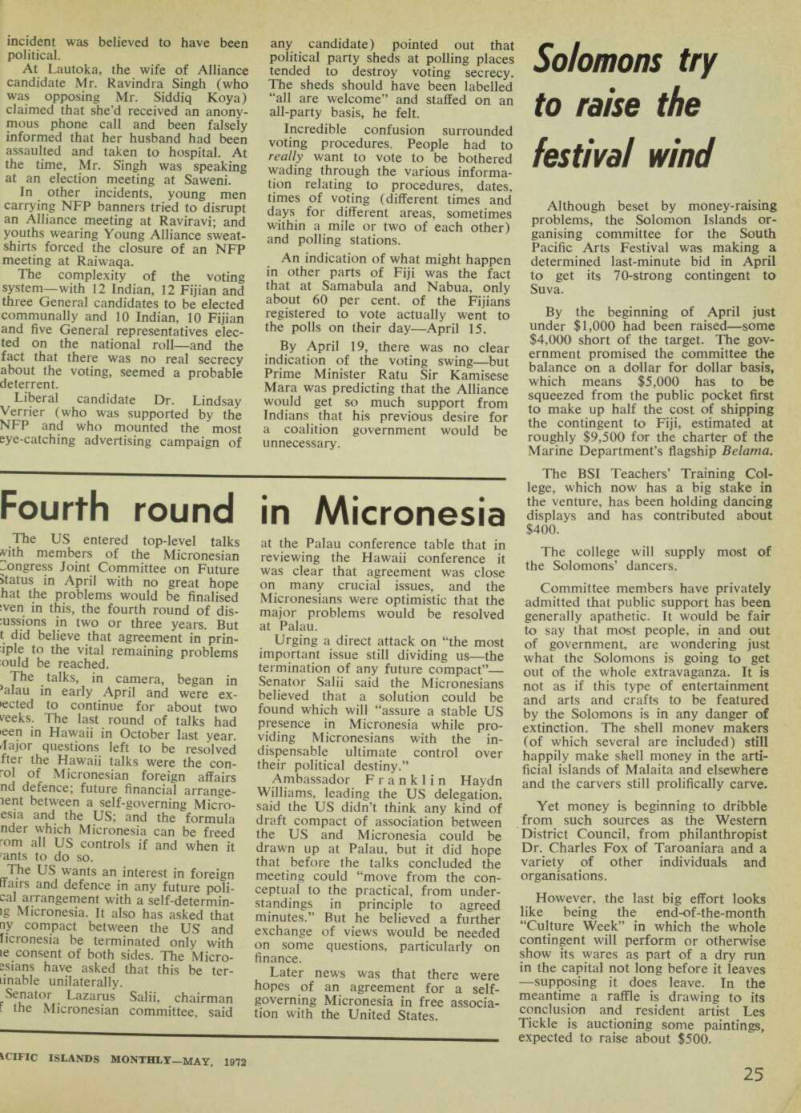
Mr. Vijay Singh ... he wrote the "Labasa Letter".
Fiji's Prime Minister, Ratu Sir Kamisese Mara, does his elec tioneering the modern way —by helicopter. The "whirly bird" en sures quick trans port for the Prime Minister, enabling him to reach vil lages in the bush in minutes, jour neys which, on foot, would take hours.
incident was believed to have been political.
At Lautoka, the wife of Alliance candidate Mr. Ravindra Singh (who was opposing Mr. Siddiq Koya) claimed that she’d received an anony mous phone call and been falsely informed that her husband had been assaulted and taken to hospital. At the time, Mr. Singh was speaking at an election meeting at Saweni.
In other incidents, young men carrying NFP banners tried to disrupt an Alliance meeting at Raviravi; and youths wearing Young Alliance sweat shirts forced the closure of an NFP meeting at Raiwaqa.
The complexity of the voting system—with 12 Indian, 12 Fijian and three General candidates to be elected communally and 10 Indian, 10 Fijian and five General representatives elec ted on the national roll—and the fact that there was no real secrecy about the voting, seemed a probable deterrent.
Liberal candidate Dr. Lindsay Verrier (who was supported by the NFP and who mounted the most eye-catching advertising campaign of
any candidate) pointed out that political party sheds at polling places tended to destroy voting secrecy.
The sheds should have been labelled “all are welcome” and staffed on an all-party basis, he felt.
Incredible confusion surrounded voting procedures. People had to really want to vote to be bothered wading through the various informa tion relating to procedures, dates, times of voting (different times and days for different areas, sometimes within a mile or two of each other) and polling stations.
An indication of what might happen in other parts of Fiji was the fact that at Samabula and Nabua, only about 60 per cent, of the Fijians registered to vote actually went to the polls on their day—April 15.
By April 19, there was no clear indication of the voting swing—but Prime Minister Ratu Sir Kamisese Mara was predicting that the Alliance would get so much support from Indians that his previous desire for a coalition government would be unnecessary.