the lustre's dimmer
pp. 28-29 · Read in the full issue
Premier Henry's star still shines but the lustre's dimmer
Although the Cook Islands Party, led by Mr. Albert Henry, won the Cook Islands general elections on April 11, the voting was close in the most populous island of Rarotonga.
In Rarotonga, which in 1970 had an estimated population of 11,239, there was a 17 per cent, swing away from the CIP to the Democratic Party.
In the 1968 elections the CIP won 65.3 per cent, of the to:al votes, but this year they polled a little less with 54.4 per cent. In spite of that, how ever, the CIP won 15 of the Legis lative Assembly’s 22 seats. Tlie opposition Democratic Party led by Dr. Tom Davis, won the other seven. There was only one indep.n dent candidate, Edwin Gold for the Mangaia constituency. He polled 10 votes.
In 1965 the CIP gained 14 seats and the Independents won eight; in 1968, the CIP captured 16 seats, and the United Cook Islanders, six.
This year, for the first time, the opposition won one of Rarotonga’s nine seats when Dr. Tom Davis was elected for the most densely popu lated area of Te-Au-O-Tonga.
Rarotonga’s CIP sitting members returned were Albert Henry and T.
Kamana for Te-Au-O-Tonga (four vacancies); T. Numanga, A. P. Short and T. Tetonga for Takitumu (three vacancies); and Taru Moana and T.
Pera for Puaikura (two vacancies).
A new CIP candidate, businessman Joe Browne won a seat in Te-Au-O- Tonga, which, for voting purposes included the 136 voters of Palmers ton Island. Both A. P. Short and T.
Numanga were former cabinet minis ters in the CIP Government.
The preliminary figures for the four successful Te-Au-O-Tonga can didates show how close the voting was in this key constituency: Albert Henry 1,363; Joe Browne 1,309; T.
Kamana 1,281; and Tom Davis 1,259.
Two CIP sitting members in the outer islands were returned un opposed. They were T. A. Henry, member for Mauke’s single seat and
a former cabinet minister, and R.
Pokoati, member for Mitiaro’s only seat. pin Other former CIP cabinet mims-
bmh fMtutffi!
Victories for the Democratic Party in the outer islands were; Mangaia’s two seats to P. Aberahama and N. Matepi; Atiu’s two vacancies went *o V. Tangatapoto and new candidate Pomani Tangata; and the single seats for Penrhyn and Rakahamra were retained bv T Tangaroa and P. Robati, respectively.
Pupuke Robati was the former leader of the onnosition ot the opposite .
Campaigning by both parties was vigorous. CIP leader Albert Henry plugged his party’s platform which has remained unchanged since 1965.
He paraded his government’s past record—improved housing, better electrie power and water supplies, economic development loans and tarsealed roads for Rarotonga.
“Prosperity to the CIP Government is not to be rich, but to be self sufficient,” he said at one meeting.
He stressed that the ties between the Cooks and New Zealand would not be broken, and Cook Islanders living in New Zealand would not lose » home. A th final cip
asx sswja
tsftrztz'ssrzi'zt
achieved were not given.
The Democratic Party attacked the CIP Government on several issues According to' the mteHm report of Zealand s Audit Office, they said, the government had got the Cook Lands into hock by about $I milho^ Albert Henry cc ! Ul \ te^f d by sayi JJ*f that the money had been spent on the people and that they owed the government $1.7 imlbon m loans^for housing, electric power, EDF loans and sQ forth he shoW ed the country was not ‘broke’ but merely short of money, as these debts were gradually being repaid, t The Democrats accused the govern ment of not handing out benefits^on an equal basis to all the islands. Any island which did not support the gov ernment was victimised, they said.
Furthermore, the government mti midated Maoris and Europeans, “Intimidation causes fear and un
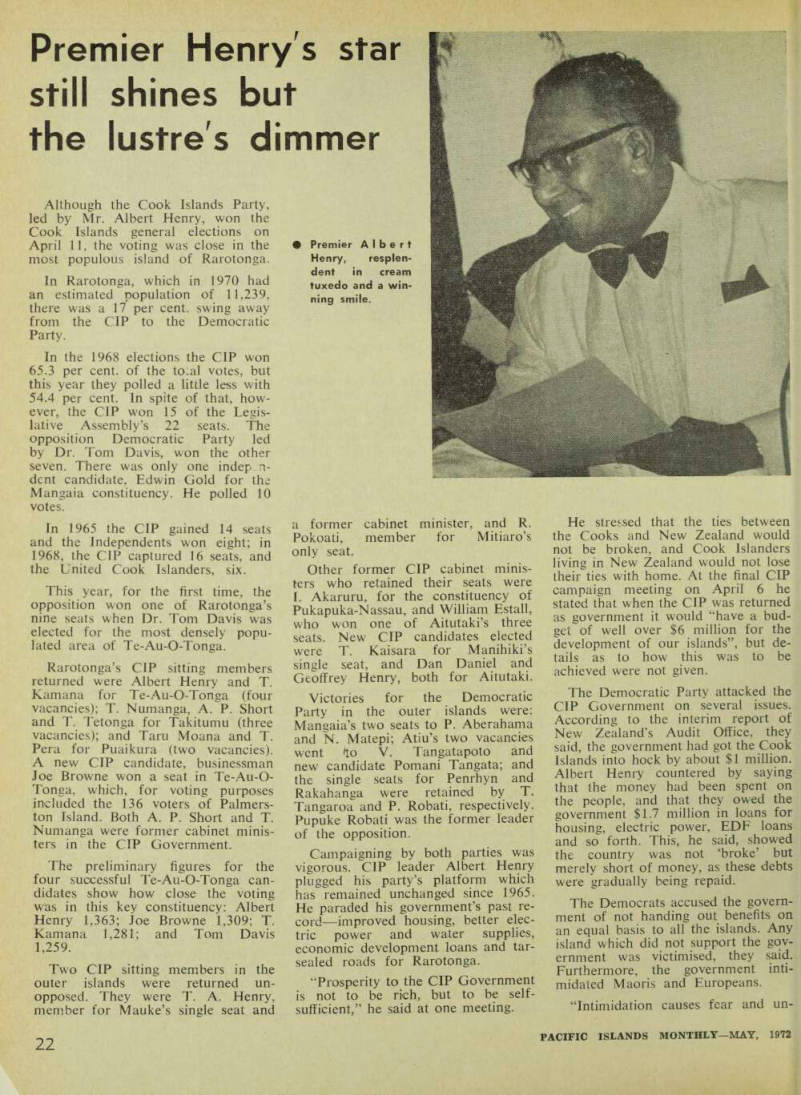
Premier Albert Henry, resplen dent in cream tuxedo and a win ning smile.
happiness and acts as a deterrent to potential investors,” said Dr. Davis at a campaign meeting for English speaking people.
At a later meeting, well attended by young people, Dr. Davis said: “Today we see young people working and be ing underpaid and not having enough to feed their children. Through private enterprise and government help, we would achieve good pay and promo tion.” From 1967 to November, 1971, he said, the basic wage of government workers had not increased, and was only increased last November because the general elections were drawing close. The Democrats said the govern ment’s Land Use Act and Aitutaki Prohibition of Motus Leases Act took away the people’s rights to their land.
During his final campaign speech, Dr. Davis said the Report of the Audit Office showed that the govern ment had guaranteed a company against loss in the charter of ships
trading to the Cook Islands. Copies of the guarantee were not available for audit, and in respect of payments already made on two charters the documents produced to support pay ments totalling $62,000 were in adequate. Because of lack of docu ments the Audit Office could not establish the total financial commit ment of the government.
On April 10 the leaders of both parties broadcast their final address.
Albert Henry said he had reliable information that Dr. Davis was in contact with an American business syndicate which was ready to operate in the Cooks when Dr. Davis was ready.
This could only happen “over my dead body”, said Mr. Henry, as it could mean a complete monopoly of business in the Cook Islands. “There can be no separate future for rich and poor, but a common one for all of us,” he said.
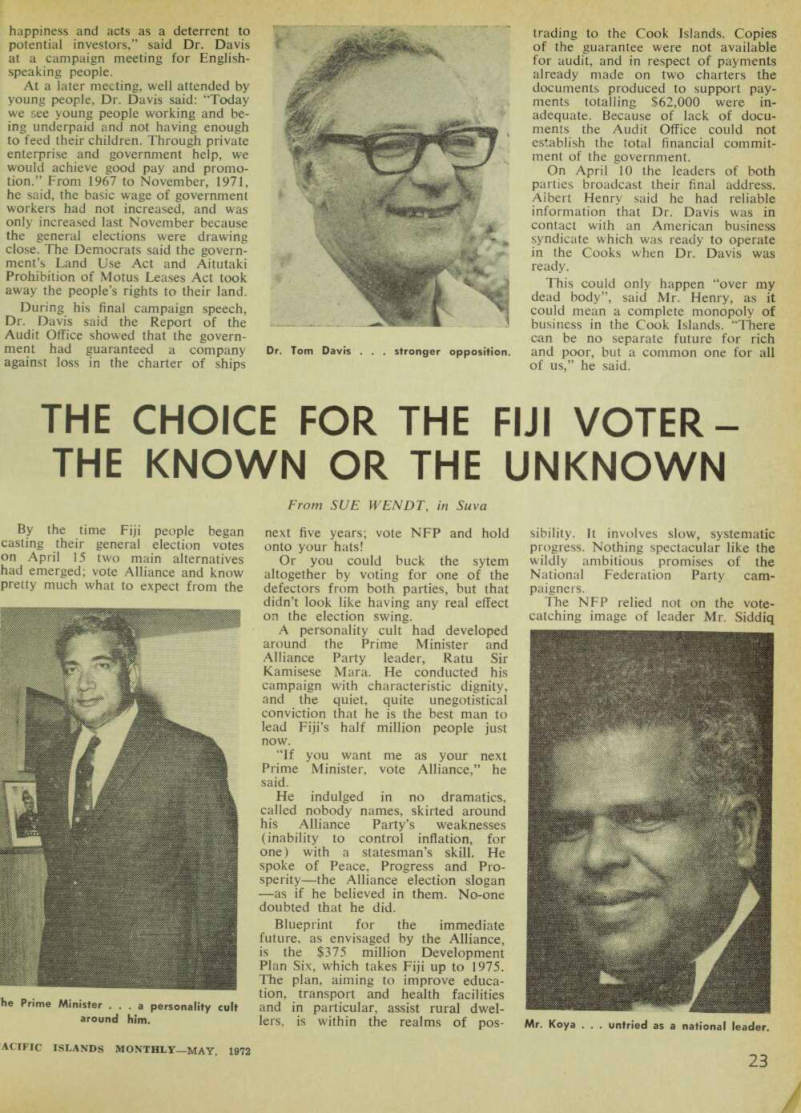
Dr. Tom Davis . . . stronger opposition.