Fiji's Leader Talks Of His
pp. 36-37 · Read in the full issue
Hopes And Plans
From JOHN CARTER, in Suva
I saw two sides of Ratu Mara’s makeup during our talk—and it was more a talk than an interview. I asked for half an hour. I got 50 minutes, a big, generous slice out of a day of a Prime Minister with the government of a country and a critical election on his mind.
For half an hour he was the urbane politician, lucidly explaining his views on a coalition government, on the coming election, on racial policies, economics. Then he unbent and I saw the other Ratu Mara, the father of his people.
Sentimental slant? Perhaps, but I suspect his own people of Lakeba occupy a bigger place in his big frame than anything else. At any rate, he is planning to devote the whole of his life, after the next five years, to improving the lot of the Lakebans and, with them, the rest of the Lauan people. They are his people, his sub jects because he is their traditional ruler, Tui Nayau, Paramount Chief of the Lau Group.
Why five years? The Prime Minister intends to retire at the end of the five-year life of the next gov ernment which, he is sure, as most people are, will be the Alliance Gov ernment, the first to be elected after independence.
“I would like to go back to Lakeba,” he told me. “I think I can then work on how I would like the Fijians to develop, using all the re sources they have and attain as rich a standard of life as any that can be found here. I feel if I am spared another 10 years after the next five years I can show these Island people what a good life can be had in the environment in which they live. This may be more lasting than what I have been doing up to now.”
It’s not an idle dream. He’s already doing something.
“I can over the next five years, by remote control while still in govern ment, plant up Lakeba with 5,000 or 6,000 acres of Caribbean Pine. This will change the whole island. Already
1 have 250 acres planted and my target to the end of this year is 400 acres. I’m getting the good support of the Forestry Department to help me organise this.”
The two jobs, being Prime Minister and Tui Nayau at the same time, go hand in hand in this way—“ Finding ways of uplifting my people has been of tremendous value in my work.
Knowing the aspirations of my people I haven’t any exaggerated ideas of what is possible. I have been in touch with the people all along and know exactly how far they can go; how, by experience, rural develop ment can lift them better than any government-sponsored schemes, and implant in their minds the desire to improve their own lot. They can only do this by seeing their own people taking a step forward. Seeing district officers and other government people in, what are to them, palatial build ings can’t inspire them to attain that standard of living. But show them their own kith and kin working to wards a good standard of life, with electricity and piped water supplies and good housing, then they will realise this is all within their reach and will inspire them.”
Ratu Mara wasn’t being the Prime Minister at this point. He left the room and returned with three pieces of timber, sawn, dovetailed and ready to contribute towards a house.
“Look at this,” said Ratu Mara. I looked. It was coconut wood. No body makes anything out of coconut wood except curio manufacturers.
“It looks good,” I said.
“It is good,” Ratu Mara replied.
“There’s any amount of coconut logs in the outer islands. All that’s needed is a saw, a bench, a tool-kit and you don’t need to go all the way to Suva to get housing timber. This is the sort of thing I am impressing on my people. It’s one of the most enjoyable things I do.”
But all that came in the last 20 minutes of our talk. Naturally, we opened on a political note and Ratu
Mara’s search for a political testa ment.
He had just announced publicly that he would like a coalition govern ment; the country run by his Alliance Party and the present Opposition, the National Federation Party. I asked why?
“By bringing in two-party govern ment to a dependent country like ours, the metropolitan colonial power was creating a form of political division which hasn’t got its correct environment here, said the Prime Minister.
“The environment in which the two-party system was born was one in which there was a division between capital and labour. When you bring such a system into Fiji, undivided as between capital and labour, you then find you must have a division, and that of course is racial. That is why I feel the two-party system, which must of necessity find a racial division here, is politically unhealthy for a developing country.
“As an example of where such a system was proved wrong, take Guyana. There is no division as be tween capital and labour. Two-party government was introduced with the result that you have two parties, one Negro, one Indian. It is the same in Trinidad and Mauritius. That is why you don’t see the two-party system developing in Africa.
“Of course, there are many things we have to unify before we have achieved racial unity—language, culture, tradition. We have yet to have one common language. We have English but you can’t use that in the canefields or the outer isles. It is either one or the other, Fijian or Hindi, and you can’t get your ideas across unless you can be understood.”
Ratu Mara had an answer to the argument that coalition meant single party government with no governor, no check on its powers.
“By coalition government I mean government by more than one party,
the parties agreeing to work together.
Those who think coalition would mean no opposition don’t realise there is a greater opposition in parliament under coalition than under the two party system, because every back bencher can criticise and would.
Some would want to create such a fuss that they would be mollified by a ministerial appointment or some such thing.”
What about common roll, I asked?
Ratu Mara explained that, accord ing to the constitution, a Royal Com mission will have the job of studying the question of common roll and its findings will go to the government.
“We are not committed to common roll in parliamentary government,” the Prime Minister said. “We will examine the report. If we find that the adoption of common roll is not in the best interests of Fiji we won’t have it.”
Outside Fiji, if not inside, there is talk of future trouble between the races in Fiji. Apart from timid souls, few inside the dominion see much to worry about— at present.
Ratu Mara believes he has the formula to keep the climate cool.
Inis is it; “My experience in bringing Fiji to he present state, where there doesn’t leem to be any anxiety over disturb inces or racial strife tells me that it s through the use of the principles )t participation and dialogue, getting he people involved in the running of he country.
“A problem crops up. We sit Dgether and explore areas of agree ment; find areas of disagreement and hen see what can be done to reduce hose latter areas.
In a multi-racial society, especi lly one which has been under olomal administration for genera ons, the problem has always been xacerbated because, as there are ifferent races, there have to be dif- Jrent interpretations of certain olicies, and interpretation can create ispicion, whereas, in European Duntnes, where there is only one ice and one language, the policy m be put across without confusion fear of wrong interpretation.
“One solution is to bring the people volved together in discussion. I ive always done this by asking the pposition to come in and discuss oblems which we haven’t been able solve on the floor of the House.
This has been the precursor to our institutional conference. This way dialogue, this getting together, has :en used to solve problems arising om the constitution and its inter etation.
“If you don’t solve a problem by
this method of dialogue, you invest the people round the table with the responsibility of seeing that any com promise that arises must be observed and maintained. It is a question of sharing responsibility and so far it has been most effective in bringing all the races together and maintaining peace.
“For this reason, I believe we will go through this election time peace fully, and if I am returned, I shall see this same policy is carried out for the next five years. I have the Opposition Leader (Mr. S. M. Koya) with me on this. He believes in this same principle of dialogue.”
Commerce, with an active stock exchange working in Fiji, is one door through which Ratu Mara hopes racial harmony will enter. It seems to be a new slant to an old problem but he sees companies as common ground on which the races can meet, “In our progress towards multi racial harmony we have to look at the commercial and industrial field and see in what form of business organisation multi-racial co-operation can flourish in, “Under the existing commercial set up it appears to me that Indian busi nesses go only as far as family rela tions. Similarly with the Chinese.
We have yet to see a big Chinese or Indian company which goes beyond family relations, “This leaves the present European stock companies as the only possible organisations where you could have a multi-racial society coming together
and developing them as national com mercial business organisations.
“Under the present structure of Morris Hedstroms, Burns Philp and Carpenters it is a matter of buying shares and then you are as equally involved as any other shareholder.
It is for these big firms to seize the opportunity to become truly national companies of Fiji and it is for the people of Fiji to seize opportunities from their side. If this could eventuate then we would have what I am looking for—a commercial and industrial organisation that will ac commodate a multi-racial society.”
I reminded the Prime Minister that when the South Pacific Sugar Mills offered shares to Fiji’s public there was a disappointing response.
“That was different,” he said.
“Only so many shares were offered.
In achieving the sort of multi-racial commercial and industrial organisa tion we are looking for, big firms must not think they need only admit enough local people to give them some sort of stamp of responsibility without any real voice in the firm’s affairs. That is why I said there must be moves from both sides.
“Firms will see it is in their own interests to involve local shareholders.
Similarly, local shareholders will see that as well as developing a business as a family circle they will take an interest in joining the big firms.
“We have already in existence and doing very well Naviti Investments which from the first was multi-racial and is developing as such. If exist ing, so-called European companies would open their doors, with their capital, knowledge and experience, I would be more happy about the future prospects of Fiji. This is one of the challenges I have before me and one I would like to tackle in the next five years.”
Ratu Mara was anxious about one thing. He doesn’t want to be re garded as the only advocate of multi racial harmony.
“I don’t want to take all the credit for multi-racial work. I knew there was a feeling of possible racial co operation when I worked as a district officer. Now that I have the oppor tunity as Prime Minister to initiate certain things I took the risk. It could have been a flop. I promoted multi-racial authorities, the multi racial committees which, at first, were coolly received by the Fijians. Now, they are becoming to come in and are beginning to see that, if you want to get things done, the Indian truck is as good for carrying things as is the Public Works truck.
“Things are now beginning to click and are going well.”
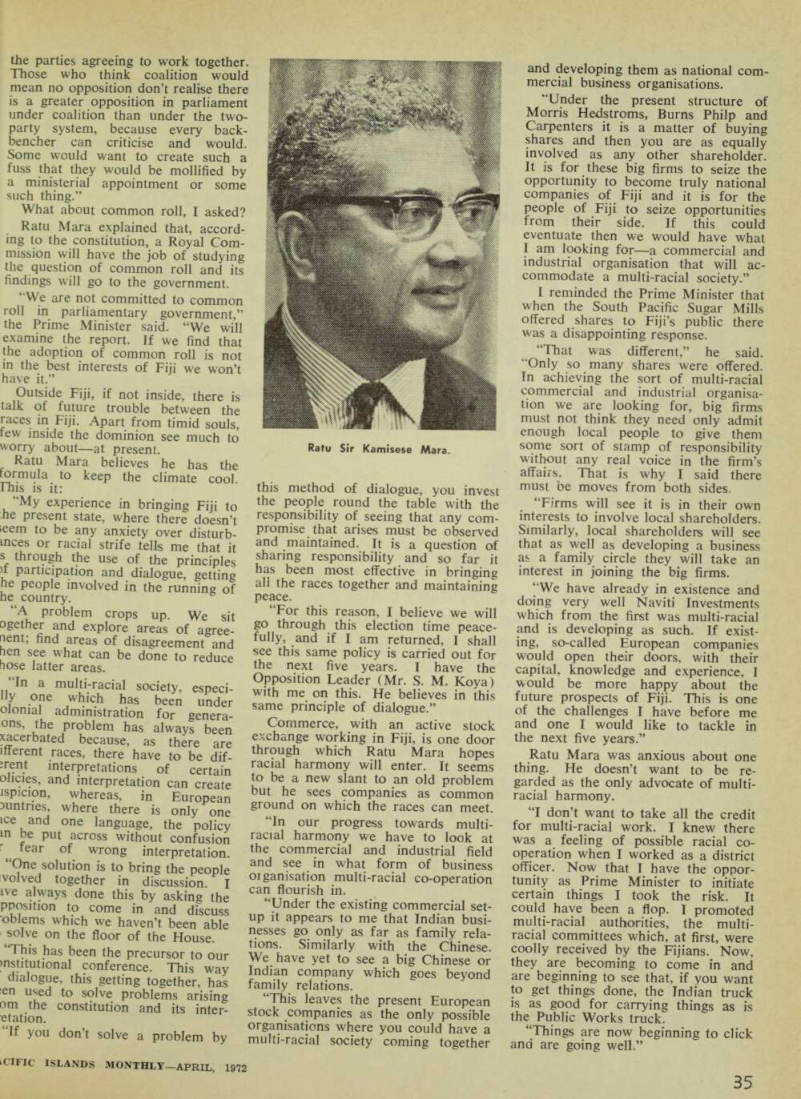
Ratu Sir Kamisese Mara.