Tahiti
pp. 34-36 · Read in the full issue
Letter
From James Boyack
WHAT with my own tendency to be long-winded and the fact that the least incident here is usually the product of an incredibly complex set of circumstances, my recent letters, and particularly the last one about SACEM, have been lengthy expositions of one general subject. More happens in Tahiti than a reading of my letters in the past six months would indicate, however.
I have decided this time around to mention several newsworthy events.
To start where 1 left off in March, “L’Affair SACEM” is still alive despite all evidence that it should be decently buried. Jean-Charles Troalen, enforcer for the French Society of Authors, Composers and Publishers of Music (SACEM), appeared once too often at the Royal Papeete nightclub. Mr. Troalen had been touring Papeete nightspots for several weeks to ascertain whether or not SACEM material was being illegally played. He was accompanied by a court observer on the critical night he was ejected from the Royal.
Charles Poroi, President of the Hotel Association as well as the Chamber of Commerce, presided over Troalen’s unceremonious exit. Mr. Poroi, surrounded by association executives, took the microphone and announced that no further music would be played until the undesired guest decamped. Poroi, son of the former senator and mayor of Papeete Alfred Poroi, intimated that it would be for his own good that Mr. Troalen left the premises. With no desire to fight his way to the door through a drunken mob, Mr. Troalen took the cue post-haste. Mr. Poroi made it clear that the court observer was welcome to remain, because the fight was a private matter, concerning only the expelled.
Governor Pierre Angeli, meanwhile, chose not to sign the Territorial Assembly bill proposing a one for 1,000 SACEM levy. He sent the proposition to Paris for a French constitutional court ruling on the assembly’s prerogative to limit SACEM collections here.
THE political battle over “communalisation” has begun.
Even as I write this, the Territorial Assembly is meeting in a specially convened session to debate four projected laws which will completely transform the administrative structure of French Polynesia. The assembly has until mid-April to make its opinion known.
The special session, begun in mid-March, could last three or four weeks. The minority delegates, those opposed to internal self-government but vigorously in favor of“communalisation”, walked out of the very first session to protest against alleged majority intentions to express only its own opinion on the matter.
“Communalisation” would create about 40 mini administrative centres across the Europe-wide breadth of French Polynesia. Each would have its own budget and its own bureaucracy. The project boils down to a chance for far-flung islands to take care of their own problems without consulting the Papeete-based assembly and French administration. The concept of “regionalisa tion” is being applied to all of Metropolitan France.
“Communalisation” is the local application of this government reform initiated by General de Gaulle just before he left office.
Local pundits seem to agree on two things—“com munalisation” is acceptable and there is not enough money in the territorial treasury to pay for it. The assembly unanimously rejected the law several weeks ago because, in its opinion, the French government was not willing to provide the additional funds necessary to implement such a sweeping administrative re structuring. Even the most fervent assembly supporters of the general concept reluctantly agreed to dump the project if Paris refused to increase its already large subsidies to French Polynesia.
GOVERNOR Pierre Angeli was one of a crush of administration officials to attend the assembly’s initial discussions of “communalisation”. He and his aides made themselves available to answer technical questions that might thwart easy flow of the debate.
His presence was the excuse for Counsellor Henri Bouvier to address himself to a wholly different subject, and this before a word had been spoken about “com munalisation”.
Mr. Bouvier was concerned that, during the previous weeks, a growing “climate of public insecurity” had been created by newspaper reports of one, hypothetical stores of arms, and two, ammunition stolen from the Army. He moved that the assembly vote (which it did unanimously) to query the governor about what was
being done “to put an end to the felonious activities mentioned by the Press and therefore to calm people down on the eve of the forthcoming elections”. Mr.
Bouvier, the most outspoken autonomist of all, was worried that reports of guns and ammunition would tarnish the autonomist majority’s image of political sanity, and therefore hurt its chances in the September elections. He said that such scare tactics had no place in Polynesia, and that everyone must be able to excercise his civil rights in an atmosphere of calm order.
The governor could not have agreed more. “I sub scribe to your opinion word for word,” the governor exclaimed, and then he promised that an investigation of all allegations would get “to the root of the affair”.
There is no question that the warm relations between those of divergent political opinion, established by Over seas Territories Minister Pierre Messmer in September, took something of a nose-dive in early March. The general uptightness coincided with the arrival here of the Secretary General of the Gaullist party in France Rene Tomasini. The chief of the majority party in France, a militant politician, might have hesitated to over the Polynesian branches’ 3rd Congress had he been aware that he was entering a hornet’s nest of incriminations.
He had not even crawled into bed on his first night here when he was stung for the first time. The bite came from National Assembly Deputy Francis Sanford who wrote him an open letter, published the next day in the three newspapers. The letter was a political blast at a politician by a politician, nothing extraordinary except for a phrase referring to arms Sanford had mi| ed f Y St °J e( l at - h,S home and on Ra ngiroa. Sanford made fun of the investigators who apparently believed this. He mentioned “27 other Fidel Castros” who like wise are thought to have arms caches.
Tomasini chose to make no reply to the letter He went about his business of bolstering the local Gaullist . . p , r ® stl ? e \ H( r lambasted the autonomists as separatists aiming for independence and he concluded n th! e p Sl? n intei T iew ’ Tahiti is an outpost of France French n ° f na - ter what ’ h must remain said s °me logical things about the local budget coming out of a Pans pocket and the fact that only hard thinking would solve Tahiti’s real problems He was continually outspoken. He could not have of 31 hIS haF K politickir, g wou ld coincide with a rash of rumours about guns and ammunition Two days later the arms story broke. To make a hipn ar ?d fan tastic tale short, an autonomist, who had been jailed for passing bad cheques, led the police on a wild goose chase. Where he said there would be arms there were none. The tentative conclusion of informed neZZ TS v a V ha i the man in Wtion was trying to hfs bluff w l5 fr n ed . or £ f u r “ secret ” information When of hf, f called ’ u 6 had to 80 through the motions ? f -J? t + r pnsed ! hat hls information was wrong, one week {ater* conclus,on ” because of what happened ‘ nt ° a * Army muniti °ns depot and Snflrmirt h, h '.?., cases of ammunition. This fact was 16 T m,lltar y sources who also indicated that 16 of the cases contained feeble, plastic training bullets and grenades. This theft was reported by all three on*Vo a^,„ 0n r a , Tu^ ay ' 7116 *** assembly session days Tate" “° n began 0n Thursd ay. two worried TIM PRICE, the 71-year-old American yachtsman who Coot KtenH.- 1 life u n route to Honolulu from the Cook Islands in December, resumed his journey from
Tahiti in early March. The hardy seaman, accompanied by Cook Island crewman Taua Tua, 47, slipped virtually unnoticed through the Papeete pass aboard the 47-foot gaff-rigged cutter Escape from Paradise at the start of what he told me will be a 40-day passage to the Hawaiian Islands.
Although no trumpets blew for his departure (I was the only person on hand for a final farewell), the 25year resident of the Cook Islands will never forget the hospitality he received here. By courtesy of the French Navy, Jim left Tahiti with a new rudder wheel com bination. Jim had lost his original rudder just below the equator two weeks out of Rarotonga. He had a spare boom aboard at the time and with this dragging behind the vessel, he was able to navigate all the way to Bora Bora. He had a temporary rudder built in Bora Bora.
This permitted him to get to Papeete where final repairs were made.
Interest in his tribulations was widespread here Yachtsmen permanently based in Papeete took up a collection and provided Jim with additional stores for his journey.
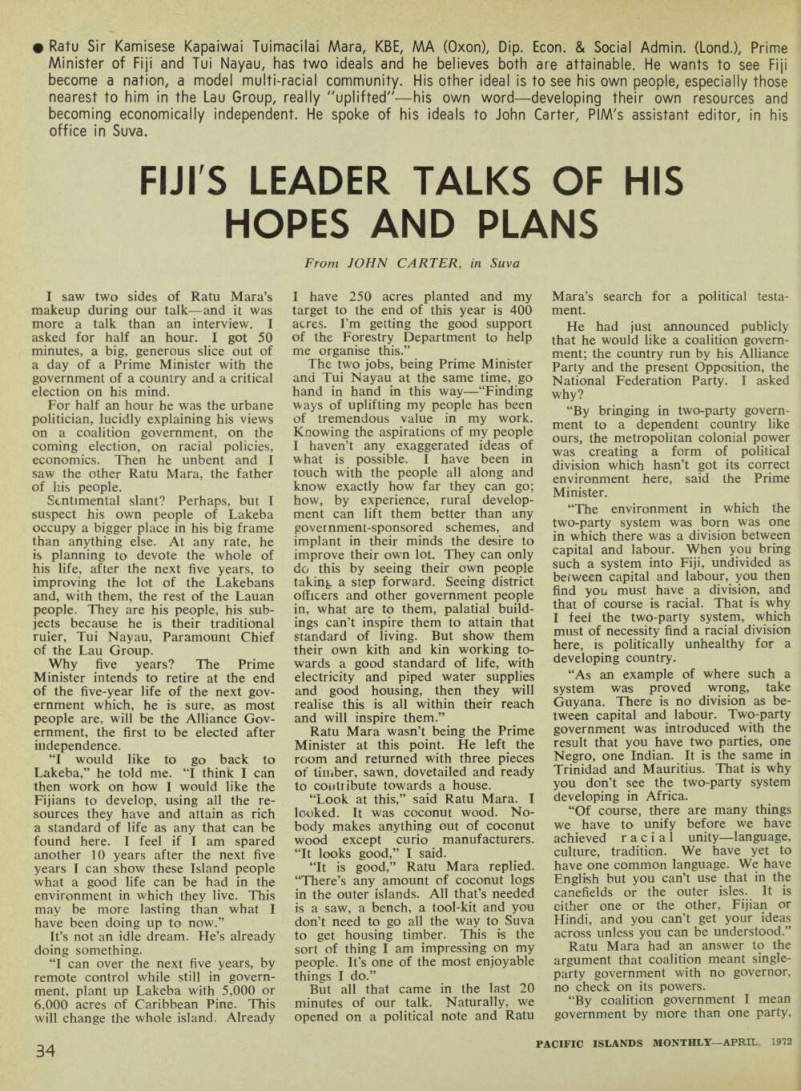
Governor Angeli took a personal interest in Jim’s adventure and invited the old seadog to the executive mansion for drinks with the commander of the French navy base here. The three men had a pleasant chat for more than an hour. The governor told Jim to stop being so thankful for the assistance he received. He said that it is perfectly natural for Tahiti to care for those who have met with distress in Polynesian waters “There is a solidarity of men of the sea,” he said.
The governor acceded with evident pleasure to Jim’s final request. The indomitable American said that he would plant the boom which saved his life in his daughter Mrs. Jean Rule’s Oahu backyard. It would become a flagpole. Each year he would add another nng around the pole to indicate another year of borrowed time”. Jim asked the governor to give him a French flag which would fly permanently from atoo the pole. * A ND IVe done again. Looking back over this letter f 1 I find I have followed the puzzle of life in Tahiti from one inter-connected piece to another, so you will have to wait before I write about a potential Olympic gold medalist boxer, a single-engine plane which dis appeared in a bad storm, a man who swam for 15 hours, Korean fishing boats heavily fined for non respect of territorial waters, ground-breaking for Travelodge Tahiti, and the first public library, parking meters and required helmets for those who ride two wheel motor vehicles.
Governor Pierre Angeli with Jim Price and Navy Commander in governor's living room.
• Ratu Sir Kamisese Kapaiwai Tuimacilai Mara, KBE, MA (Oxon), Dip. Econ. & Social Admin. (Lond.), Prime Minister of Fiji and Tui Nayau, has two ideals and he believes both are attainable. He wants to see Fiji become a nation, a model multi-racial community. His other ideal is to see his own people, especially those nearest to him in the Lau Group, really "uplifted"—his own word—developing their own resources and becoming economically independent. He spoke of his ideals to John Carter, PlM's assistant editor, in his office in Suva.