New shipping alliances won't
p. 31 · Read in the full issue
mean the end of Union SS
“The Union Company is in the Pacific Islands shipping business to stay.”
These are the words of “Mr. Trans port of Australia”, Sir Peter Abeles, deputy chairman and managing director of Thomas Nationwide Transport Ltd.
TNT controls the fortunes of the Union Steam Ship Co. of New Zealand through its holding in Bulkships, which has 50 per cent, of the New Zealand company’s stock.
Sir Peter, a Sydney transport man, revealed that TNT is looking at new shipping systems and new ship types for its line services.
At the moment the new ships are in the study stage only. Cellular con tainerships, vehicle-deckers, and hybrid types are being looked at.
LASH (Lighter Aboard SHip) is not an immediate possibility, but Sir Peter does not rule out small LASH ships in the future for suitable trades.
But one thing is clear: the Union Company’s Island services will go over to one of the forms of unit loads, whether it be pallets, flats, or pure containers. It is only the method of carrying the units which is still in the debating stage.
Union has given the New Zealand Government an undertaking that it will continue to service the Islands.
But even if this were not the case, Union would want to stay in the trade.
“We believe that with general population growth and improvements in standards of living, the trade will grow,” Sir Peter told PIM in late March.
“If we let go now we won’t be there when better commercial times come,” he said.
At the moment, Union has five ships running out of New Zealand to Fiji, Tonga, West Samoa and US Samoa, Norfolk, New Caledonia and French Polynesia.
Three of these vessels run regular schedules out of Auckland to Fiji, Tonga, West and US Samoa with occasional calls at other ports when there is cargo to be picked up. A fourth ship runs from New Zealand ports to Norfolk and Noumea while a fifth operates to Papeete with some calls at Western Samoa.
All of these vessels are of the conventional type.
Shipping experts believe the Islands
trade could lend itself to a smaller version of the highly successful PAD trans-Pacific vessel. This type of ship has a ramp which lowers from the stern quarter and does not need a specially constructed berth.
It has a high rate of working cargo by specialised vehicles running over the ramp into internal vehicle decks.
Building cost is somewhat higher with this type of vessel because of the strengthened decks, but it is highly versatile and is holding down costs wherever it is in use.
This stem-loading vehicle-decker can carry pure containers, pallets, flats and vehicles.
Sir Peter was asked whether TNT would buy into tourist hotels and develop ship passenger services.
This is relevant in view of the fact that his company is now the biggest single shareholder in Ansett which has extensive accommodation interests. TNT acquired a 23 T per cent, interest in Ansett in March, buying one big parcel of Ansett shares from W. R. Carpenter Holdings.
“No,” said Sir Peter, “freight is our business and it is wise to stick to doing what you know best.”
He said it was true that Ansett had accommodation interests, but this was either acquired or built when the tourist accommodation
situation was pretty bad in Aus tralia. It was no longer necessary to build, as agreements could be reached with people who had the accommodation.
“If TNT had a controlling interest in Ansett we would not extend the accommodation side,” he said.
The same philosophy applied to Union’s Pacific Islands business, he said.
Sir Peter confirmed that Union had lost P & O’s general agency business in New Zealand.
Since the takeover of Union from P & O, the British transport giant has formed its own company to handle its passenger, accommodation and general agency business.
But Union has retained P & O agencies in the Islands while P & O continues to hold Union agencies in Australian ports.
Overseas trades?
Sir Peter said Union would not enter liner trades requiring heavy and specialised investment. But it was possible that it would seize the op portunity to take the New Zealand flag into trades offering a basic cargo with the possibility of picking up profitable cargoes at non-scheduled ports.
“Union will not become part of some big overseas operating complex, but it is possible, as a small operator, that it could take advantage of suit able opportunities,” he said.
It seems clear at this stage that Union has a firm future under TNT control.
The parent is well on its way to becoming Australia’s first integrated transport service. Union must benefit from this type of operation.
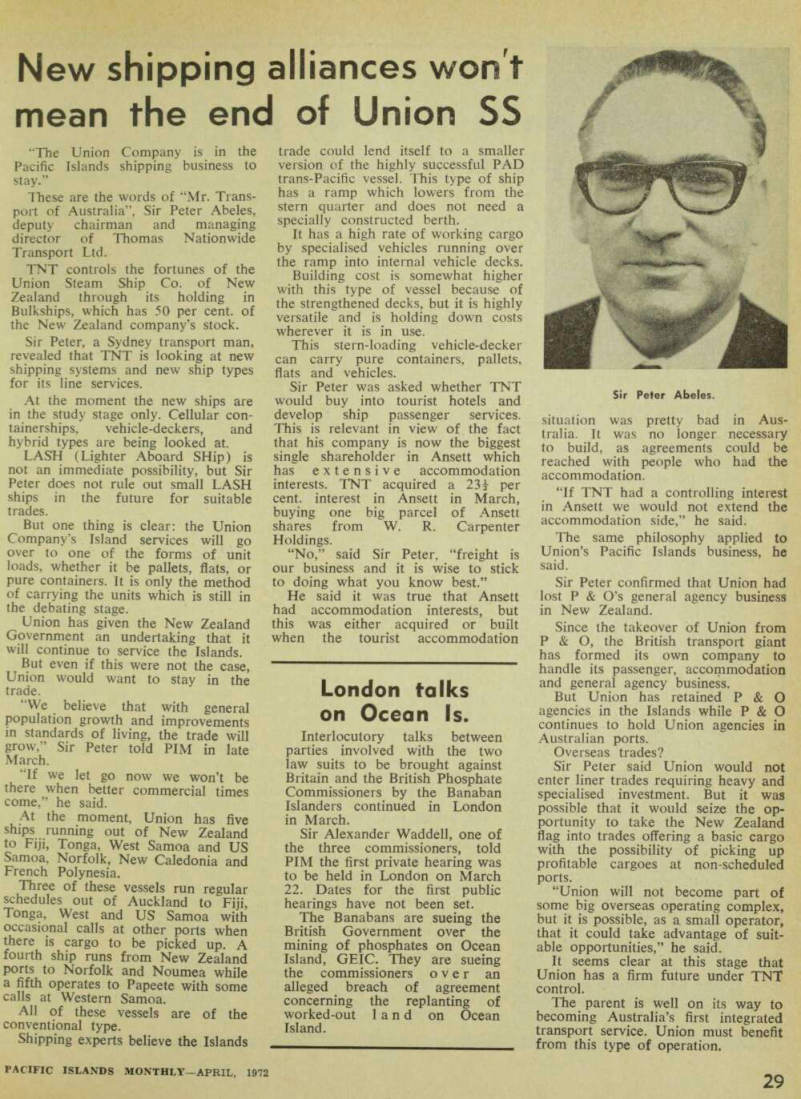
Sir Peter Abeles.