Regional Air Competition
pp. 29-30 · Read in the full issue
To Be Fiercer
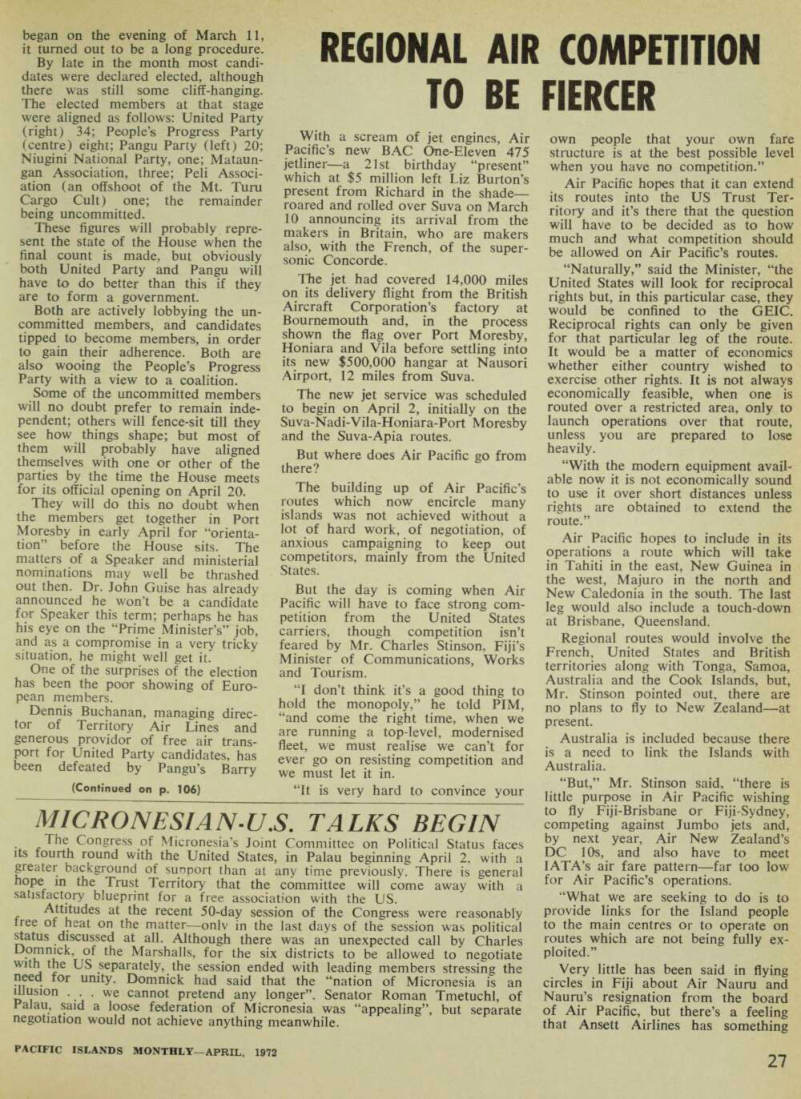
With a scream of jet engines, Air Pacific’s new BAC One-Eleven 475 jetliner—a 21st birthday “present” which at S 5 million left Liz Burton’s present from Richard in the shade— roared and rolled over Suva on March 10 announcing its arrival from the makers in Britain, who are makers also, with the French, of the super sonic Concorde.
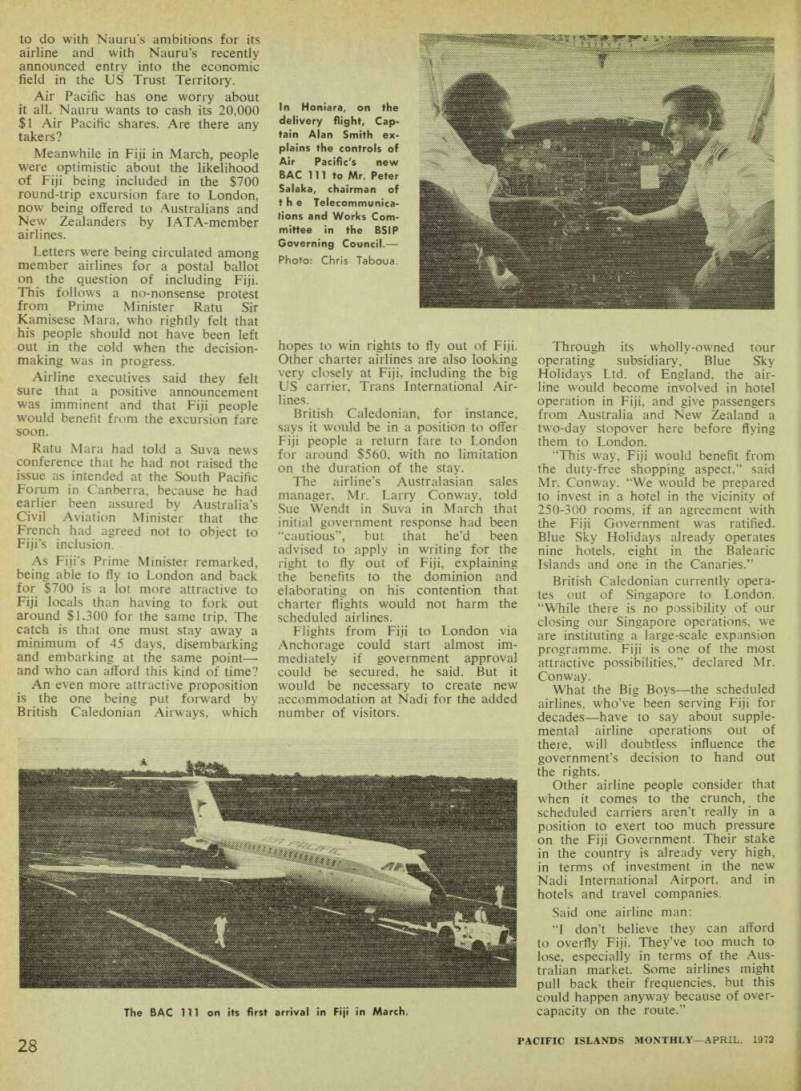
The jet had covered 14,000 miles on its delivery flight from the British Aircraft Corporation’s factory at Bournemouth and, in the process shown the flag over Port Moresby, Honiara and Vila before settling into its new $500,000 hangar at Nausori Airport, 12 miles from Suva.
The new jet service was scheduled to begin on April 2, initially on the Suva-Nadi-Vila-Honiara-Port Moresby and the Suva-Apia routes.
But where does Air Pacific go from there?
The building up of Air Pacific’s routes which now encircle many islands was not achieved without a lot of hard work, of negotiation, of anxious campaigning to keep out competitors, mainly from the United States.
But the day is coming when Air Pacific will have to face strong com petition from the United States carriers, though competition isn’t feared by Mr. Charles Stinson, Fiji’s Minister of Communications, Works and Tourism.
“I don’t think it’s a good thing to hold the monopoly,” he told PIM, “and come the right time, when we are running a top-level, modernised fleet, we must realise we can’t for ever go on resisting competition and we must let it in.
“It is very hard to convince your
own people that your own fare structure is at the best possible level when you have no competition.”
Air Pacific hopes that it can extend its routes into the US Trust Ter ritory and it’s there that the question will have to be decided as to how much and what competition should be allowed on Air Pacific’s routes.
“Naturally,” said the Minister, “the United States will look for reciprocal rights but, in this particular case, they would be confined to the GEIC.
Reciprocal rights can only be given for that particular leg of the route.
It would be a matter of economics whether either country wished to exercise other rights. It is not always economically feasible, when one is routed over a restricted area, only to launch operations over that route, unless you are prepared to lose heavily.
“With the modern equipment avail able now it is not economically sound to use it over short distances unless rights are obtained to extend the route.”
Air Pacific hopes to include in its operations a route which will take in Tahiti in the east, New Guinea in the west, Majuro in the north and New Caledonia in the south. The last leg would also include a touch-down at Brisbane, Queensland.
Regional routes would involve the French, United States and British territories along with Tonga, Samoa, Australia and the Cook Islands, but, Mr. Stinson pointed out, there are no plans to fly to New Zealand—at present.
Australia is included because there is a need to link the Islands with Australia.
“But,” Mr. Stinson said, “there is little purpose in Air Pacific wishing to fly Fiji-Brisbane or Fiji-Sydney, competing against Jumbo jets and, by next year, Air New Zealand’s DC 10s, and also have to meet lATA’s air fare pattern—far too low for Air Pacific’s operations.
“What we are seeking to do is to provide links for the Island people to the main centres or to operate on routes which are not being fully ex ploited.”
Very little has been said in flying circles in Fiji about Air Nauru and Nauru’s resignation from the board of Air Pacific, but there’s a feeling that Ansett Airlines has something
to do with Nauru’s ambitions for its airline and with Nauru’s recently announced entry into the economic field in the US Trust Territory.
Air Pacific has one worry about it all. Nauru wants to cash its 20,000 $1 Air Pacific shares. Are there any takers?
Meanwhile in Fiji in March, people were optimistic about the likelihood of Fiji being included in the $7OO round-trip excursion fare to London, now being offered to Australians and New Zealanders by IATA-member airlines.
Letters were being circulated among member airlines for a postal ballot on the question of including Fiji.
This follows a no-nonsense protest from Prime Minister Ratu Sir Kamisese Mara, who rightly felt that his people should not have been left out in the cold when the decision making was in progress.
Airline executives said they felt sure that a positive announcement was imminent and that Fiji people would benefit from the excursion fare soon.
Ratu Mara had told a Suva news conference that he had not raised the issue as intended at the South Pacific Forum in Canberra, because he had earlier been assured by Australia’s Civil Aviation Minister that the French had agreed not to object to Fiji’s inclusion.
As Fiji’s Prime Minister remarked, being able to fly to London and back for $7OO is a lot more attractive to Fiji locals than having to fork out around $1,300 for the same trip. The catch is that one must stay away a minimum of 45 days, disembarking and embarking at the same point— and who can afford this kind of time?
An even more attractive proposition is the one being put forward by British Caledonian Airways, which
hopes to win rights to fly out of Fiji.
Other charter airlines are also looking very closely at Fiji, including the big US carrier, Trans International Air lines.
British Caledonian, for instance, says it would be in a position to offer Fiji people a return fare to London for around $560, with no limitation on the duration of the stay.
The airline’s Australasian sales manager, Mr. Larry Conway, told Sue Wendt in Suva in March that initial government response had been “cautious”, but that he’d been advised to apply in writing for the right to fly out of Fiji, explaining the benefits to the dominion and elaborating on his contention that charter flights would not harm the scheduled airlines.
Flights from Fiji to London via Anchorage could start almost im mediately if government approval could be secured, he said. But it would be necessary to create new accommodation at Nadi for the added number of visitors.
Through its wholly-owned tour operating subsidiary, Blue Sky Holidays Ltd. of England, the air line would become involved in hotel operation in Fiji, and give passengers from Australia and New Zealand a two-day stopover here before flying them to London.
“This way, Fiji would benefit from the duty-free shopping aspect,” said Mr. Conway. “We would be prepared to invest in a hotel in the vicinity of 250-300 rooms, if an agreement with the Fiji Government was ratified.
Blue Sky Holidays already operates nine hotels, eight in the Balearic Islands and one in the Canaries.”
British Caledonian currently opera tes out of Singapore to London.
“While there is no possibility of our closing our Singapore operations, we are instituting a large-scale expansion programme. Fiji is one of the most attractive possibilities,” declared Mr.
Conway.
What the Big Boys—the scheduled airlines, who’ve been serving Fiji for decades—have to say about supple mental airline operations out of there, will doubtless influence the government’s decision to hand out the rights.
Other airline people consider that when it comes to the crunch, the scheduled carriers aren’t really in a position to exert too much pressure on the Fiji Government. Their stake in the country is already very high, in terms of investment in the new Nadi International Airport, and in hotels and travel companies.
Said one airline man; “I don’t believe they can afford to overfly Fiji. They’ve too much to lose, especially in terms of the Aus tralian market. Some airlines might pull back their frequencies, but this could happen anyway because of over capacity on the route.”
The BAC 111 on its first arrival in Fiji in March.
In Honiara, on the delivery flight, Cap tain Alan Smith ex plains the controls of Air Pacific's new BAC 111 to Mr. Peter Salaka, chairman of th e Telecommunica tions and Works Com mittee in the BSIP Governing Council.— Photo: Chris Taboua.