Yesterday
p. 83 · Read in the full issue
It was all to do with a meeting in Apia between the NZ Minister for Islands' Territories, the Hon. T. Clifton Webb— there was a film star called Clifton Webb, who used to stand on his head, but it couldn't be him—the Western Samoa Legislative Assembly, the Fono of Faipule and leading officials, "concerning matters affecting administration of Western Samoa". They talked about establishing an Executive Council, im proving the judicial system, increasing food production and extending the observatory at Mulinuu Point. Samoans wanted Samoan members of the Executive Council elected by the vote of the Samoans in the Assembly but the High Commissioner, Mr. R. G.
Powles, wouldn't agree.
And we thought, "Fancy, that's how it was then". Nine years later Western Samoa was independent and the Samoans could please themselves who voted for whom. That's what we mean about
feeling like the Almighty. You think,
"What a fuss they're making. They might have saved themselves the bother".
By the way, Mr. Powles became Sir Guy Powles and the NZ Ombudsman who sees to it that Big Brother doesn't tread on the little man, like the Samoan who didn't want to be trodden underfoot.
We felt the same way about another item; "Big plan for new timber industry".
It was a big story about the Common wealth Government and Bulolo Gold Dredging Ltd.—the most successful gold mining company in New Guinea, the story said agreeing to form a joint
company. Commonwealth New Guinea Timbers Ltd., to exploit in the Morobe section of New Guinea a stand of Klinlcii Pine est.mated to produce 500 millions of super feet. There were high hopes of success and also thoughts about conservation, a going thing today, and how they would replace the chopped-down timber with more trees. We know now how it went.
It s doing fine and firmly in business.
In fact, PlM's got an advert, about the company's products on page 118 of this issue—and that's not a free puff.
One group which had worried in the past but was cockahoop in March, 1952, was the copra planter fraternity. For ages, in Fiji, New Guinea, the Solomons and Samoa, they'd carried on about the villainy of the British Ministry of Food, which was paying them in devalued currency without making up the difference.
Well, the British Government came good, upped the buying price of copra above the world price and brought tears of gratitude to the planters' agonised eyes. In a matter of months the MOF price shot up to £73 a ton in Fiji, from £6l/7/-, and to £69 in PNG, from £57.
Planters in British dependencies were "sitting pretty" said PIM. Maybe, it was a good thing that the planter, in the
midst of his rejoicing, couldn't see to what depths his morale and his copra, would descend in 1972!
Round about the same time, Fiji was licking its wounds after the disastrous hurricane which blew parts of Viti Levu and the Yasawas inside out on January 28. That 20-year-old RIM report said Fiji was courageously repair ing storm damage. But it also reported that no end of a row was going on between the government, the Methodist Church and "The Fiji Times". Apparently, a Methodist minister in the Waidina Valley area had reported to his head quarters that some Fijians were suffering famine conditions, their gardens having been devastated by the hurricane. The Rev. A. Tippett, head of the Methodists in Fiji, told "The Fiji Times" which told the people and the British Empire.
The government was furious and, said RIM, it became angry when its officials investigated and found that, "while some of the natives were distressed, there was nothing resembling famine conditions".
Perhaps as a kind of light relief, RIM printed an unusual story—unusual today maybe—about a European, a driver, who was gaoled for a month in Port Moresby for an offence under the new Native Women's Protection Ordinance. The man had "permitted" a native woman to reside in premises "other than those of a native" between 6 p.m. and 6 a.m. "without the prior written consent of the District Commissioner".
The man told the court he intended to marry the girl, but he was gaoled all the same. Surprising? It's not so long since such a law and others regarded as discriminatory, like the one which laid down what a native must wear, were wiped from the Statute Book.
There were plenty of other stories but, seeing that there has been mention lately about some bright ideas for exploring the possibility of establishing hydro-electricity schemes in Fiji, let's finish with one which was headlined "No hydro-electricity for Suva". The idea was to harness the Navua River and supply Suva and south Viti Levu with electricity. RIM said the experts had reported that such a scheme would cost £5 million and would still fall short of the ideal. The Fiji Government agreed with the Colonial Development Corporation that "this kind of hydro-electricity was not for Fiji."
So, if anyone else starts another hare like it, maybe somebody will take out the report, dust it off, show it to those who matter and save all the expense of another feasibility study which would probably cost as much as the whole works would have cost 20 years ago!
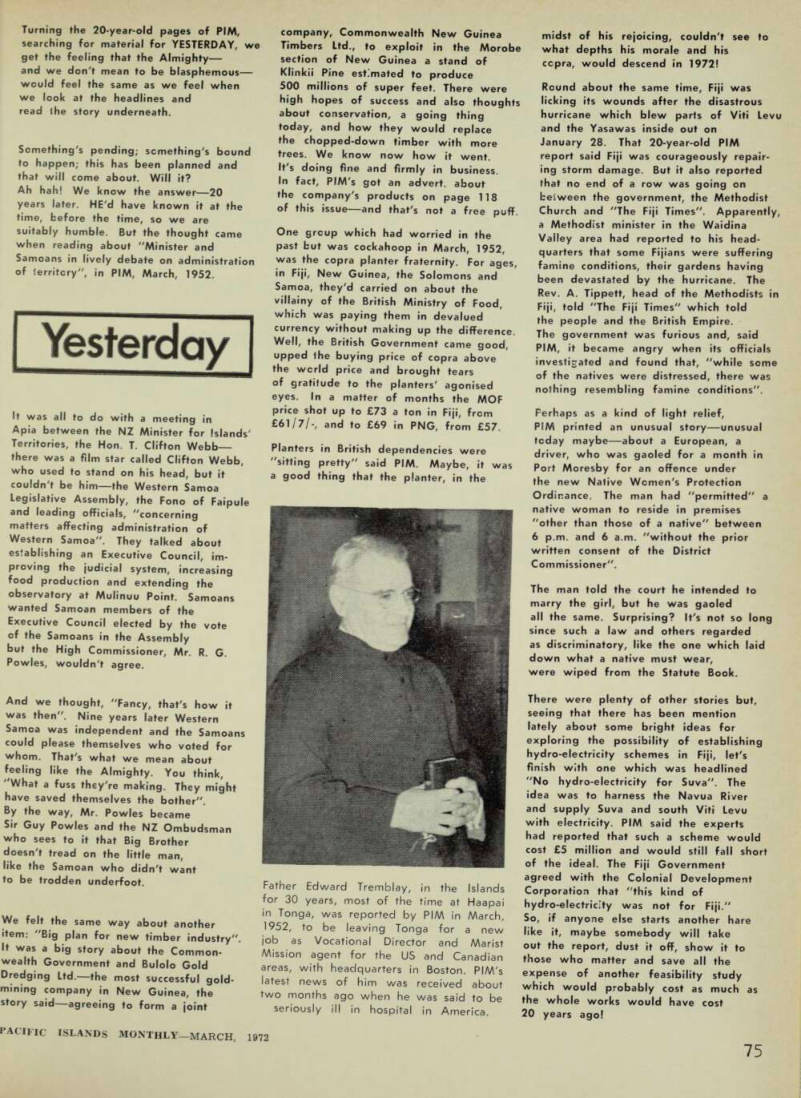
Father Edward Tremblay, in the Islands for 30 years, most of the time at Haapai in Tonga, was reported by PIM in March, 1952, to be leaving Tonga for a new job as Vocational Director and Marist Mission agent for the US and Canadian areas, with headquarters in Boston. PIM's latest news of him was received about two months ago when he was said to be seriously ill in hospital in America.