A paying-off pennant for
pp. 80-83 · Read in the full issue
the John Williams line
After 127 years the missionary ships named John Williams are no more. The last of them, John Williams VII, has been sold by the mission to the Gilbert and Ellice Islands Government and has had its name changed.
The end of the “line” had been foreseen 18 months ago, when the Congregational Council for World Mission (formerly the London Mis sionary Society, owners of the famous ships) decided that improvement in airways and shipping services within the Gilbert and Ellice Islands Colony made the present John Williams un necessary.
The CCWM set July, 1972, as the date for the ending of the service.
But instead it was decided to sell her to the GEIC Government earlier than this, and on Friday, December 31 last, she sailed to her old anchorage at Antebuka, where there was a short handing-over ceremony. She then be came the Nareau.
The last message sent out from the John Williams VII was a telegram to London to Princess Margaret, who had christened her and the previous John Williams, saying all aboard were “grateful of the Princess’ interest in the last two ships of a line now termi nated after 127 years in the Pacific”.
In January one of the tasks of the Nareau, ex-John Williams VII, was to tow to Tarawa the boat in which two people are attempting to row the Pacific, and which struck a reef.
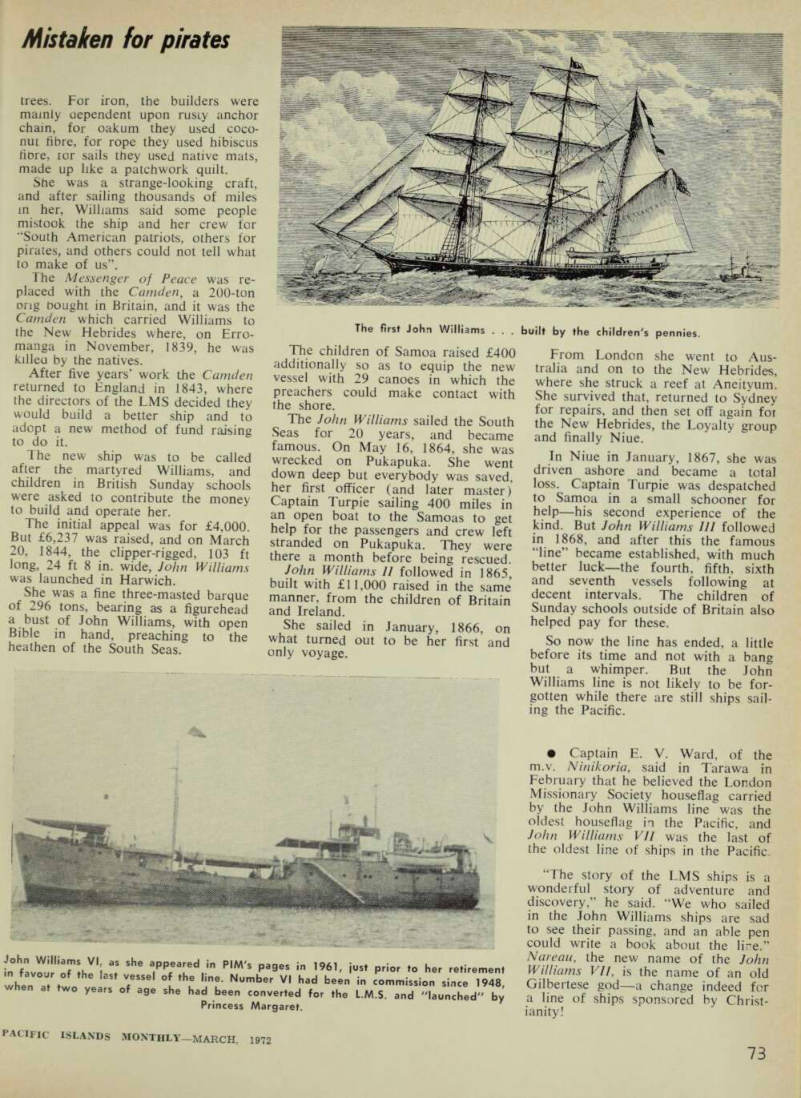
The first John Williams was launched on March 20, 1844. She was built because she was sorely needed in the Pacific. The LMS had been making do with different vessels of other names from earliest times, the most famous of them being the Messenger of Peace, built by Rev.
John Williams in 1827 on Rarotonga.
Of it, Williams said, “Although 1 knew little of ship-building, and had scarcely any tools to work with, I succeeded in about three months in completing a vessel between 70 and 80 tons burden, with no other assist ance than that which the natives could render, who were wholly un acquainted with the mechanical art .
The project of making a ship of his own had been maturing in Williams’ mind for some time. He
had wanted it so he could extend his mission from the Cooks to the Samoas and to the New Hebrides.
Timber for it was cut in the mountains, and split by wedges. Bent planks were obtained from crooked
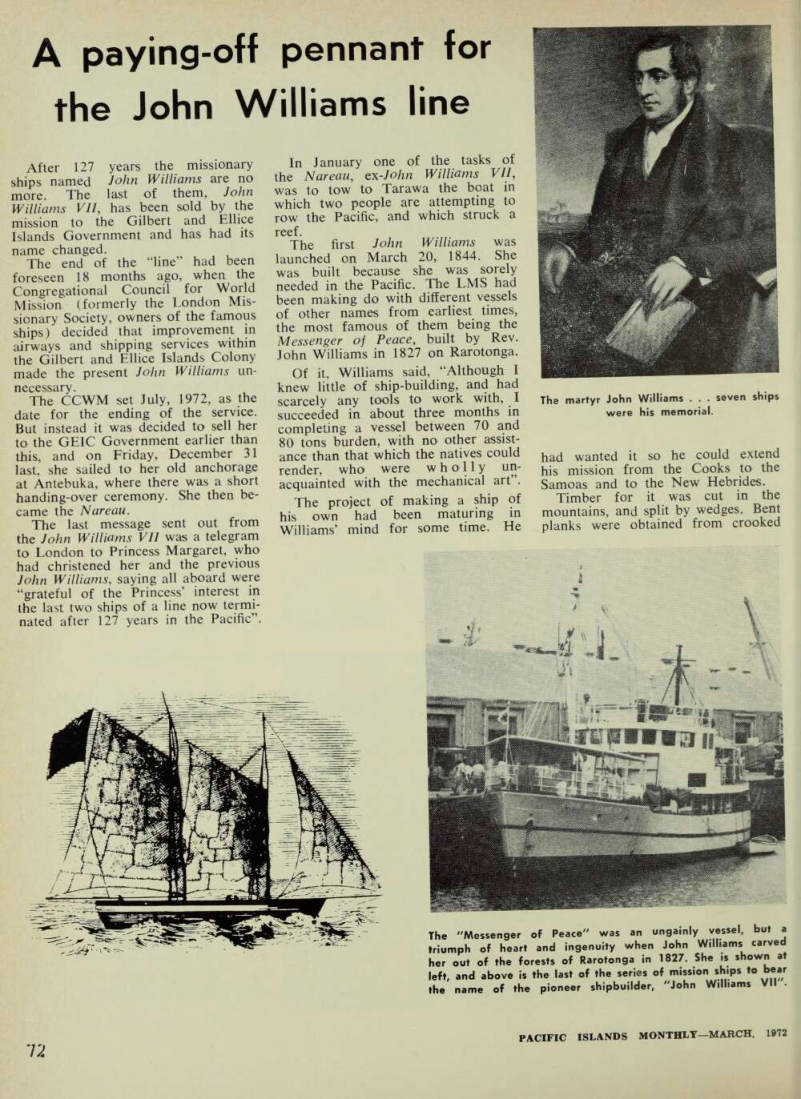
The martyr John Williams . . . seven ships were his memorial.
The "Messenger of Peace" was an ungainly vessel, but a triumph of heart and ingenuity when John Williams carved her out of the forests of Rarotonga in 1827. She is shown at left, and above is the last of the series of mission ships to bear the name of the pioneer shipbuilder, "John Williams VII".
Mistaken for pirates
trees. For iron, the builders were mainly dependent upon rusty anchor chain, for oakum they used coco nut fibre, for rope they used hibiscus fibre, ror sails they used native mats, made up like a patchwork quilt.
She was a strange-looking craft, and after sailing thousands of miles in her, Williams said some people mistook the ship and her crew for “South American patriots, others for pirates, and others could not tell what to make of us”.
The Messenger of Peace was re placed with the Camden, a 200-ton ong bought in Britain, and it was the Camden which carried Williams to the New Hebrides where, on Erro manga in November, 1839, he was killed by the natives.
After five years’ work the Camden returned to England in 1843, where the directors of the LMS decided they would build a better ship and to adopt a new method of fund raising to do it.
The new ship was to be called after the martyred Williams, and children in British Sunday schools were asked to contribute the money to build and operate her.
The initial appeal was for £4,000.
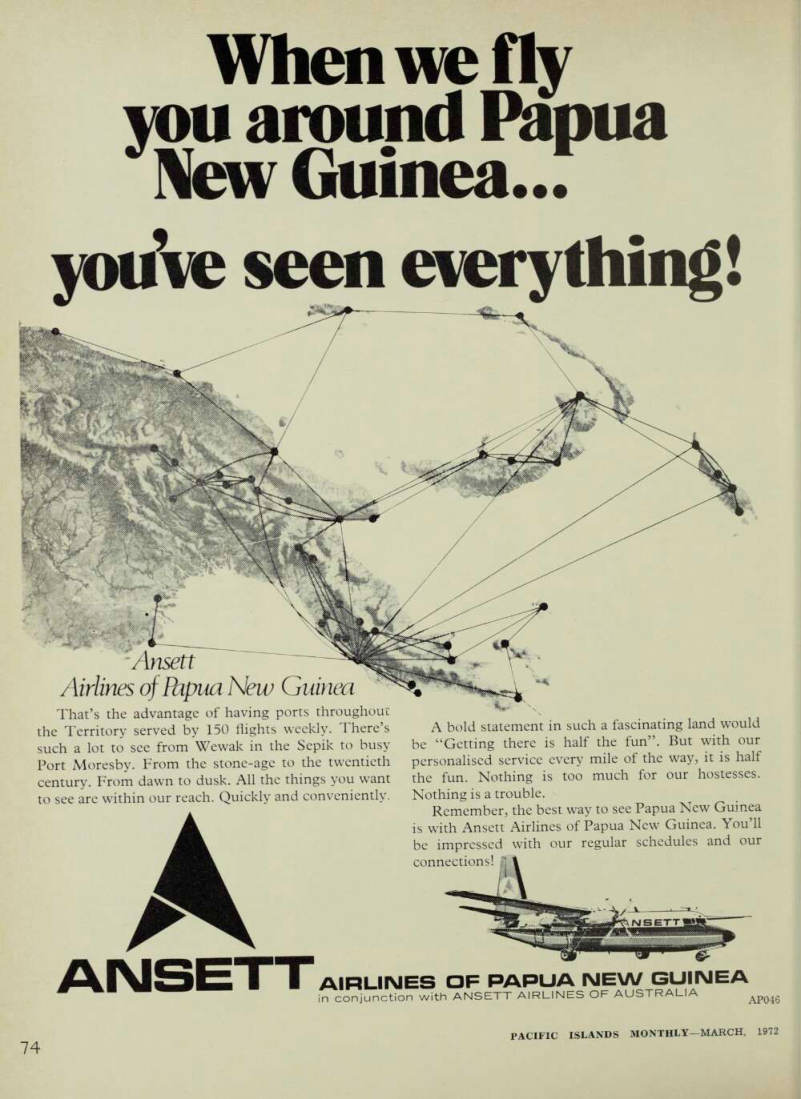
But £6,237 was raised, and on March 20, 1844, the clipper-rigged, 103 ft long, 24 ft 8 in. wide, John Williams was launched in Harwich.
She was a fine three-masted barque of 296 tons, bearing as a figurehead a bust of John Williams, with open Bible in hand, preaching to the heathen of the South Seas.
The children of Samoa raised £4OO additionally so as to equip the new vessel with 29 canoes in which the preachers could make contact with the shore Ihe John Williams sailed the South Seas for 20 years, and became famous. On May 16, 1864, she was wrecked on Pukapuka. She went down deep but everybody was saved her first officer (and later master) Captain Turpie sailing 400 miles in an open boat to the Samoas to get help for the passengers and crew left stranded on Pukapuka. They were there a month before being rescued John Williams II followed in 1865* built with £ll,OOO raised in the same manner, from the children of Britain and Ireland.
She sailed in January, 1866, on what turned out to be her first and only voyage.
From London she went to Aus tralia and on to the New Hebrides, where she struck a reef at Aneityum.
She survived that, returned to Sydney for repairs, and then set off again for the New Hebrides, the Loyalty group and finally Niue.
In Niue in January, 1867, she was driven ashore and became a total loss. Captain Turpie was despatched to Samoa in a small schooner for help—his second experience of the kind. But John Williams 111 followed in 1868, and after this the famous “line” became established, with much better luck—the fourth, fifth, sixth and seventh vessels following at decent intervals. The children of Sunday schools outside of Britain also helped pay for these.
So now the line has ended, a little before its time and not with a bang but a whimper. But the John Williams line is not likely to be for gotten while there are still ships sail ing the Pacific. • Captain E. V. Ward, of the m.v. Ninikoria, said in Tarawa in February that he believed the London Missionary Society houseflag carried by the John Williams line was the oldest houseflag in the Pacific, and John Williams VII was the last of the oldest line of ships in the Pacific.
“The story of the LMS ships is a wonderful story of adventure and discovery,” he said. “We who sailed in the John Williams ships are sad to see their passing, and an able pen could write a book about the lire.”
Nareau, the new name of the John Williams VII, is the name of an old Gilbertese god—a change indeed for a line of ships sponsored by Christ ianity!
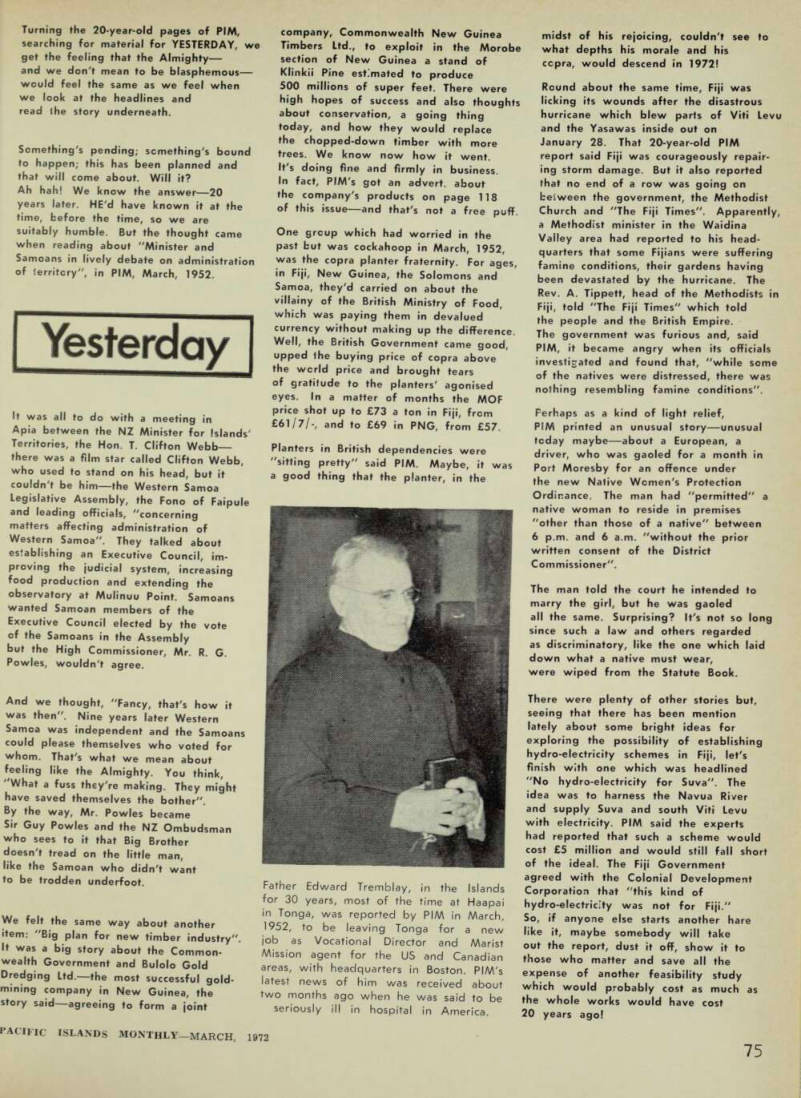
John Williams VI, as she appeared in PIM's pages in 1961, just prior to her retirement in favour of the last vessel of the line. Number VI had been in commission since 1948, when at two years of age she had been converted for the L.M.S. and "launched" by Princess Margaret.
The first John Williams . . . built by the children's pennies.
Turning the 20-year-old pages of PIM, searching for material for YESTERDAY, we get the feeling that the Almighty— and we don't mean to be blasphemous— would feel the same as we feel when we look at the headlines and read the story underneath.
Something's pending; something's bound to happen; this has been planned and that will come about. Will it?
Ah hah! We know the answer—2o years later. HE'd have known it at the time, before the time, so we are suitably humble. But the thought came when reading about "Minister and Samoans in lively debate on administration of {erritcry", in PIM, March, 1952.