Yesterday
p. 81 · Read in the full issue
Top topic for talkers in the Islands 20 years ago this month was the one the British usually use as an opening gambit when feeling their way through a new situation—the weather, wet, windy weather produced by a couple of hurricanes.
It was PlM's top topic as well, of course, with page after page after page of meaty facts about Fiji's agony when a 150 mph hurricane almost tore Suva's heart out on January 28. Damage was estimated at £1 million plus; a bonanza banana year was shattered; the wharf ripped to pieces and houses and shops flattened. As "Yesterday" said last month, more than 20 people were killed. "A time of utter misery" said PIM. "Suva, hitherto a tidy, foliage-embowered little town of 23,000 people, was a tangled wreck." It recovered, as all places do. Today, it has almost quad rupled its population and is no longer a little town —more's the pity, think some.
The Solomons was hit round about the same time with another hurricane and once again there were the familiar tales of damage. But the thing which really agitated PIM was the fact that the hurricane-warning system seemed to have broken down all over the place.
Suva got 90 minutes warning even though meteorological stations in New Zealand had been tracking the thing for days from its birth-place west of the Solomons. Today, of course, the Spy in the Sky keeps watch!
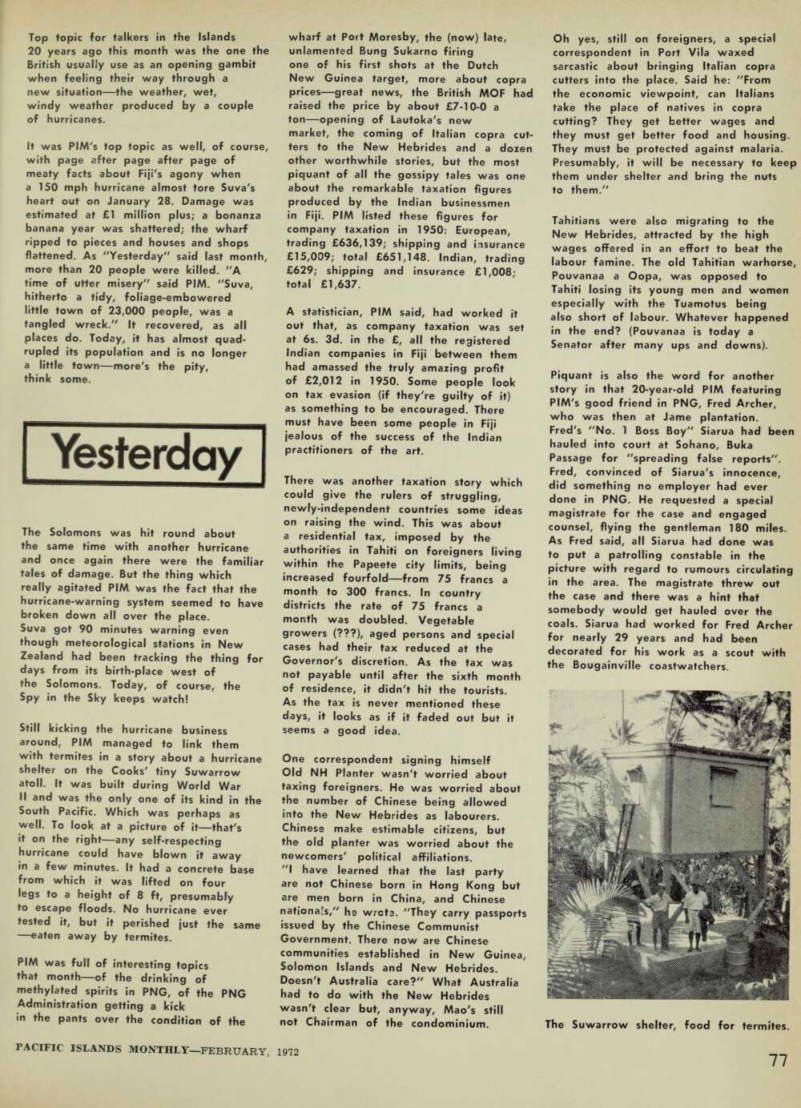
Still kicking the hurricane business around, PIM managed to link them with termites in a story about a hurricane shelter on the Cooks' tiny Suwarrow atoll. It was built during World War II and was the only one of its kind in the South Pacific. Which was perhaps as well. To look at a picture of it—that's it on the right—any self-respecting hurricane could have blown it away in a few minutes. It had a concrete base from which it was lifted on four legs to a height of 8 ft, presumably to escape floods. No hurricane ever tested it, but it perished just the same —eaten away by termites.
PIM was full of interesting topics that month—of the drinking of methylated spirits in PNG, of the PNG Administration getting a kick in the pants over the condition of the
wharf at Port Moresby, the (now) late, unlamented Bung Sukarno firing one of his first shots at the Dutch New Guinea target, more about copra prices—great news, the British MOF had raised the price by about £7-10-0 a ton —opening of Lautoka's new market, the coming of Italian copra cut ters to the New Hebrides and a dozen other worthwhile stories, but the most piquant of all the gossipy tales was one about the remarkable taxation figures produced by the Indian businessmen in Fiji. PIM listed these figures for company taxation in 1950: European, trading £636,139; shipping and insurance £15,009; total £651,148. Indian, trading £629; shipping and insurance £1,008; total £1,637.
A statistician, PIM said, had worked it out that, as company taxation was set at 6s. 3d. in the £, all the registered Indian companies in Fiji between them had amassed the truly amazing profit of £2,012 in 1950. Some people look on tax evasion (if they're guilty of it) as something to be encouraged. There must have been some people in Fiji jealous of the success of the Indian practitioners of the art.
There was another taxation story which could give the rulers of struggling, newly-independent countries some ideas on raising the wind. This was about a residential tax, imposed by the authorities in Tahiti on foreigners living within the Papeete city limits, being increased fourfold—from 75 francs a month to 300 francs. In country districts the rate of 75 francs a month was doubled. Vegetable growers (???), aged persons and special cases had their tax reduced at the Governor's discretion. As the tax was not payable until after the sixth month of residence, it didn't hit the tourists.
As the tax is never mentioned these days, it looks as if it faded out but it seems a good idea.
One correspondent signing himself Old NH Planter wasn't worried about taxing foreigners. He was worried about the number of Chinese being allowed into the New Hebrides as labourers.
Chinese make estimable citizens, but the old planter was worried about the newcomers' political affiliations.
"I have learned that the last party are not Chinese born in Hong Kong but are men born in China, and Chinese nationals," he wrote. "They carry passports issued by the Chinese Communist Government. There now are Chinese communities established in New Guinea, Solomon Islands and New Hebrides.
Doesn't Australia care?" What Australia had to do with the New Hebrides wasn't clear but, anyway, Mao's still not Chairman of the condominium.
Oh yes, still on foreigners, a special correspondent in Port Vila waxed sarcastic about bringing Italian copra cutters into the place. Said he: "From the economic viewpoint, can Italians take the place of natives in copra cutting? They get better wages and they must get better food and housing.
They must be protected against malaria.
Presumably, it will be necessary to keep them under shelter and bring the nuts to them."
Tahitians were also migrating to the New Hebrides, attracted by the high wages offered in an effort to beat the labour famine. The old Tahitian warhorse, Pouvanaa a Oopa, was opposed to Tahiti losing its young men and women especially with the Tuamotus being also short of labour. Whatever happened in the end? (Pouvanaa is today a Senator after many ups and downs).
Piquant is also the word for another story in that 20-year-old PIM featuring PlM's good friend in PNG, Fred Archer, who was then at Jame plantation.
Fred's "No. 1 Boss Boy" Siarua had been hauled into court at Sohano, Buka Passage for "spreading false reports".
Fred, convinced of Siarua's innocence, did something no employer had ever done in PNG. He requested a special magistrate for the case and engaged counsel, flying the gentleman 180 miles.
As Fred said, all Siarua had done was to put a patrolling constable in the picture with regard to rumours circulating in the area. The magistrate threw out the case and there was a hint that somebody would get hauled over the coals. Siarua had worked for Fred Archer for nearly 29 years and had been decorated for his work as a scout with the Bougainville coastwatchers.
The Suwarrow shelter, food for termites.