Magazine Section
pp. 77-79 · Read in the full issue
When The Navy Went To War
Against The Solomon Islanders
Her Majesty’s ship Diamond, in the command of Capt. Alfred Dale, was on patrol in the Western Pacific between May and August, 1882, under instructions to visit all trading and mission stations in those islands, to supervise the traffic in black labour and to “render such protection and assistance as may be in your power to British subjects and other persons located in these islands and carrying on their lawful occupations”.
But more particularly Captain Dale had been instructed (by Commodore James Erskine, in charge of Royal Navy vessels on the Australian station at that time) to undertake two specific duties. One was to inquire into the reported massacre of the crew of the Queensland brig Janet Stewart by men of Malaita, in the Solomons, and to deal with the culprits, “as you may consider proper by Act of War”.
The other task was to make yet another attempt to capture a Florida island man named Puko, who had taken part in the murder of four Royal Navy men of HMS Sandfly two years previously, including the vessel’s commander, Lieut. Bower.
When Puko was captured Captain Dale’s instructions were clear—he was to “cause him to be executed in such a manner and in such a place as you may consider most likely to have a deterrent and impressive effect.”
The Royal Navy already had extracted considerable retribution in the case of the Sandfly massacres, but the attack had caused public outcry in the Australian colonies and particularly back home in England, and the navy wasn’t yet ready to call it a day.
HMS Sandfly was a Royal Navy schooner on patrol duty in the Western Pacific with a crew of 30 men. In October, 1880, Lieut. Bower and four of his men had taken the whaleboat and gone on a separate surveying expedition off the coast of Florida, leaving the Sandfly in charge of a sub-lieutenant.
What they didn’t know was that
some of the Florida natives were looking for heads for the benefit of a local chief, Kalekona, who was sulking over some slight and had demanded them.
When the four naval men landed on a small island for a rest and a swim, five natives, including Kale kona’s son, Vuria, surprised them and fell on them with tomahawks.
They cut down three straight away; a fourth sailor decided it was prefer able to risk the sharks and drowning by attempting to swim to the Florida mainland; and plucky Lieut. Bower put up such a fight single-handed (and unarmed) that they left him alone—for the time being. But they later returned, flushed him out of a hollow tree he had hidden in after he had found it impossible to launch the whale boat on his own, and killed him too.
The man who had dared the sharks lived to raise the alarm.
The Sandfly returned to bury the headless bodies and to destroy Kale kona’s canoe house, canoes and shore huts, losing another man in the process.
Within three months a larger vessel, HMS Emerald, had returned to Florida, and blue jackets made many landings, burning houses and firing their rifles where they saw any thing to fire at, generally terrorising the area in an effort to have the guilty men delivered up.
With no access to their food gardens, several of the old and weak natives died. The natives were now satisfied that a man-of-war meant business, for up to that time they were inclined to ridicule them.
Rev. Alfred Penny, of the Mela nesian Mission, told later how a group of local people, after the event, had explained to him how they had watched the Emerald while she was two miles out from the shore and seen a white puff of smoke leap from her side.
Incredibly, something had passed through a house where they were standing, and burst, and they had “flung down their arms and fled in all directions, while the people in the house crawled out like serpents”.
But none of the murderers of the naval men was killed or captured.
HMS Emerald returned to Sydney, and yet another expedition was sent to Florida consisting of HMS Cormorant and two small RN schooners. This time the Navy made use of the good offices of the mis sionaries in parleying with the natives, and ultimately it was agreed that Kalekona’s life should be spared and that of his son Vuria on con dition that Kalekona use his power to capture the remaining four murderers.
Vuria would be held as hostage as security for his father’s good inten tions.
As a result of this arrangement three of the murderers were soon caught, and the Cormorant’s com mander proceeded to despatch them with what he believed to be a deter ring, impressive effect.
One was shot at the scene of the massacre, a second was hanged by
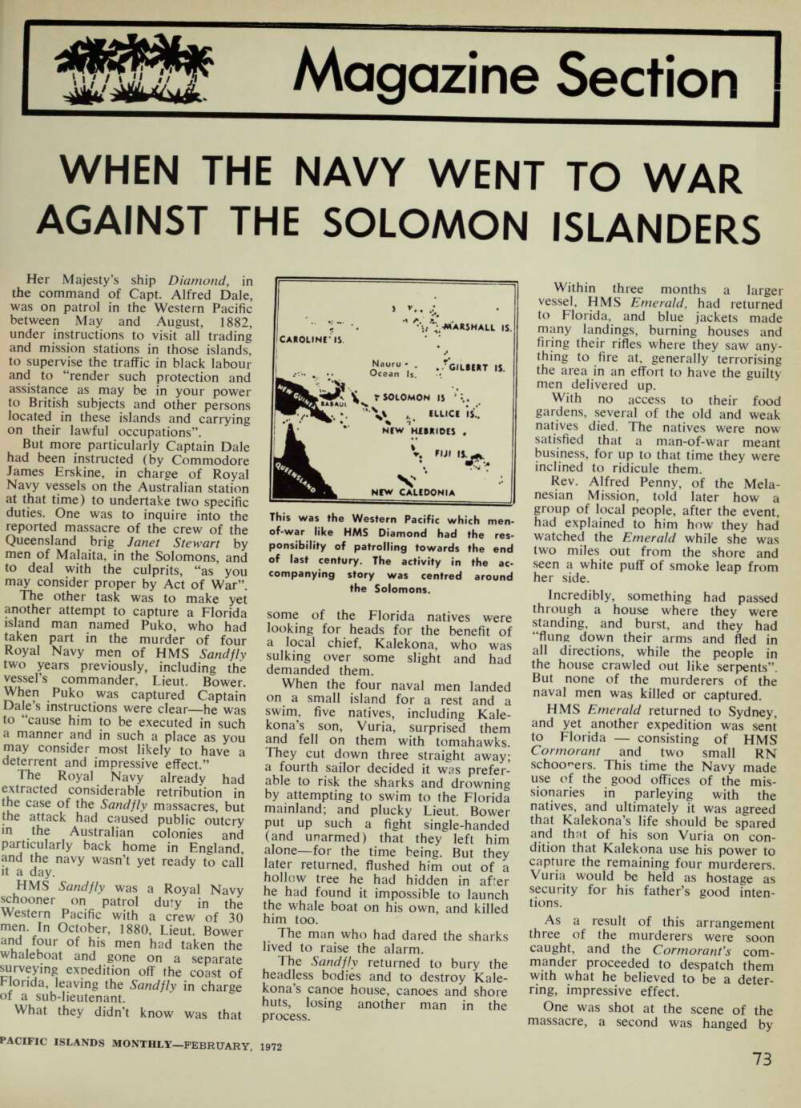
This was the Western Pacific which men of-war like HMS Diamond had the res ponsibility of patrolling towards the end of last century. The activity in the ac companying story was centred around the Solomons.
the local people under supervision of the Royal Navy, and the third was taken to another nearby island and shot there.
Puko alone was still at large.
So now, two years after the mas sacres, Captain Dale and yet another vessel, HMS Diamond, were on the scene in an effort to complete the task of retribution. Vuria was still being held hostage, at Ugi, elsewhere in the Solomons.
The massacre of the people on the Janet Stewart was a far more recent incident, and no investigation had yet been made into it.
News of this massacre had reached Sydney on May 2, 1882, a fortnight before Captain Dale had received his sailing orders. Captain S. Thomas of the Janet Stewart, together with the second mate, had just arrived at Mackay, Queensland, aboard the schooner Isabella, telling how he and
7 heard yells—the attack had begun '
the second mate had returned to the
ship from a recruiting expedition to
find that the Malaita natives had attacked the ship in their absence and killed all aboard except a seaman named Gustavus, who had hidden.
Those killed were the Government Agent aboard the recruiting vessel, a Mr. Lockhead, the chief mate, Mr. Penny, and four crew members.
The Malaita natives had then set fire to the 202 ton wooden brig after
plundering her.
The captain and the two other survivors had escaped in one of the ship’s boats and had made contact with a local trader. The incident had happened in February.
Captain Dale was an experienced officer, and in the Solomons he soon located the only survivor of those
who had been on the Janet Stewart when she was attacked—Gustavus— real name Gustave Germain, a Frenchman.
Germain gave the following story to Captain Dale in writing: “We had anchored in Quahquahroo Bay, Solomons, on February 9, 1882, for the purpose of obtaining labour.
We had 35 recruits on board, which we chiefly got at Port Adam. On the morning of the second day after our arrival the captain and second mate went away in two boats to get labour, leaving on board the first mate and the Government Agent who was sick, the cook, two seamen and one native boy, and myself.
“Soon after 7 o’clock the natives came off to the ship; they brought three recruits for which the mate paid them in trade tomahawks. Soon the ship was crowded with natives.
“I did not like the look of things and I tried to get a revolver from the mate, but he said he had only his own. I went then and had my break fast, but afterwards I went down into the forecastle to get something to defend myself with, as I felt sure the natives were intent on mischief.
“Whilst in the forecastle I heard yells, and then I knew the attack had begun, and I had seen that the mate and the Government Agent were un armed. Before I could get up the ladder two natives came down into the forecastle; they attacked a sick man there but I killed one with my knife; the other ran on deck. I tried to get the sick man to come with me into the chain lockers, but he would not. I remained in the chain lockers until the captain came aboard about 2 o’clock. The natives had left before he came, after killing every one, and had set the ship on fire forward.
“When I heard the captain I came out of my hiding-place. The captain gave orders to put the fire out. The wheel and everything was broken, and the rigging all cut.
“We got some biscuits, etc., and left the ship, and after we had shoved off a big fire broke out under the poop. I went into the captain’s cabin before leaving and I don’t think there was any fire there then. I left the captain and second mate in the cabin.
I heard the natives who attacked the ship speak broken English.”
Captain Dale reported to Com modore Erskine that Germain was “a most intelligent man” and that he thought reliance could be placed on his statement. On the strength of it,
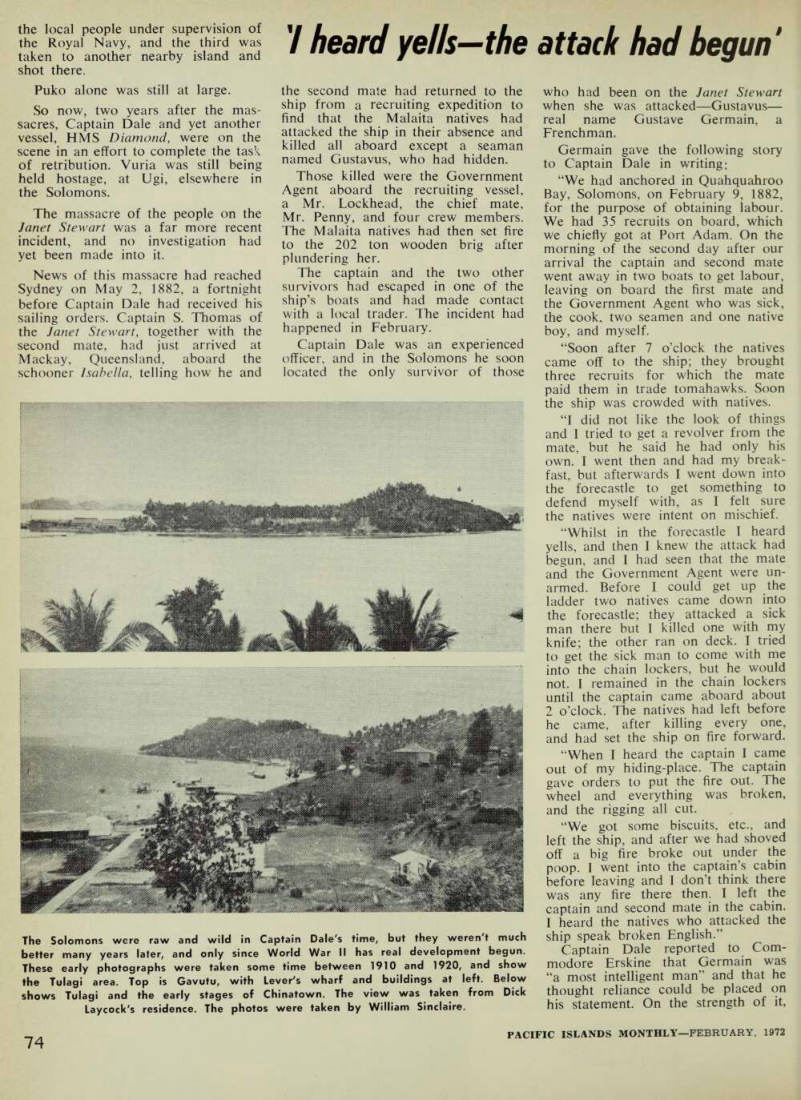
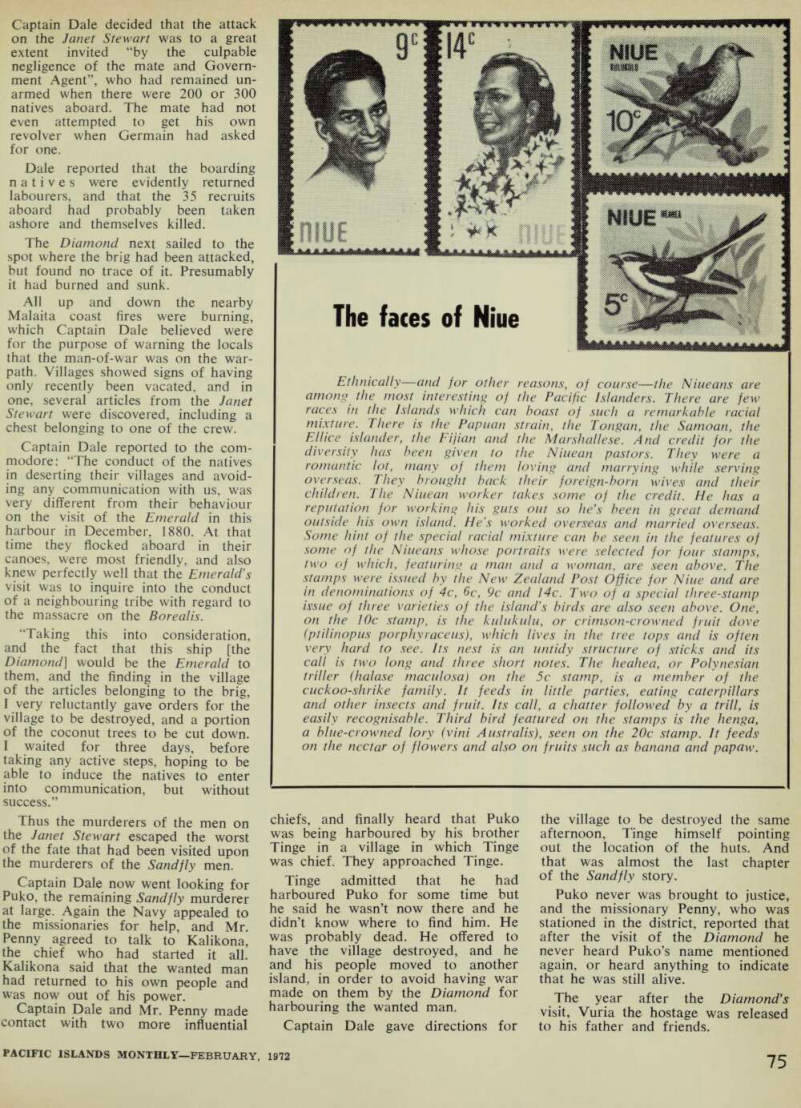
The Solomons were raw and wild in Captain Dale's time, but they weren't much better many years later, and only since World War II has real development begun.
These early photographs were taken some time between 1910 and 1920, and show the Tulagi area. Top is Gavutu, with Lever's wharf and buildings at left. Below shows Tulagi and the early stages of Chinatown. The view was taken from Dick Laycock's residence. The photos were taken by William Sinclaire.
Captain Dale decided that the attack on the Janet Stewart was to a great extent invited “by the culpable negligence of the mate and Govern ment Agent”, who had remained un armed when there were 200 or 300 natives aboard. The mate had not even attempted to get his own revolver when Germain had asked for one.
Dale reported that the boarding natives were evidently returned labourers, and that the 35 recruits aboard had probably been taken ashore and themselves killed.
The Diamond next sailed to the spot where the brig had been attacked, but found no trace of it. Presumably it had burned and sunk.
All up and down the nearby Malaita coast fires were burning, which Captain Dale believed were for the purpose of warning the locals that the man-of-war was on the war path. Villages showed signs of having only recently been vacated, and in one, several articles from the Janet Stewart were discovered, including a chest belonging to one of the crew.
Captain Dale reported to the com modore: “The conduct of the natives in deserting their villages and avoid ing any communication with us, was very different from their behaviour on the visit of the Emerald in this harbour in December, 1880. At that time they flocked aboard in their canoes, were most friendly, and also knew perfectly well that the Emerald’s visit was to inquire into the conduct of a neighbouring tribe with regard to the massacre on the Borealis.
“Taking this into consideration, and the fact that this ship [the Diamond ] would be the Emerald to them, and the finding in the village of the articles belonging to the brig, I very reluctantly gave orders for the village to be destroyed, and a portion of the coconut trees to be cut down.
I waited for three days, before taking any active steps, hoping to be able to induce the natives to enter into communication, but without success.”
Thus the murderers of the men on the Janet Stewart escaped the worst of the fate that had been visited upon the murderers of the Sandfly men.
Captain Dale now went looking for Puko, the remaining Sandfly murderer at large. Again the Navy appealed to the missionaries for help, and Mr.
Penny agreed to talk to Kalikona, the chief who had started it all.
Kalikona said that the wanted man had returned to his own people and was now out of his power.
Captain Dale and Mr, Penny made contact with two more influential
chiefs, and finally heard that Puko was being harboured by his brother Tinge in a village in which Tinge was chief. They approached Tinge.
Tinge admitted that he had harboured Puko for some time but he said he wasn’t now there and he didn’t know where to find him. He was probably dead. He offered to have the village destroyed, and he and his people moved to another island, in order to avoid having war made on them by the Diamond for harbouring the wanted man.
Captain Dale gave directions for
the village to be destroyed the same afternoon, Tinge himself pointing out the location of the huts. And that was almost the last chapter Sandfly story, Puko never was brought to justice, and the missionary Penny, who was stationed in the district, reported that after the visit of the Diamond he never heard Puko’s name mentioned again, or heard anything to indicate that he was still alive, Thc after (he v i s i t , Vuria the hostage was released to his father and friends.