Book Reviews
pp. 83-87 · Read in the full issue
How Red Ted Of Queensland
Became Emperor Of Fiji
“I think there could be payable gold in Guadalcanal. The indications were good enough to justify a bit of exploration. Our group ear-marked a big sum several years ago to cover a search. But you can tell your Solo mon Islands readers that it’s all off.
We had men and equipment ready to start the search. We cancelled the plans today.”
It was just after the war, and the speaker was E. G. Theodore, and I had gone to see him at the Daily Tele graph office in Sydney, at his request.
I was then editor/publisher of PIM.
This was the man who had told me in Fiji, just before Japan turned the Pacific Islands into a war zone, that he and his associates in Emperor Mines Ltd., intended to seek a new goldfield in the Solomons. He had assured me, when Pearl Harbour intervened, that they would go on with the enterprise when the war was over.
Now, in Sydney, I naturally wanted to know what had happened to cancel these plans. He seemed really upset.
I had known Theodore for many years, when he was Premier of Queensland and Commonwealth Treasurer and I was a newspaper reporter. He had been engaged many times in fiery political battles, when he was almost always cool and equable. Now he was not.
“That fool !” he exploded— and he named a member of the Brit ish Government.
As we all remember, Churchill took Britain into a general election as soon as the war was over and—to the great surprise of the world, and Churchill—the British Labour Party had received a mandate to govern.
The new British Government shed some of its red lustre as time went on, but in the beginning it was ready to nationalise everything, and that
included mining enterprises. One minister, whom Theodore described to me as a “bloody unimaginative Socialist” had announced new reg ulations which provided for mining companies in British territories like the Solomons a scale of taxation which would rob them of most of the rewards which lucky miners had a right to expect.
As the search for gold in Guadal canal would have been very much of a gamble, Theodore and his associates withdrew; with remarks which still burn brightly.
I recalled that incident of many years ago when the present PIM editor handed me, for review, a copy of Theodore His Life and Times, by Irwin Young, just published. I found the book intensely interesting, because I had known the man, and greatly admired his quality; but apart from that, it is a fascinating story of how a boy, humbly born in Aust ralia of Roumanian parents, fought his way unaided into the top ranks of Government and Big Business,
and into the records as a great Aust ralian.
Theodore began life as a labourer, carrying his swag between back blocks mine settlements. Somehow, he acquired education; became a trade union organiser; a Labour Party poli tician; and a member of the Queens land Parliament.
Thenceforward, Theodore’s career is a matter of history.
He entered parliament as an aca demic Socialist intensely conscious of the social injustices suffered by the poorer classes. His intellect and his strength of character carried him to the top echelon in State and Com monwealth governments, where he tried very hard to introduce a form of Socialism based on frank recog nition of the facts that men are not born with equal ability, and that there can be no worthwhile progress in human affairs unless government makes adequate provision for indivi dual freedom and enterprise.
Inevitably, Theodore came into
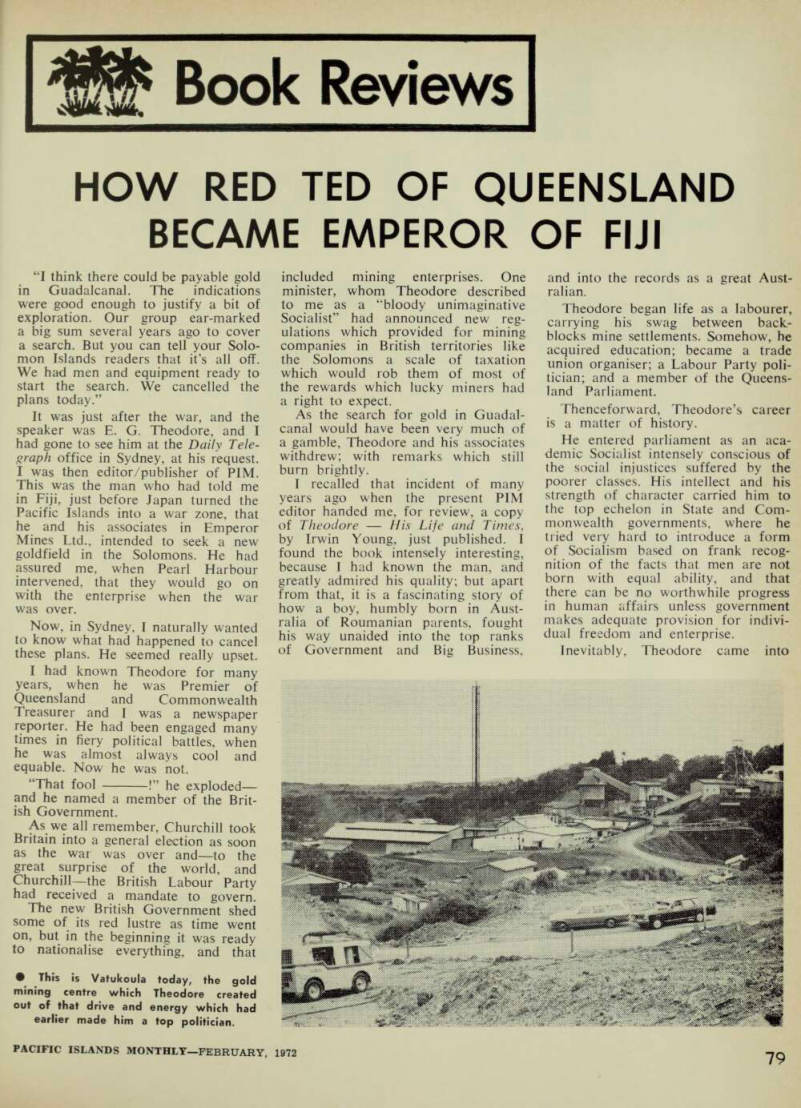
• This is Vatukoula today, the gold mining centre which Theodore created out of that drive and energy which had earlier made him a top politician.
conflict—as did other famous Aust ralian Labour leaders, like Holman, Lyons, and Hughes—with the class conscious, uncompromising Leftists of the Australian Labour Party.
From 1919 (when he became Queens land Premier at the age of 35) until 1932 (when he was forced out of the Commonwealth Treasureship, and Deputy Leadership, and his seat in parliament), he was engaged in pol itical battles in which he neither gave nor received any quarter.
The open contempt with which he treated the little men who yelped on his trail during his career in Canberra created a pack of Theodore-haters who never gave up: they screamed at the mention of his name even years later, when he had made a sensational success of the Emperor goldmines in Fiji, and when his dir ection and control of the Allied Works Council in World War II had earned him the grateful thanks of the Australian nation.
Fiji has reason to be very grateful to some of NSW’s most notorious Leftists—Ward, Lang, Bailey, Beazley and Garden because they were the backbone of the gang which ultimately drove Theodore out of Australian politics and into the establishment of the Fiji goldmin ing industry at Vatukoula.
It is an exciting story, that one of Fiji gold. Old Bill Borthwick, grub staked by Pat Costello, found the gold in the Tavua hills. It was De pression time, and gold then was very valuable, and many experts hastened to Fiji to look it over. But the tellu rite ores, from which the Borthwick prospects stemmed, were unknown to men familiar only with Australian and New Guinea goldfields, and they were unimpressed.
Somehow, Costello got word to John Wren, then a famous Melbourne financier; and Wren passed it over to his ex-politician friend Theodore, then playing with newspaper enter prises in Sydney.
Theodore went to Fiji; investigated; and then, backing his judgment against the almost unanimous thumbs down attitude of his associates (in cluding a reluctant John Wren) he went ahead and established the Emperor. Loloma and Dolphin mines.
Up to 1964, those three produced two million ounces of gold, worth SA6O million (the industry sickened after that, while the world’s gold price was held down. But the shackles are nearly off gold now, and Emperor mines should recover).
From 1932, until the Japanese in vaded the Pacific 10 years later, Theo dore spent an increasing amount of his time in Fiji, and became a prom inent citizen there a famous host at his residence, Vunikawi, 10 miles out of Suva, and at his huge bure at the mining town of Vatukoula.
He personally designed and super vised the building of this pretty little town, where he provided amen
ities of all kinds for the various racial communities engaged there.
Young’s book has many piquant stories of Theodore’s early experien ces in establishing Emperor mines.
Equipment and supplies were ship ped to Lautoka, thence on the CSR sugar-trains 35 miles to Tavua, thence carried or hauled over raw, unroaded country five miles to Vatukoula.
Supervising it, Theodore had regularly to swim a river, and he trained Fiji boys to swim with him, and carry his clothes on their heads.
He decided early to import a dynamo and diesel engine weighing many tons, and to bring in an Austra lian bullocky to take charge of the
waggon and bullock-team which, almost yard by yard, dragged the equipment over five miles to the mine.
Young says that this became a great popular attraction, the Fijians coming miles to listen to the Australian swearing at the bullocks.
They took in gelignite and deton ators, which they kept in a gal vanised iron shed, but Theodore and his son soon had to sleep in that store, to protect their property be cause the Fijians had discovered that the explosives were surprisingly ef fective in killing lagoon fish.
The book reveals how Theodore fought money interests in his early career so doughtily that they called him “Red Ted of Queensland”; how his political enemies in Sydney con spired with a Queensland gang to involve him in the Mungana Leases scandal, and—although he was cleared by courts and official inquiries —how that smear lay permanently upon his reputation; how he investi gated, and condemned, certain min ing prospects in Borneo.
This is a fascinating account of a poverty-to-riches career. There are many such in the South Pacific, but this is unique in showing how a great individualist, starting life as a convin ced Socialist, can be driven slowly into the opposite political camp by the sheer inability of the professional type of trade-union politician to understand politico-economic issues, and because of the readiness of the union bosses to drag down any one of their number who disclosed quali ties of leadership and independent thinking.
Theodore himself never made pub lic comment upon this aspect of his political career; but he said in a letter to Prime Minister Curtin about 1935 when they were trying to induce him to go back into politics: I have not lost faith in myself nor my belief in the soundness of the policy I have advocated, but my faith in the intelligence of the workers is sadly shaken. When I see a great mass of workers deifying the char latan Lang, and tolerating the egreg ious Garden, and allowing the Labour policy to be treated with contempt and contumely. I begin to lose hope.” — R. W. Robson.
(Theodore— His Life And Times. By
Irwin Young. Alpha Books, Sydney. $4.50).