Footnotes
pp. 56-57 · Read in the full issue
A soldier’s job is to kill people. A policeman’s job is to prevent people being killed. These are the tasks for which they are trained and which they carry out to the best of their ability.
They are not always successful, of course.
Our Papua New Guinea police were not success ful in preventing the killing of Jack Emanuel, but there is no reason to suppose that the sold iers would have done any better, though in earlier colonial days the government would, no doubt, have mounted a punitive expedition after the event and killed a lot of people who had had nothing to do with the murder.
Soldiers are not always successful either.
While good at killing people, it turns out with rather distressing frequency that they have killed the wrong people.
What appears to have in it the makings of a major political row has recently flared up in Papua New Guinea over the respective functions
of police and soldiers.
It began with the news that a deputation from the United Party had waited on the Minister for External Territories and the Minister for the Army in Can berra with a proposal that Aust ralian military personnel should be seconded to the Papua New Guinea police force to lead riot
squads.
It is, perhaps, not unduly cynical to suspect that this was
a political ploy which the United Party hoped would assist it in its current election campaign, in which, due to the rising tide of lawlessness in some parts of Papua New Guinea and par ticularly in the Highlands, law’n’order is a very live issue.
What is surprising is that to all appearances this party delegation was received in Canberra as if it Were a delegation from the government and people of Papua New Guinea.
It is true, of course, that the United Party hopes to become the government when the new House of Assembly convenes in April. It is not unreasonable to think that Australia’s Liberal- Country Party Government would like to see
Red Faces
When Red
Lights Blinked
the United Party become the government. But to jump the gun in this way seems going a bit far.
Anyway the ploy misfired. It was predictable that the Pangu Party would declare its opposi tion to the proposal. Michael Somare, the Party’s parliamentary leader, already returned unopposed to the West Sepik Regional seat, and Tony Voutas, now the party’s backroom boy, both
came out with hard-hitting state ments. They were joined by the Police Association, which not only declared its opposition to the proposal but went on to express its unease about the para-military functions which it is sometimes called upon to perform.
It suggested that a more for ward-looking plan than that advo cated by the United Party would be to send indigenous officers overseas for advanced training.
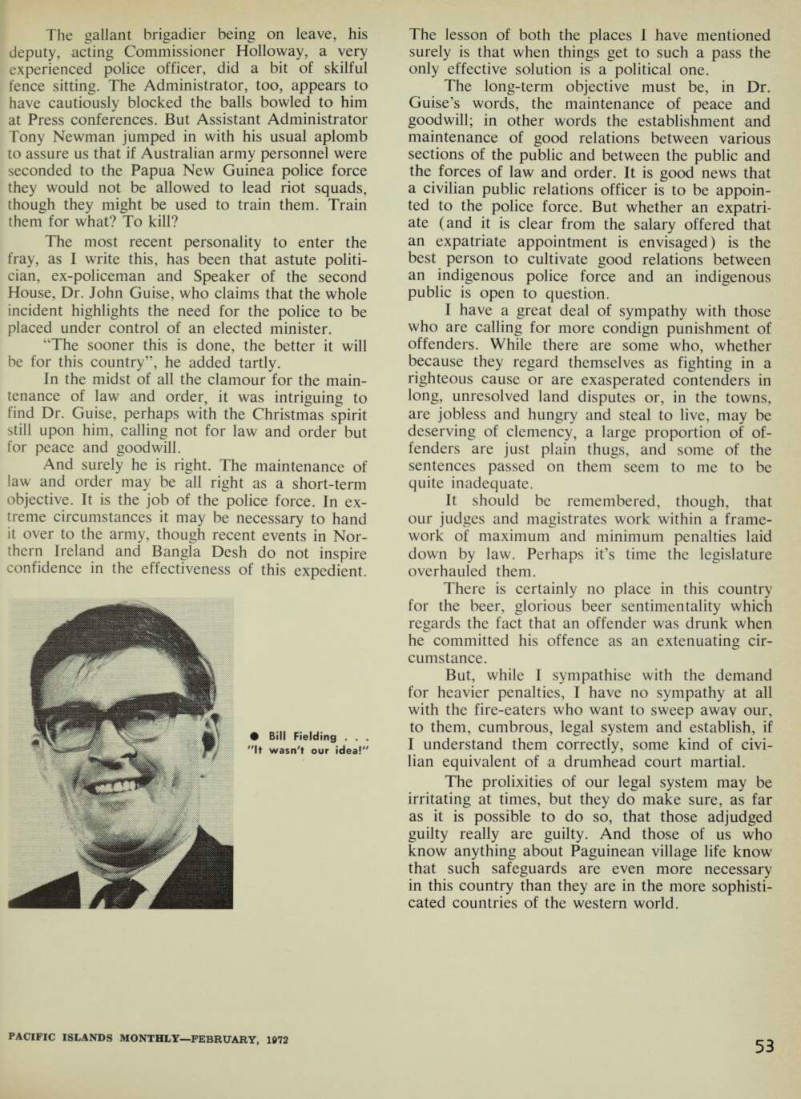
In the meantime, the United Party had app arently seen the red lights blinking. Bill Field ing, member for Northern Regional in the second House and now, for some reason best known to himself, standing for Central Regional, had been a member of the party’s deputation to Can berra.
He now, disarmingly if somewhat belatedly, explained that the proposal they had taken to Canberra had not originated from the United Party at all, but from Police Commissioner (and former Army Brigadier) Nicholls. He did not explain why the United Party had apparently been prepared to take the credit for it until it started to go sour.
With Percy Chatterton
in Port Moresby
The gallant brigadier being on leave, his deputy, acting Commissioner Holloway, a very experienced police officer, did a bit of skilful fence sitting. The Administrator, too, appears to have cautiously blocked the balls bowled to him at Press conferences. But Assistant Administrator Tony Newman jumped in with his usual aplomb to assure us that if Australian army personnel were seconded to the Papua New Guinea police force they would not be allowed to lead riot squads, though they might be used to train them. Train them for what? To kill?
The most recent personality to enter the fray, as I write this, has been that astute politi cian, ex-policeman and Speaker of the second House, Dr. John Guise, who claims that the whole incident highlights the need for the police to be placed under control of an elected minister.
“The sooner this is done, the better it will be for this country”, he added tartly.
In the midst of all the clamour for the main tenance of law and order, it was intriguing to find Dr. Guise, perhaps with the Christmas spirit still upon him, calling not for law and order but for peace and goodwill.
And surely he is right. The maintenance of law and order may be all right as a short-term objective. It is the job of the police force. In ex treme circumstances it may be necessary to hand it over to the army, though recent events in Nor thern Ireland and Bangla Desh do not inspire confidence in the effectiveness of this expedient.
The lesson of both the places I have mentioned surely is that when things get to such a pass the only effective solution is a political one.
The long-term objective must be, in Dr.
Guise’s words, the maintenance of peace and goodwill; in other words the establishment and maintenance of good relations between various sections of the public and between the public and the forces of law and order. It is good news that a civilian public relations officer is to be appoin ted to the police force. But whether an expatri ate (and it is clear from the salary offered that an expatriate appointment is envisaged) is the best person to cultivate good relations between an indigenous police force and an indigenous public is open to question.
I have a great deal of sympathy with those who are calling for more condign punishment of offenders. While there are some who, whether because they regard themselves as fighting in a righteous cause or are exasperated contenders in long, unresolved land disputes or, in the towns, are jobless and hungry and steal to live, may be deserving of clemency, a large proportion of of fenders are just plain thugs, and some of the sentences passed on them seem to me to be
quite inadequate.
It should be remembered, though, that our judges and magistrates work within a frame work of maximum and minimum penalties laid down by law. Perhaps it’s time the legislature overhauled them.
There is certainly no place in this country for the beer, glorious beer sentimentality which regards the fact that an offender was drunk when he committed his offence as an extenuating cir cumstance.
But, while I sympathise with the demand for heavier penalties, I have no sympathy at all with the fire-eaters who want to sweep away our, to them, cumbrous, legal system and establish, if I understand them correctly, some kind of civi lian equivalent of a drumhead court martial.
The prolixities of our legal system may be irritating at times, but they do make sure, as far as it is possible to do so, that those adjudged guilty really are guilty. And those of us who know anything about Paguinean village life know that such safeguards are even more necessary in this country than they are in the more sophisti cated countries of the western world.
• Bill Fielding . . .
"It wasn't our idea!"