Deep diver
pp. 58-59 · Read in the full issue
carves a bright future out of black coral
From a Suva correspondent
GERMAN-BORN Peter Frey did not make the headlines two years ago when he surfaced clutching a branch of black coral. However, he was probably the first to discover it grow ing in Fiji waters at depths below 150 ft.
The depth was important to Frey.
His belief, based on experience, was that the greater the depth at which black coral grew the less impurities he was likely to find. And, if this were true, it would more readily lend itself to be worked on.
“I took samples to Hawaii and Switzerland where I had them tested for quality and hardness”, said Frey (37), with his strong German accent.
“The tests proved that the coral found in deep water was particularly suitable for carving, and coral grow ing at depths from 60 to 150 ft was suitable for plain jewellery when polished.”
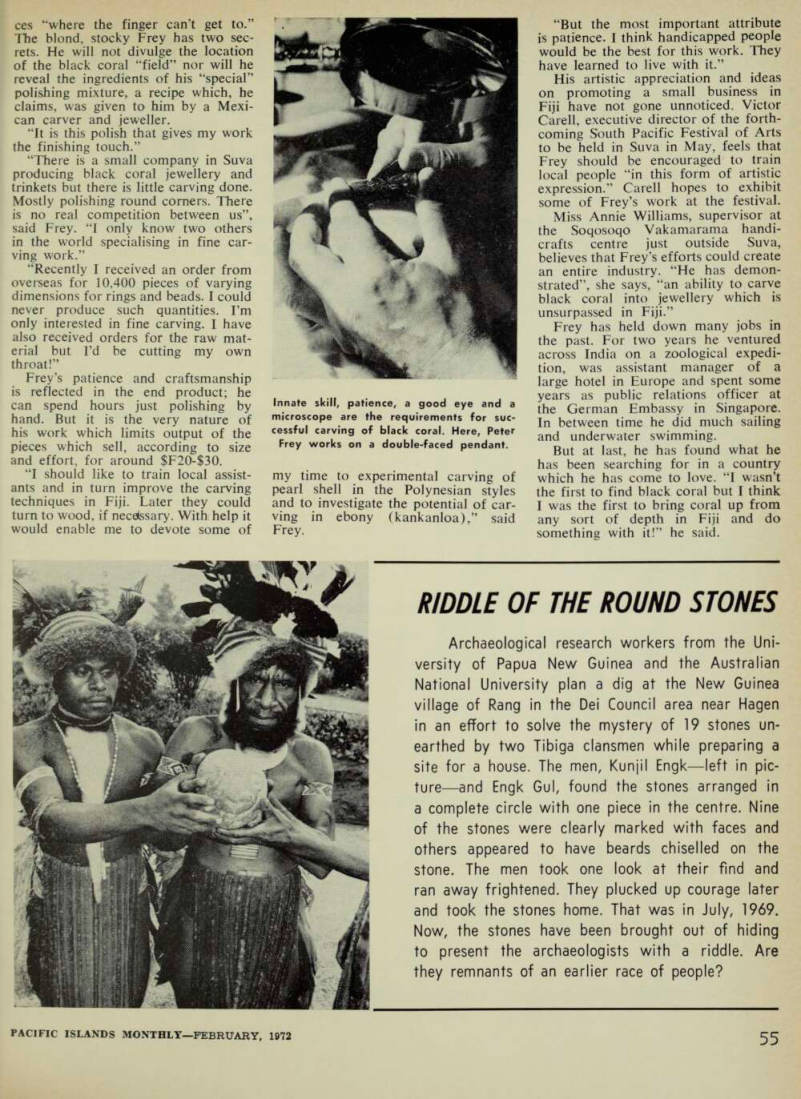
His deep-sea discovery was in suf ficient quantities to supply a small carving and jewellery industry. So, last year, he returned to Fiji to fur ther his experiments and to select the tools best suited to work on black coral which, in its raw state, has the appearance of petrified wood. His experiments proved successful and to day he is producing, without assist ance, finely-carved pendants, rings, earrings and matching pieces from his Waimanu Road flat in Suva. Few are more than two inches long and one pendant can take him two days to complete.
“The work is so fine I have to work with a large microscope”, said the much-travelled Frey. “It’s very demanding on the eyes and it is impossible to work for very long periods. I work for four hours and then go away for a swim. I may come back in a couple of hours and start again. Once, I carved for 16 hours without a long break but after that I couldn’t see properly for two days!”
“The most dangerous part is div ing for the coral but fortunately I can collect enough for a year’s work in a series of dives.”
Black coral, a species of Horn coral, has been used as jewellery for hundreds of years in the Middle and Far East where it is known as Black Ivory. More recently, the commercial production of jewellery began in Hawaii through the efforts of the Maui divers and today has become an important part of the tourist in dustry.
It is found in many parts of the world including the Red Sea, Persian Gulf, Philippines, Bahamas and New Zealand. There are over six species, says Frey, “but only one is suitable for my purpose.”
His carvings are based on authentic Polynesian and Melanesian designs although he admits there is little car ving done in Fiji to which he can refer.
“I spent a great deal of time dur ing my holidays in London studying
the arts of the South Pacific at the British Museum”, said Frey. His association with carving goes back to his childhood in Garmisch-Parten kirchen in Bavaria, an area renowned for the production of hand-carved violins, religious ornaments and fine woodwork.
“Since I can remember I have al ways been interested in carving. It was compulsory at school, although I graduated in engineering at Munich University.”
However, his work is not all car ving. The preparation of the black coral for carving can often be a lengthy and painful operation. “1 have to remove the outer surface and dry it at different stages to avoid cracking”, said Frey. “That can take a long time.”
In addition, he manufactures by hand the solid silver attachments and rings; the only machine used in the whole operation is a small electric polisher for cleaning the small crevi
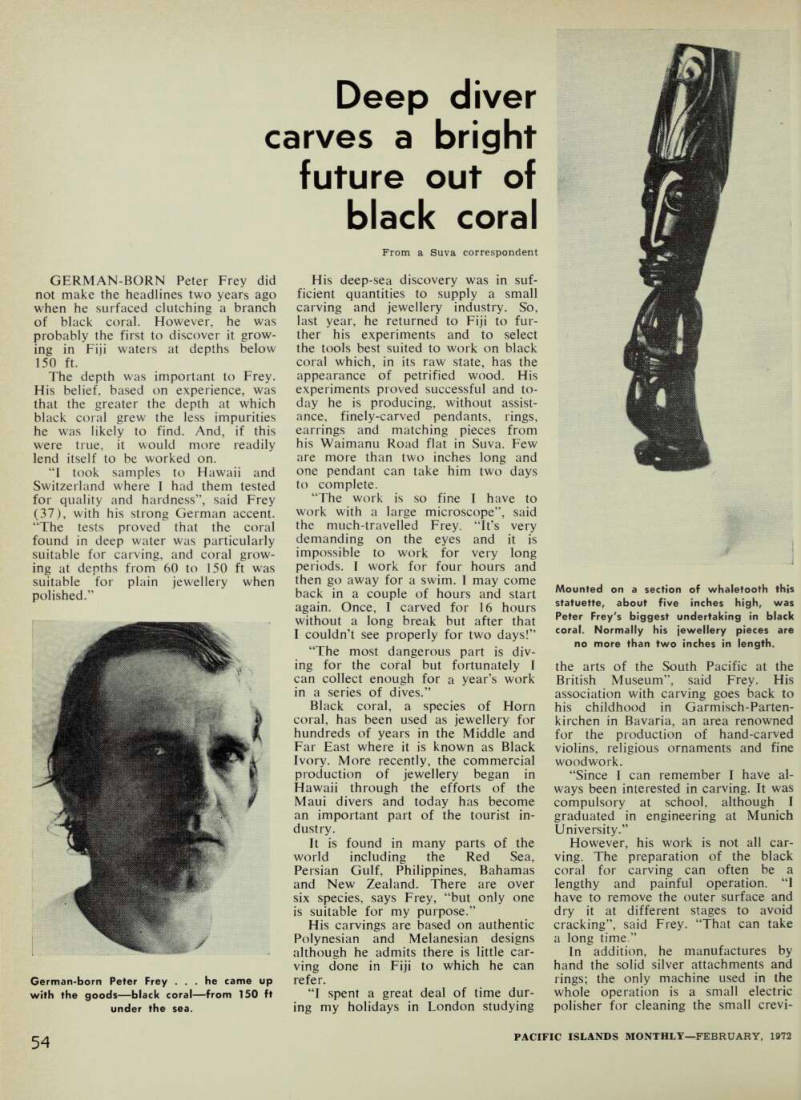
German-born Peter Frey ... he came up with the goods—black coral —from 150 ft under the sea.
Mounted on a section of whaletooth this statuette, about five inches high, was Peter Frey's biggest undertaking in black coral. Normally his jewellery pieces are no more than two inches in length.
ces “where the finger can’t get to.”
Tlie blond, stocky Frey has two sec rets. He will not divulge the location of the black coral “field” nor will he reveal the ingredients of his “special” polishing mixture, a recipe which, he claims, was given to him by a Mexi can carver and jeweller.
“It is this polish that gives my work the finishing touch.”
“There is a small company in Suva producing black coral jewellery and trinkets but there is little carving done.
Mostly polishing round comers. There is no real competition between us”, said Frey. “I only know two others in the world specialising in fine car ving work.”
“Recently I received an order from overseas for 10,400 pieces of varying dimensions for rings and beads. I could never produce such quantities. I’m only interested in fine carving. I have also received orders for the raw mat erial but I’d be cutting my own throat!”
Frey’s patience and craftsmanship is reflected in the end product; he can spend hours just polishing by hand. But it is the very nature of his work which limits output of the pieces which sell, according to size and effort, for around SF2O-$3O.
“I should like to train local assist ants and in turn improve the carving techniques in Fiji. Later they could turn to wood, if necetesary. With help it would enable me to devote some of
my time to experimental carving of pearl shell in the Polynesian styles and to investigate the potential of carving in ebony (kankanloa),” said Frey.
“But the most important attribute is patience. I think handicapped people would be the best for this work. They have learned to live with it.”
His artistic appreciation and ideas on promoting a small business in Fiji have not gone unnoticed. Victor Carell, executive director of the forth coming South Pacific Festival of Arts to be held in Suva in May, feels that Frey should be encouraged to train local people “in this form of artistic expression.” Carell hopes to exhibit some of Frey’s work at the festival.
Miss Annie Williams, supervisor at the Soqosoqo Vakamarama handi crafts centre just outside Suva, believes that Frey’s efforts could create an entire industry. “He has demon strated”, she says, “an ability to carve black coral into jewellery which is unsurpassed in Fiji.”
Frey has held down many jobs in the past. For two years he ventured across India on a zoological expedi tion, was assistant manager of a large hotel in Europe and spent some years as public relations officer at the German Embassy in Singapore.
In between time he did much sailing and underwater swimming.
But at last, he has found what he has been searching for in a country which he has come to love. “I wasn’t the first to find black coral but I think I was the first to bring coral up from any sort of depth in Fiji and do something with it!” he said.
Innate skill, patience, a good eye and a microscope are the requirements for suc cessful carving of black coral. Here, Peter Frey works on a double-faced pendant.