Distance Lends Disenchantment To
pp. 53-55 · Read in the full issue

The Islands' Sporting Scene
By MIKE HOHENSEE, former editor of the Fiji monthly, “Fiji Sport”.
It is not easy keeping abreast of the developments and individual achievements on the sporting front in the South Pacific. Although there are those who are capable of apprais ing their own particular sport, an authoritative, overall picture is hard to come by. This is possibly because of the lack of contact between Island sporting associations.
Each time a South Pacific Games comes to a close an important link is broken.
Last year, after nearly two weeks of competition in Tahiti, over 1,000 competitors and officials went their own way. They may not come to gether again for four years—at the next Games in Guam in 1975.
This causes problems, as I will de scribe later.
One sport at least is trying to bridge the gap. The territories which took part in the swimming events at the last Games agreed at the technical meeting held in Papeete that they will keep in touch by circulating the results of their annual champion ships.
In this way every member territory will be able to keep up to date on the performances of their rivals and in addition, determine what sort of op position they can expect in inter national competition.
In theory this seems a good scheme; potential medal winners will know approximately what thev must do to be m the running at forthcoming meetings. But it could be argued that many territories could be frightened away from the Games on receiving some of the result sheets sent out by Papua New Guinea and New Cale donia. These two dominated the swimming events at the Tahiti Games to such an extent that it wasn’t funny.
Papua New Guinea won the 10
gold medals in the men’s events, and broke nine records as they did so, and New Caledonia won all but one of the gold medals available in the women’s section.
It would not necessarily be a bad thing for all the territories to be fully aware of what they were up against for too many, I feel sure, go to the Games almost oblivious of inter national standards. By studying the performances of the top-class swim mers, (and this could apply to athle tics and other sports), the weaker territories could prune quite consid erably the numbers they send to the Games.
The pruning should not be too drastic. There is always room for the young and inexperienced in inter national sport. The Games afford them the only opportunity to witness top athletes in action.
Anyone who is anyone in sport has agreed that the Games inspire good, clean competition and that they are an excellent way of bringing the peoples of the South Pacific together in one arena. They have, however, a
disturbing side-effect.
When the Games’ flag is lowered and the symbolic flames are no more, it is the signal for many competitors to sit back and gaze wondrously at
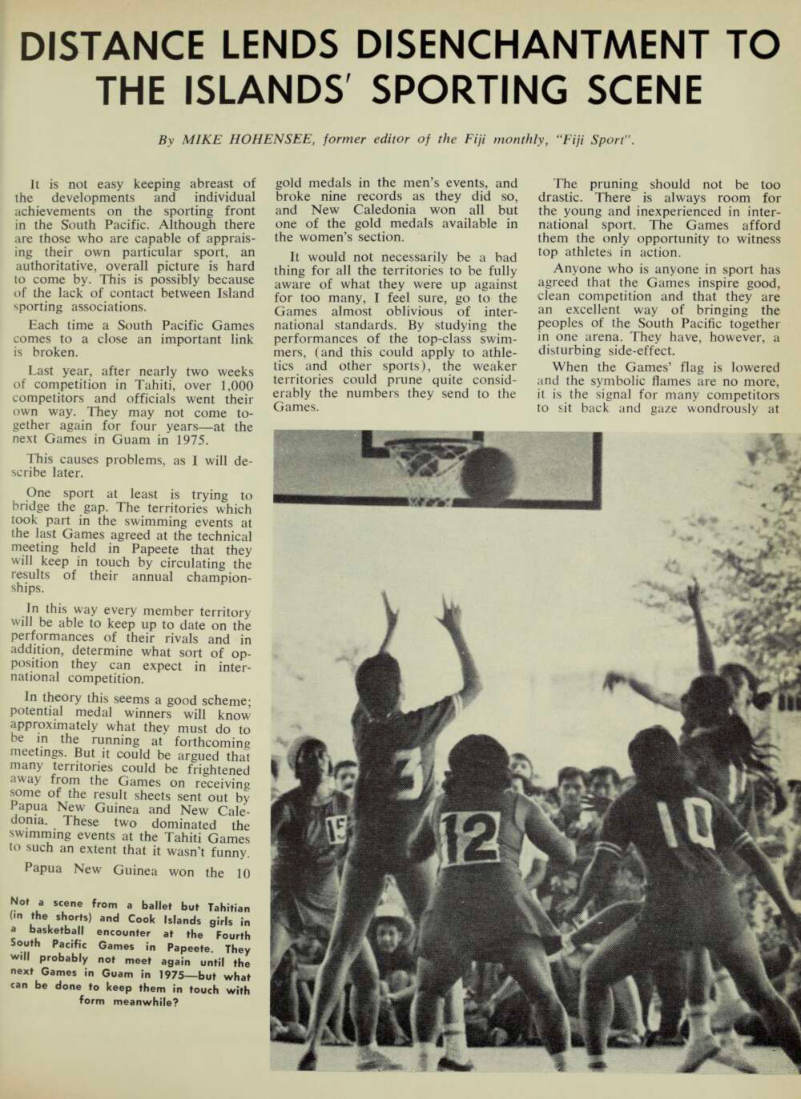
Not a scene from a ballet but Tahitian (in the shorts) and Cook Islands girls in a basketball encounter at the Fourth South Pacific Games in Papeete. They Will probably not meet again until the next Games in Guam in 1975—but what can be done to keep them in touch with form meanwhile?
Islands' sporting scene
their medals—if they were lucky enough, or of sufficient ability, to have won any. And, in many instances it is many, many months before they become mobile again!
Often, dedication to training is only apparent a season before the Games and it is no secret that the aim of some athletes is to do sufficient to acquire a seat on the plane going to the Games rather than battle for rec ognition. To some, the Games and their location are the attractions, not what can be achieved by competing in them.
Fortunately, this outlook does not apply to the vast majority but there is little doubt, especially on the athle tic field, that interest takes a dive immediately after the Games have ended. On that basis, we can possibly expect poor performances for a couple of years yet!
The Fiji Amateur Athletic Asso ciation earlier this year had great difficulty getting its new season under way. Few athletes of any stand ard turned out for competition at Suva’s Buckhurst Park and weeks after the official start to the season not one woman had registered. And without registration they cannot com pete.
Footnote: The swimming frater nity have gone one step further in their attempt to bring the islands to gether. New Caledonia has suggested that an inter-regional meet be held in Fiji in 1973 and that New Zealand and Australia be invited to take part also. ☆ ☆ ☆ I was studying the merits of the entries for the New South Wales Open tennis championships which were held at Sydney’s White City stadium in January when my gaze stopped at player number nine. The name was Wanaro N’Godrella, who at the South Pacific Games last year literally strol led through the opposition to win three individual gold medals: the singles, the doubles and the mixed doubles.
At that time, I said somewhere that his inclusion in the New Cale donian Games team did not achieve very much for tennis. He certainly hadn’t a chance to improve his stand ard of play and his opponents were lucky if they could get their racquets to the ball let alone master N’God rella s use of topspin. In winning his three medals he lost 24 games only. « He was in a different league at White City and he was representing France where, it appears, he plays
most of his tennis. In the singles he was put out in the second round by N. Giltinan of New South Wales, 6-4, 7-6, 6-4. Partnered with country man Meyer, he went out of the doubles in the secound round also, to Bartlett and Ball. ☆ ☆ ☆ This year the Papua-New Guinea Amateur Golf Association will hold its annual championships at the 18hole Lae course over the Easter holiday. Originally planned for Port Moresby the venue had to be switched because of alterations being carried out there.
As in recent years the men’s championships will be held over 54 holes and the women’s over 36. The men’s title should be a foregone con clusion if South Pacific Games gold medallist John Wilkinson is around.
He could only expect serious opposi tion from Games silver medallist and team-mate, Philip Frame. ☆ ☆ ☆ Samu Yavala, one of Fiji’s top track athletes, thought all his troubles were over when he was awarded an athletic scholarship at the Eastern New Mexico University in the United States. He would be able to train alongside and compete against some of the world’s best in preparation for an assault on the Olympic 400-metre event in Munich in August.
But in January he was faced with another problem. Where was he going to get SFSOO for his air fare to the States? He turned to the Fiji Govern ment without success. They had al ready doled out $F 12,000 to get the Fiji contingent to Tahiti.
It looked as though the South Pacific Games 400-metre record hold er would be a non-starter in the race against time. He had less than two weeks to raise the money for he was required to report to the university, which had granted him a four-year scholarship, before January 10.
At this point Fiji’s daily newspaper.
The Fiji Times, stepped in. It laun ched a public appeal, and Yavala was off!
Like Yavala, Seru Gukilau, Fiji’s number one hurdler, has had to go overseas to find competition. In an effort to improve his times Gukilau left for New Zealand last month for three months to train under former Fiji coach Mike D’Ath.
Both Yavala and Gukilau had run out of challengers. Yavala was the fastest man in Fiji from 100 to 800 metres and Gukilau was the all comers record holder for the 110 and 400 metres hurdles. In Tahiti Gukilau (23) and Yavala (23) were members of the gold medal winning 4 x 400 metres relay team.