fiji talanoa
pp. 50-51 · Read in the full issue
With Sue Wendt, In Suva
"When I get home," declared the visiting Melbourne businessman, "I'm going to write an article for anyone who'll print it. It'll be called 'The Rape o? the Fijian People'!"
It's not unusual to hear "instant ex perts" declaiming about social injustices in Fiji, but few visitors wax as adamant about the doom of the Fijians as the eloquent gent I met during a recent cruise through the Yasawas.
Although it was, doubtless, pre sumptuous of him to comment after only two weeks in the country, he said, he was convinced that a great crime was being perpetrated against the Fijian people.
"Fijians have a dreamlike purity . . . never in my life have I seen people who walk so tall, with so much natural pride.
But they are being pushed towards their own destruction in the name of progress," he asserted.
Head of a large Melbourne manufac turing firm, he was too much enmeshed in the rat race to even consider opting out himself, he said—and yes, living without sewerage or water supplies or medical attention might indeed prove a hardship. Nevertheless, he lamented the fact that Fijians were being forced into the kind of cash-orientated "progressive" society he deplored—and gloomily pre dicted the demise of what he called the "uncomplicated warmth of the Fijian character." It was spurious to talk about the benefits of education and economic development, he insisted, when Fijians already had the kind of simple, pressure free life the whole of mankind yearned after. "It's heartbreaking to see it being destroyed!"
Worst of all, he felt, were the big land developments —and he'd seen evidence of the corrupting effects of such projects when he visited a village near The Fijian hotel.
"The people said they wanted to see the law changed, so they'd be free to sell their land if they chose. They thought some big investor might be interested in buying the village—then they could move elsewhere and live in comfort. I told
them—they asked my opinion—that it would be a disaster for them," he said.
Newcomers might be forgiven for mourning the passing of an era they envisage as a far, better one than this.
However, their "preserve the happy natives" philosophy has become —in today's Fiji—more offensive than they realise. The sentiment has been expressed before, but Fijians are not exhibits in a zoo, to be preserved in natural state so that visitors may observe a Utopia un trammelled by money, comforts, cars, modern housing and similar scourges. The turning point is long past and to avoid being pushed towards destruction, Fijians are equipping themselves with the means for survival.
Latest example of Fijian initiative is the formation of the Naitasiri Indepen dence Development Company, by the people of one of Fiji's largest provinces.
With a board of 20 directors, who are chiefs of the province and members of the Naitasiri Provincial Council, the com pany has some big plans. They include finding new outlets for the province's timber resources and establishing at least 200 farmers on individual beef-ranching lots of about 100 acres each. A long term aim is to establish a butchery, to supply meat direct to the consumer.
Resourcefulness of another kind is evinced by the policies of the small but
potentially-interesting Fijian Independent
Party. Party president Mr. Viliame Savu, ex-Suva councillor, has announced that the party platform for the coming general election will be based on the highly con tentious land issue. The party has declared that it wants "the immediate return of all Crown and freehold lands in Fiji to the rightful native owners—with the present holders being given priority by the native owners to lease."
Cornerstone of the party's philosophy is that Fijians alone "should decide the destiny of their lands."
The FIP will also seek an increase in Fijian representation in the House of Representatives from 22 to 32 seats; the replacement of the present Governor- General by a Fijian as soon as possible
and retention of the present citizenship provisions of the Constitution.
While the party's influence and support is as yet unproved, its platform could be popular with those who adhere to the "Fiji for the Fijians" school of thought.
Party president Mr. Savu said the FIR would be contesting national seats in the general election because its policies also had the support of "a lot of Indians, some Europeans, part-Europeans and Chinese."
Although it's hardly true that Fiji is yet in the grip of pre-election fever (the election is scheduled for April), interest is on the upsurge. The governing Alliance Party has endorsed candidates for 48 of the 52 seats in the House of Representa tives. Although the Alliance is not really expected to lose, this first post-indepen dence election could see a strong swing towards the National Federation Party, particularly among young Fijians. The Opposition Party in January was con ducting its pre-election publicity along cautious lines, but Leader Mr. S. M. Koya warned the Alliance that it was in for some real surprises when the NFP dis closed its election platform in February.
The party —once exclusively Indian— would sponsor European candidates for the general electors' seats, in addition to Indians and Fijians, Mr. Koya said.
The NFP leader, whose public image these days is that he is the most reason able and approachable of men, said he was duty-bound to point out that the party was dedicated to the continuance of parliamentary institutions, the rule of law and for the continuance of a multi racial society in Fiji. Parliamentary institutions, he declared, could be main tained only as long as people were pre pared to tolerate each other's political views and were prepared to disagree without rancour and accept election results as reasonable and law-abiding citizens.
All very sensible and reassuring. Could it be that the mud-slinging and hot tempers of previous elections will be con spicuous by their absence —on both sides?
Seems a bit too much to expect . . .
Meanwhile, from the "plans for 1972" department, comes news of a $1 million Honolulu-style International Market Place to be built near Nadi Airport. Managing director of the company behind the pro ject is controversial real estate man Mr.
Chick Jonnick, who after long delay has been granted a three-year permit to live and work in Fiji. He heads the recently formed International Market Place (Fiji) Ltd. Another of Mr. Jonnick's companies, General Investments Corporation, which has an office at Nadi, was involved in plans for a 250-acre commercial and residential subdivision at Savusavu, on Vanua Levu. Little has been heard on that front since the government rejected original plans for the sub-division on the grounds that it didn't conform to required
development standards.
The market place project looks more promising and has attracted the support of some of Fiji's most astute businessmen.
Government has given its approval in principle and final plans, prepared by Sydney architect Douglas B. Snelling, are to be submitted within the next month or two. The plans encompass 70 retail outlets, including 16 food shops (hot dogs, pizzas, ice-cream parlours, take-away Mexican and Chinese meals, etc.); an 8,000 sq. ft nightclub and restaurant; a 4,000 sq. ft steak and lobster house; a teahouse surrounded by land scaped garden and an open-air theatre for the staging of local and overseas entertainment.
The feasibility study was prepared by Sydney hotel and restaurant consultant, Mr. Renzo Romano, who plans to take over management of at least one of the fwo big restaurants—and possibly both,
he says.
According to one director, former Nadi
Town Clerk Mr. P. D. Jogia, "One of our aims is to have only the most reputable businessmen operating shops in the centre. The prices will be fixed, at a duty-free level. We're hoping this will eliminate a very unpleasant trend now obvious at Nadi—that of shopkeepers touting in the streets for business, telling tourists they could have bought a parti cular article more cheaply. This sort of thing is leaving visitors with a very bad feeling about Fiji."
Other disturbing trends in Fiji tourism came under fire in January—and none too soon. A dangerous complacency is growing in several spheres—and one or two hoteliers are almost arrogant in their disregard for visitor complaints.
Overcharging by taxis is not uncommon, the food in some hotels hasn't improved in two years; and neither has the service.
And more and more complaints are being heard about theft from hotel rooms.
Spearheading the recent attack was outspoken general manager of the Fiji Visitors Bureau, Mr. Rory Scott, a man never afraid to call a spade a spade and one whose criticisms are always both valid and constructive. While he did not suggest that the general level of tourism service was poor in Fiji, he said, there was evidence of an increasingly slipshod attitude in certain sectors of the industry and in certain organisations. Complaints from visitors were more numerous than he could ever recall. They were prompted by such occurrences as coach transport breakdowns and loss of luggage, hotels discounting travellers' cheques by as much as 14 per cent., hotels running out of food for guests at critical periods and vouchers issued to visitors not being honoured.
Touting in the markets and in the streets was another activity which annoyed visitors—and publicity had been given recently to hijacking and overcharging by taxis. People immediately concerned with tourism should ask themselves whether they were to blame for exploitation or lowering of standards, Mr. Scott warned.
His remarks were endorsed a few days later by Travelodge International executive Mr. B. L. Manfred, in Fiji to announce the appointment of Mr. Colin Thompson, formerly Fiji manager for the hotel chain, to the job of manager, Victoria. (He is succeeded by Mr. Ken Oates, formerly manager of Suva Travelodge).
While agreeing with Mr. Scott's com ments, Mr. Manfred added that the fact that Fiji's tourist industry was going through a period of self-criticism was in itself a healthy sign. Travelodge was showing its faith in the dominion by going ahead with plans for its fifth and largest hotel, to be built on Navo Island, off the Coral Coast. Mr. Manfred said there were also plans to add extra ac commodation to both Nadi and Suva Travelodges.
Accusations of "hijacking" of visitors by taxi drivers brought energetic denials from taxi unions in Suva and Nadi, with union officials objecting strongly to the term hijack—" This is not Cuba"—and declaring that taxi owners had not received a single complaint. The union rejected allegations that drivers had been taking visitors to hotels other than those they requested and that they had been accepting commissions from duty-free dealers. The recent publicity, they claimed, was in fact a dastardly plot "by hoteliers and the like to break the union, wreck the taxi industry and introduce more rental cars."
Visitors to Fiji sometimes exhibit a not very-endearing naivety which can make them seem unintentionally patronising.
The locals, however, are getting pretty good at giving tit for tat.
Take the recent performance in Suva of an enthusiastic singing group from the States, the New Oregon Singers. Employ ing that frequently humiliating gimmick of dragging unsuspecting members of the audience on stage for an interview, the group's ebullient leader found him self confronted with a handsome Fijian in a sulu.
Having commented on the "unusual costume", the visitor then remarked that his victim seemed very intelligent . . . and trotted out that old chestnut "you speak such good English—where did you learn?"
The reply came without hesitation; "Well sir, at school. English is of course a very difficult language . . . Fijian is much easier. I could speak that when I was three years old!"
A nicely subtle send-up indeed!
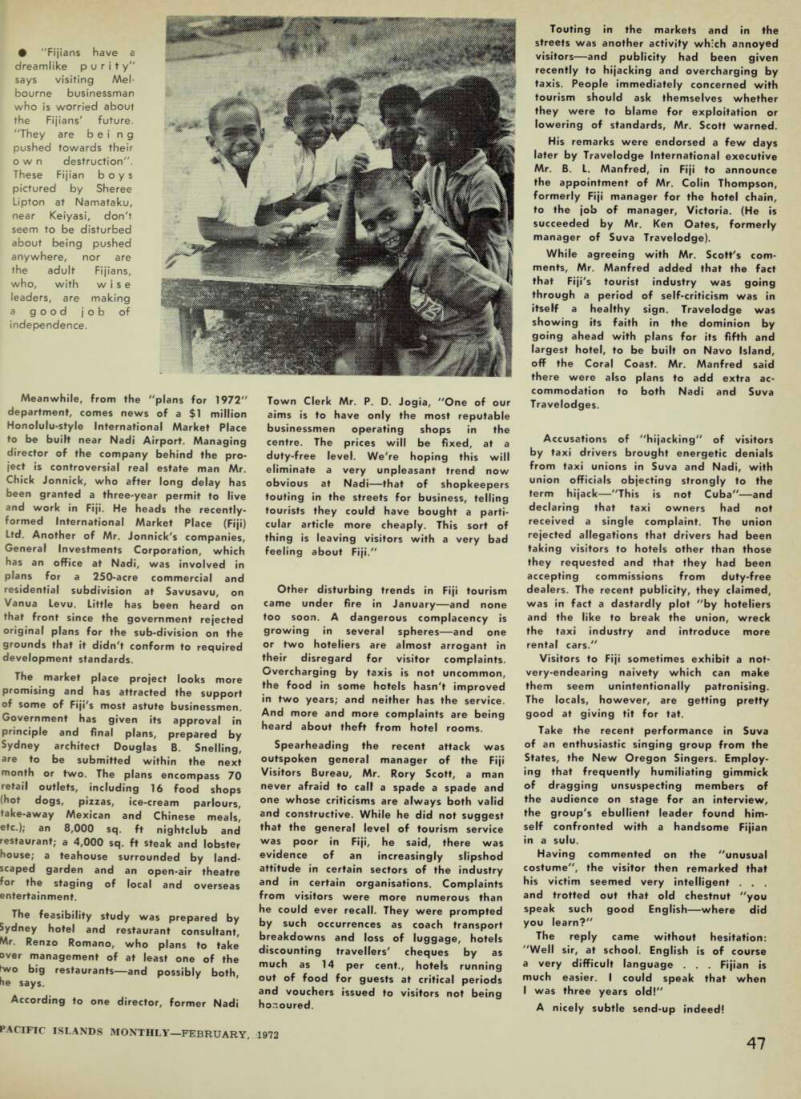
• "Fijians have a dreamlike purity" says visiting Mel bourne businessman who is worried about the Fijians' future.
"They are being pushed towards their own destruction".
These Fijian boys pictured by Sheree Lipton at Namataku, near Keiyasi, don't seem to be disturbed about being pushed anywhere, nor are the adult Fijians, who, with wise leaders, are making a good job of independence.