Tahiti
pp. 48-49 · Read in the full issue
Letter
From James Boyack
The local Territorial Assembly vaulted into this election year with a flourish of activity that climaxed in a controversial vote on the 1972 budget of CFP3.862 billion (about 5A35.7 million).
The budget packed a volume as thick as a small city’s telephone directory, but the counsellors approved the entire package in less than seven hours—a record.
They did have to sit on their hands 24 hours before setting this record. The minority group walked out of the initial budget session to protest alleged electioneering.
There were two long plenary sessions in the weeks preceding discussion of the budget. These produced a spate of 25 resolutions. Many of them were tinged with the odour of the “pork-barrel”. Others were politically controversial. The 1972 election campaign had begun. This charge came from all quarters. The windy plenary sessions were a prelude to the budget showdown on who was playing politics.
Budgetary debate began calmly enough. CAFES Financial Commission reporters Yannick Amaru and Daniel Millaud reviewed the budget’s character and aims. They noted, as had the governor when he forwarded the budget to the assembly for approval, that social services (health, welfare and youth-oriented projects) were to be accented in 1972 much as services related to production were favoured in 1971. The reporters regretted that a “very evident” slowdown in the territory’s economic expansion ruled out additions to original propositions. The expected 6 per cent, increase in receipts from import duties and related indirect taxes would be the product of higher prices worldwide and not increased prosperity. They mourned that again the lion’s share of revenue would underwrite public services rather than go for infrastructural im provement. They happily confirmed that there would be no new or increased taxes.
Strangely enough, Article 1, Chapter 1 of the budget referred to a new tax voted the previous week. This tax bill was the most controversial of the 25 that flowed into newspaper headlines during pre-budget sessions.
It would take 2 per cent, of all funds exported from the territory. Exempt would be commercial transfers and those made by beneficiaries of the Investment Code (which, among other things, liberates profits for foreign exchange).
The sponsors of the bill reasoned that those who get
rich here, but bank elsewhere, would, with such a tax, contribute to the territory’s development. Particular offenders were not singled out, but the bill was evidently aimed at metropolitan functionaries, military and scientific personnel, and at transient entrepreneurs and other businessmen with overseas interests.
The administration had declared the bill illegal prior to passage. The transfer of funds within the franc zone was unrestricted, it recalled, and foreign exchange con trol was a prerogative only of the French Government.
In passing, it also noted that much of the money to be so taxed was shipped in from France and could, with out interference from the Territorial Assembly, be shipped back.
Sponsor Henri Bouvier took the budgetary session as an occasion to withdraw the bill. Its presence in the budget would give the administration a fool-proof excuse to block the release of 1972 funds. Discussion of this thorny matter reminded minority delegates of their exclusion from budget decisions. The autonomist majority, exclusive members of the Financial Commis sion, was entirely responsible for the budget’s wording.
The Gaullist Mayor of Pirae, Gaston Flosse, blurted out that the majority had written “an electoral budget”.
He said it was “a sprinkling of little operations to please this district, that island and that valley”. He reminded Assembly President John Teariki of the autonomist’s own plea that electoral considerations should not influence budget discussions.
This comment, and several others by the minority, were ignored by the floor. Flosse, by now fuming, again interjected, “What? We don’t even have the right to ex press our opinion . . . and I even heard one of the budget reporters (Amaru) say, ‘He’s a pain in the ass’ (// nous emmerde )”. When the floor shrugged aside even this outburst, Flosse demanded that the session be suspended.
The minority left the hall to confer.
When it returned, Frantz Vanizette spoke: “This preliminary discussion, the resolutions of the past days . . . everything pursuades us this is an electoral budget and as such a budget of the majority. In addition, this vote is being taken without regard to our comments.
Since we can’t make ourselves heard, since it’s a majority budget, you can vote it without us. Make your own propaganda and don’t use us as witnesses or ac complices.”
President Teariki, a demure man, replied that for the first time in memory, a majority had, in fact, granted minority requests for specific projects in the islands.
This interesting fact was the final straw for Mr.
Flosse. He viewed it as indisputable proof that the budget was electoral. He led his colleagues out of the door. The session had to be postponed until the next day when it did not matter whether there was a quorum or not.
Many of the minority members had second thoughts about their boycott the next day. They dutifully took their places for the final vote. Had they not put in an appearance, there was every likelihood that money allotted to their constituencies by the CAFES would, during the vote, be transferred to majority projects.
Nothing is more fatal to a politician, especially one who represents distant, poor islands, than a failure to bring home the bacon.
The perfunctory budget vote came alive only during debate about funds controversially withheld by the Financial Commission.
The Tahiti Tourist Development Board was allocated CFP3O million less than it had requested, and Tahiti’s participation in the South Pacific Arts Festival was squelched when CFPS.3 million necessary for this was vetoed.
The governor himself (actually the acting governor, Secretary-General Jean Tissier) ventured into the lion’s den to do battle for the extra TTDB resources. He offered a personal defence of no other portion of the budget.
As its name indicates, the TTDB is the government branch responsible for the development of tourism in these islands. Its difficult and delicate mission is to nurture Tahiti’s first real industry, to build to maturity the territory’s first authentic basis for self-support (it should be mentioned here that fishing, exploitation of the ocean and lagoons is a priority of equal importance for many local observers, and the 1972 budget generously provided for efforts in this domain at local and South Pacific Commission levels).
The TTDB asked the assembly for more than CFP9O million in 1972. (Its overall budget, one that includes loans and other revenue, is about 135 million).
The legislature offered 71 million. This difference of millions sparked the day’s major debate. It demonstrated the disregard, even disdain many of the assemblymen harbour for tourism.
Acting Governor Tissier vigorously defended the TTDB’s request for additional funds. He said the amount was indispensable to the CFP4O million market ing budget. To withhold it, he said, would be to limit funds for advertising, publications, research, public relations and other promotional efforts. It would also force the board to cut back its staff.
Tissier implored the assembly to find at least 10 of the desired 30 million.
The counsellors were not impressed. Some were incensed. Henri Bouvier defended the assembly’s stand.
He said that the TTDB got along with a restricted budget in 1971 (65.5 million) and that more money could be offered now only to the territory’s detriment, particularly in the domain of infrastructural improve ment.
Moreover, he said, “the TTDB’s funds go, in large part, to promotion outside Tahiti. To what end? To fill the big hotels, those owned by PanAm and UTA The more the territory spends, the less those inter national trusts have to lay out. They came here with promises to support tourism, but they have been acting more like procurers. We don’t need pimps! . . They came here to exploit the charms of
Polynesia, to make her into a prostitute. Let the pimps pay!”
Mr. Tissier stayed cool. He replied that the hotels and airlines often provide services without charge to assist government promotions (TTDB Director Alec Ata estimated that the local industry contributed almost CFPIO million in this way last year).
The assembly remained intransigent. The budget reporters suggested that the TTDB deficit would dis appear if private enterprise contributed cash and if a 15 per cent, hotel tax was levied. Both propositions could be studied, Mr. Tissier said, but neither would produce revenue before 1973. He stressed that pro motion is a long-range affair. It cannot be suspended for a year and resumed effectively.—“To interrupt an advertising campaign in mid-stream is an extraordinary demand.”
Tourism Director Ata explained after the session: “Efforts today produce visible results 18 months hence.
Our 1972 campaign was geared to the opening of Travelodge at the end of 1973. We had scheduled a 20 per cent, increase in marketing for 1972. The assembly has forced us to compress our budget to the 1971 plateau (27 million).”
He said the main austerity victim will be Tahiti’s market diversification programme, particularly in Japan.
Some of the majority assemblymen began calling for a compromise. They admitted tourism was a significant part of the future. “After all,” Jean Millaud said, “tourism is producing an officially-controlled CFP2 billion, 2,000 new jobs and many other activities.
Since we are always talking about autonomic interne, we’d better start looking for resources.”
Yannick Amaru finally pushed through an extra 10 million on condition a visitor tax was proposed in 1972. The vote was 7-6.
Another 7-6 decision denied CFPS.3 million for a Tahitian delegation at the South Pacific Arts Festival.
Henri Bouvier was appalled. “If it were for a French bowls championship,” he said, “everybody would vote yes. But as soon as it’s a question of the mind and spirit, forget it! We want to prove the Tahitians are the strongest or most handsome, like at the Fourth Games, but we also show they are the dumbest.”
A public uproar at time of writing, looks like forcing the Administration to produce the funds for such a delegation after all.
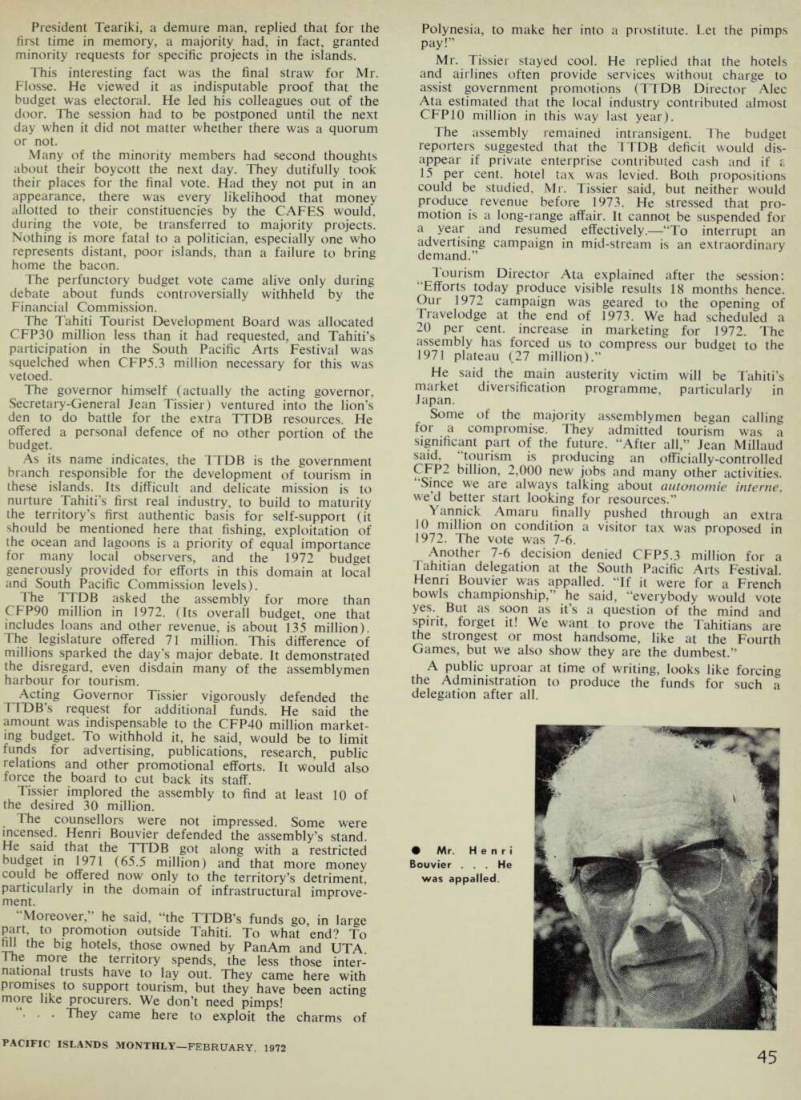
• Mr. Henri Bouvier ... He
was appalled.