Fiji's Fight Against Inflation
p. 47 · Read in the full issue
Raw Mara Starts Ball Rolling In
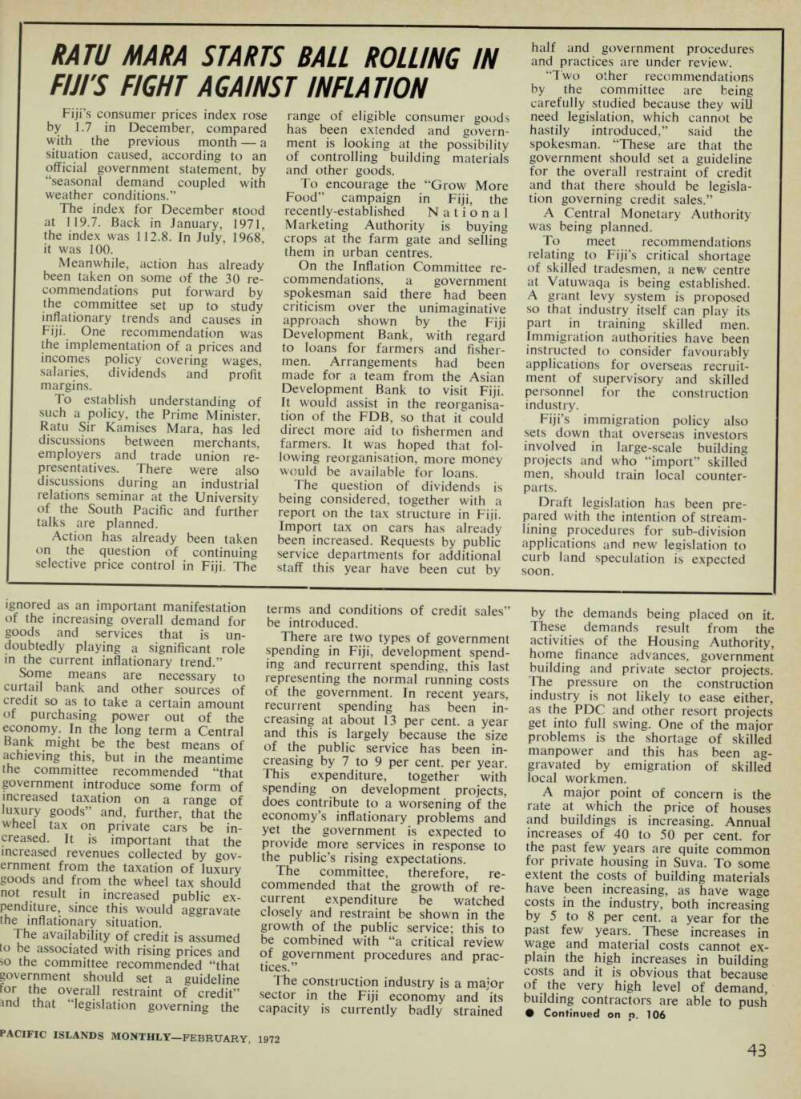
Fiji’s consumer prices index rose by 1.7 in December, compared with the previous month a situation caused, according to an official government statement, by “seasonal demand coupled with weather conditions.”
The index for December stood at 119.7. Back in January, 1971, the index was 112.8. In July, 1968, it was 100.
Meanwhile, action has already been taken on some of the 30 re commendations put forward by the committee set up to study inflationary trends and causes in Fiji. One recommendation was the implementation of a prices and incomes policy covering wages, salaries, dividends and profit margins.
To establish understanding of such a policy, the Prime Minister, Ratu Sir Kamises Mara, has led discussions between merchants, employers and trade union re presentatives. There were also discussions during an industrial relations seminar at the University of the South Pacific and further talks are planned.
Action has already been taken on the question of continuing selective price control in Fiji. The
range of eligible consumer goods has been extended and govern ment is looking at the possibility of controlling building materials and other goods.
To encourage the “Grow More Food” campaign in Fiji, the recently-established National Marketing Authority is buying crops at the farm gate and selling them in urban centres.
On the Inflation Committee re commendations, a government spokesman said there had been criticism over the unimaginative approach shown by the Fiji Development Bank, with regard to loans for farmers and fisher men. Arrangements had been made for a team from the Asian Development Bank to visit Fiji.
It would assist in the reorganisa tion of the FDB, so that it could direct more aid to fishermen and farmers. It was hoped that fol lowing reorganisation, more money would be available for loans.
The question of dividends is being considered, together with a report on the tax structure in Fiji.
Import tax on cars has already been increased. Requests by public service departments for additional staff this year have been cut by
half and government procedures and practices are under review.
“Two other recommendations by the committee are being carefully studied because they wiU need legislation, which cannot be hastily introduced,” said the spokesman. “These are that the government should set a guideline for the overall restraint of credit and that there should be legisla tion governing credit sales.”
A Central Monetary Authority was being planned.
To meet recommendations relating to Fiji’s critical shortage of skilled tradesmen, a new centre at Vatuwaqa is being established.
A grant levy system is proposed so that industry itself can play its part in training skilled men.
Immigration authorities have been instructed to consider favourably applications for overseas recruit ment of supervisory and skilled personnel for the construction industry.
Fiji’s immigration policy also sets down that overseas investors involved in large-scale building projects and who “import” skilled men, should train local counter parts.
Draft legislation has been pre pared with the intention of stream lining procedures for sub-division applications and new legislation to curb land speculation is expected soon.