New pattern of development for an
pp. 38-39 · Read in the full issue
elite New Guinea island retreat
By a staff writer
The Papua New Guinea Govern ment has formally approved a $l - scheme by an Australian syndicate to develop an off-shore New Guinea island as a get-away from-it-all retreat for a limited few of the well-heeled.
The development is on Wuvulu (or Maty) Island, 112 miles off the north coast or 55 minutes flight by light aircraft from Wewak. The plan differs from other development schemes in the South Pacific in that people who buy land on the island will be formed into a private club, with privileges and responsibilities.
And only 181 one-acre blocks on the 3,600-acre island are for sale. No further subdivision is permitted.
An agreement between the PNG Administration and the developers was signed in December personally by the PNG Administrator, Mr. L.
W. Johnson, and by Mr. Colin Helliar and Mr. Paul Stocker, both of Sydney.
Mr. Helliar, 33, senior partner in the Sydney law firm of Colin Helliar and Co,, is managing director of the development company, Wuvulu Hold ings Pty. Ltd., registered in Port Moresby. Mr. Stocker, 48, a land developer, is a director. Together with Mr. Bob Anthony, a public relations man who is elder brother of Australia’s deputy Prime Minister, Mr, Doug Anthony, they are prin cipals in the syndicate of about 10 men and a woman who are mostly Sydney lawyers.
Wuvulu Holdings was formed to purchase, in 1970, the 2,760-acre Agita Plantation on Wuvulu from Mrs. Joan Lean, sole owner follow ing the death of her husband in a motor accident. The Leans had bought the plantation after World War II and lived there. Sale price was “something less than $250,000,” says Mr. Helliar.
Agita comprises all but about 840 acres of the island, the remainder being two separate blocks of native land, occupied by about 540 Wuvulu islanders in two villages, Onne (sunset) and Aunu (sunrise). The plantation is a freehold property and was ex propriated from the Germans after World War I by the Australian Gov ernment and sold by tender in 1927 for £60,100.
The plantation at present produces 240 tons of copra a year and is
managed by Mr. Brian Cullinan, who will continue to operate it for the new owners, Mr. Helliar said in Sydney in January that it was planned to main tain the island in its present un spoiled condition by strict covenants on the land. The 181 one-acre blocks had already been pegged, each with a beach frontage and road access.
No private jetties were permitted, houses could not be built within 50 ft of the water frontage or within 60 ft of the road, nothing could be erected on the sand, building design had to be approved, and no fences were permitted. Every person had right of access to any block, and there were no private enclaves.
Sale price of the one-acre blocks will be $30,000 each, and in addition buyers must contribute $2OO each a year to a corporate organisation to be called the Bismarck Planters Society. These contributions, totalling $36,000 a year, will be devoted to the welfare of the native islanders.
The society under the agreement with the Administration, will be responsible for the provision of medical, dental and optical services to the islanders, the eradication of mosquitoes (to help do this the society will turn a swamp into a lake), the maintenance and improvement of roads, the provision of electric lights on the roads, the building of an air strip, the establishment of a co operative store and a training scheme to run it, and the maintenance of adequate water supplies.
All these things must be done within five years, and at the end of five years a committee of three (representing the Administration, the islanders and the society) will be set up to determine whether the islanders require more land for their own use, in which case Wuvulu Holdings has agreed to allocate to a trustee on the islanders’ behalf anything from 200 to 300 acres on a 99-year lease at $1 a year.
The company has already built the airstrip (Islander aircraft standard, coral sand), and has spent a total of $lOO,OOO so far on development work.
The $l-million budget includes ex penditure on erection of a com fortable 28-unit club house (in reality a hotel) for the Bismarck Planters Society. A maximum of 1,000 associate members at a nominal annual fee will also be invited to join the society,
and this entitles them to stay on the island.
Mr. Stocker said it was not im portant to the development whether all the blocks had houses built on them or not. An “unspoiled, away from-it-all atmosphere” was sought.
The society’s hotel would be there for those members who wanted to use it, and the plantation would continue to operate at a profit.
“In early February we’re having Mr. Jean-Michel Cousteau and an expert team give us a report on how we can look after the reef and the fish in the area,” Mr. Stocker said.
Jean-Michel Cousteau is president of the Living Sea Corporation, and a son of Jacques-Yves Cousteau.
Mr. Stocker added that the design for the hotel, by Sydney architects Rommel Moorcroft and Partners, reflected the old German bungalow style architecture seen in the Bismarck Archipelago.
“It’s a link with history, with Queen Emma’s day, with Whalen and von Hagen and the rest,” he said.
“We’d like to retain some of that colour.”
Mr. Stocker is an American who has been eight years in Australia and now says he’s Australian. He has a wife and three children in Sydney.
From Oregon, he took a law degree after being discharged from the Navy Air Corps at the end of World War 11, and for eight years was an elected member of the Washington State legislature. He became interested in development when he helped stage the Seattle World Fair, and then helped former Governor H. Rex Lee, of American Samoa, erect a Poly nesian Village at the New York World Fair.
He moved to Australia from Ame rican Samoa and helped to develop the 3,000 acre Ocean Shores estate at Brunswick Heads, NSW, and later sold his interest.
Among the subjects Colin Helliar took at Sydney University were archaeology and anthropology, and he says both have resulted in his getting much more closely involved with the Wuvulu plans than he had expected.
“It’s absorbing . . . it’s fun . . .
Wuvulu has changed our lives!” he said. “We’re in it for business, but: we are trying to do the right thing; by everybody, and we think the i recipe is right.”
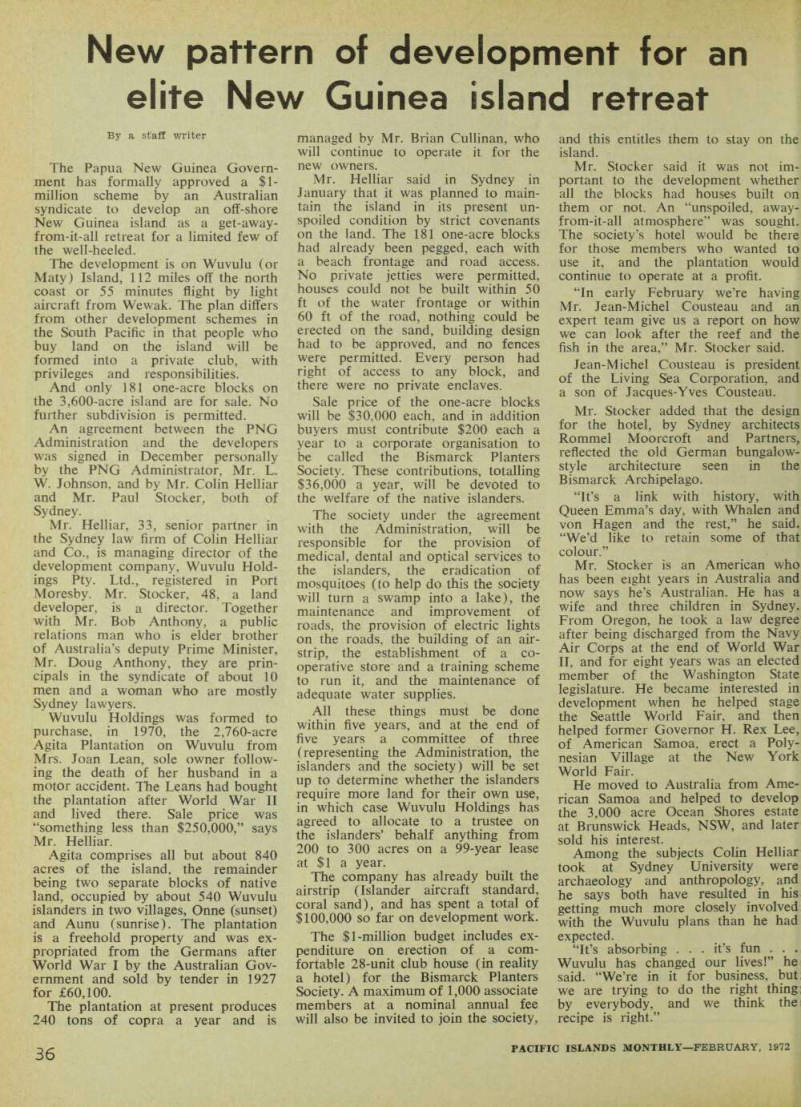
Above, Wuvulu from the air. It's freehold except for two areas of native-owned land on the far point. One of the two native villages is at left. A small airstrip was recently opened, and there are hopes of a regular service connecting the main land through Wuvulu to the Ninigo group to the north.
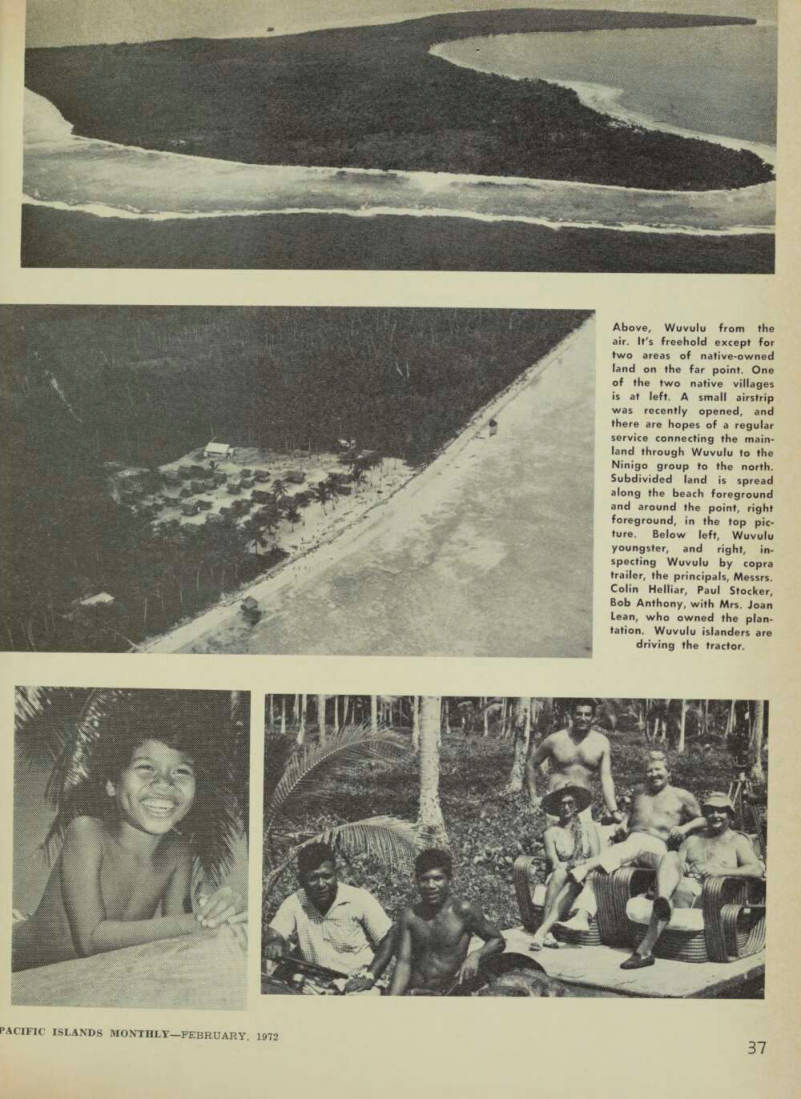
Subdivided land is spread along the beach foreground and around the point, right foreground, in the top pic ture, Below left, Wuvulu youngster, and right, in specting Wuvulu by copra trailer, the principals, Messrs.
Colin Helliar, Paul Stocker, Bob Anthony, with Mrs. Joan Lean, who owned the plan tation. Wuvulu islanders are driving the tractor.