Fiji Does Its Own Thing Over
pp. 42-112 · Read in the full issue

World Problem Of Inflation
Fiji’s long-awaited inflation report has been finally released to Parliament and to the public —although in very limited numbers. This special report from Suva reviews all the major features of the report and presents most of the committee's recommendations to the government.
Special report by a SUVA correspondent
On February 19, 1971, Mr. Vijay R. Singh, the Minister for Commerce and Industry, announced in parlia ment that, “Government was be coming increasingly concerned about inflation and had therefore decided to set up a committee to study this subject and make recommendations for consideration by government.”
The committee’s terms of reference were “to examine the nature and causes of inflation in Fiji” and to report specifically on, • A prices and incomes policy; • On ways and means of in creasing productivity in the building and agricultural sector and; • On how further increases in costs and prices could be curbed.
The report was to have been sub mitted to government by April 16, but was delayed and was not sub mitted until May 31, 1971.
It has now been released—more than seven months later!
Membership of the committee re flected an interesting balance between the various parties involved in the inflation issue. For the government there was the chairman, Mr. Vijay R. Singh, Minister for Commerce, Industry and Co-operatives, Mr. J. P.
Barron, Director of Public Works, Mr. L. Hewitt, Deputy Comptroller of Customs (now Comptroller of Customs), Mr. E. Jones, principal agricultural economist, Mr. M.
Qionibaravi, Secretary for Finance and Mr. Tomasi R. Vakatora, Sec retary and Commissioner for Labour.
For the private sector there was Mr. C. D. Aidney, of Williams and Gosling (who is also president of the Fiji Employers Consultative Associa tion), Mr. G. S. Barrack (a seasoned campaigner on such committees) of Carpenters Fiji Ltd., Mr. G. Chenery, manager of the Bank of New South Wales and Mr. J. Grundy, executive director of the Fiji Employers’ Con sultative Association. The trade union movement was represented by Mr.
S. Waqanivavalagi, secretary of the Fiji Mineworkers’ Union and president of the Trade Unions Congress, Mr.
James Raman, secretary of the Factory and Commercial Workers’
Union, Mr. Mohammed Ramzan,
secretary of the Trade Unions Con gress and Mr. Taniela Veitata, sec retary of the Fiji Dockworkers’ Union.
Other members were Mr. Derek Robinson of the Fiji Consumers’ As sociation and Mrs. Sharan of Labasa.
Mr. Veitata, apparently engaged in devoting his complete energies to the planning and successful conclusion of the month-long dockworkers’ strike, did not respond to letters sent to him and did not attend any of the meetings.
Basically, inflation is the problem of rising prices. It is a worldwide problem and affects developed and developing countries alike. For example, over the two years 1969 and 1970 the consumer price index rose by 9 per cent, in Fiji, by 7 per cent, in Australia and by 13 per cent, in New Zealand. Obviously, inflation is not limited to Fiji.
Economists are divided as to just how undesirable inflation is. While
rising prices are in part “a necessary factor in economic development,” they also have many undesirable con sequences. For example, export prices may rise as compared with import prices, so reducing exports and in creasing imports and causing a worsening in the balance of payments.
Where export prices are fixed on world markets, as is the case with Fiji’s major exports such as sugar, coconut oil, etc., then the local export industry might find itself faced with rising local costs, while facing fixed export prices. Similarly, local manu facturing industries might find that rising local costs would push up the prices of their products so that they would be less successful in selling in the domestic market md in the neighbouring export markets.
Inflation also tends to re-distribute income so that the rich get richer and the poor get poorer. Obviously, the potential consequences of this in Fiji
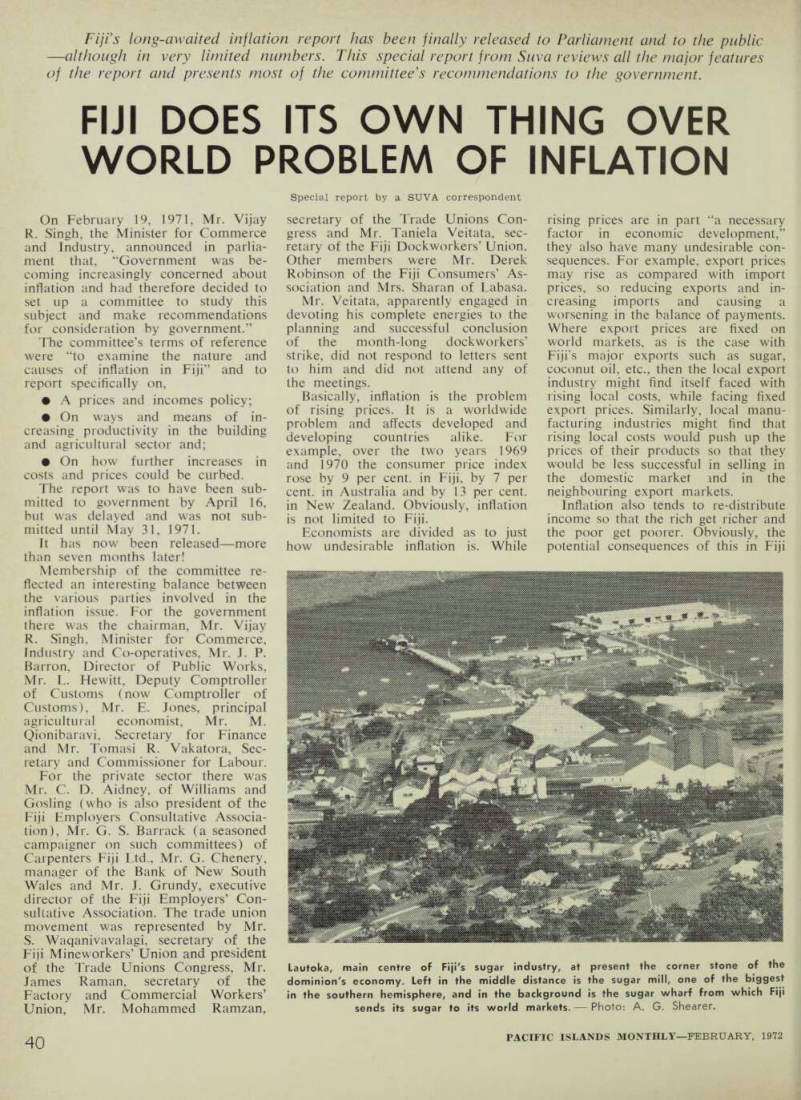
Lautoka, main centre of Fiji's sugar industry, at present the corner stone of the dominion's economy. Left in the middle distance is the sugar mill, one of the biggest in the southern hemisphere, and in the background is the sugar wharf from which Fiji sends its sugar to its world markets.-Photo: A. G. Shearer.
might not be too good. With so much of Fiji’s rural community depending on the production of sugar and copra, a situation of rising local prices with export prices fixed in world markets, could lead to increas ing poverty in the rural areas.
The two main causes of inflation are increasing costs, which then lead to rising prices, and also increasing demand, which pushes up prices. In this last situation there are too many people chasing too few goods and services and so people are willing and able to pay the higher prices demanded by businessmen selling the goods.
In Fiji’s case, consumer prices were increasing by only one or two per cent, a year before 1968. Since then, prices have increased by four or five per cent, a year and will doubtless go higher yet. It is these recent increases which are the problem.
Changes in prices are measured by the Consumer Prices Index which is calculated from the prices of various food-stuffs, housing, household items, clothing, footwear, transport and the like. Account is naturally taken in the index of the fact that in Fiji people spend more money on items such as food than on, say, clothing and footwear.
The most important price increases have been in relation to local and imported foods. Since people spend over 40 per cent, of their income on food then food prices will naturally be important in the cost of living.
The prices of other items, notably housing and household expenses, have also increased quite sharply.
An important cause of many of these price increases is quite simply the fact that Fiji relies heavily on imports, and the price of imports and of the freight rates for transport ing them to Fiji have been rising at an increasing rate. Obviously little or nothing can be done about this problem.
Other price increases, notably the prices of local food in the Suva and Nausori markets and the price of nouses probably reflect increased demand for food and houses which s permitting sellers to push the prices ap.
While the whole problem of infla lon is a relatively recent one; “the general atmosphere of accelerating vage demands, indications of widen ng margins in the distribution sector, md the great interest in, and attention o rising land prices, creates a dis urbing overall picture of rising costs md prices”, the report says.
This is creating “a widespread ex »ectation of continuing price rises, a tate of psychology that is dangerous”, ndeed were prices to continue rising
at their present rate then, “this alone would cast doubt upon the ability of government to achieve the develop ment targets set out in Develop ment Plan Six; and the economy’s competitive position in export markets might very well be jeopardised along with its ability to continue to attract tourists and new industries.”
Perhaps most significant of all, in any inflationary situation, “an ex pectation of continuing rapid price rises can cause in actual fact a more rapid rise” and then everybody wants to get on the bandwagon by pushing up wage demands, profit margins and selling prices, thus making the infla tion even more serious.
The committee’s profound con clusion from the arguments discussed above is, “that the present inflationary situation is becoming increasingly serious.” The mind boggles that the government needed a committee to tell them this.
Because of the tremendous importance of foodstuffs in people’s total spending, it is important to look a little more closely at the rising prices of foodstuffs. As far as local foodstuffs are concerned, the major price increases have been for beef, sausages, fresh fish, eggs, dalo, cas sava and fresh vegetables. Dairy pro ducts, however, have hardly increased in price. Many of these price increases result from higher prices charged for local foodstuffs sold at markets. The main problem here seems to be that a rising population, and an increasing number of people living in the towns, has pushed up the demand for local foodstuffs, but farmers have not in
creased their production to supply this demand. Obviously, action is required to increase farmers’ pro duction of foodstuffs.
The retail price of imported food has increased more slowly than the price of local food, but the price increases have still been quite high.
One problem is that the cost of food stuffs purchased from New Zealand, Australia and other overseas countries is increasing steadily, while freight rates for transporting the food to Fiji increased by 11 per cent., for example, between 1969 and 1970.
Increases in inter-island freight rates made in mid-1971 have also led to rises in food prices outside of Viti Levu.
While wage levels in the retail and distribution sectors have increased in recent years, there is no evidence that the increases have been substantial or could explain to a significant degree the rises observed in the prices of imported foodstuffs.
There is evidence, however, that gross markups, that is the percentage added to the landed cost of the goods to give the retail price, have been rising. Gross markups in a sample survey of imported foodstuffs in July, 1968, ranged from 12 per cent, to 70 per cent, and by December, 1970. the range of markups had risen to a minimum of 22 per cent, and a maximum of 89 per cent. If gross markups have increased by 30 per cent, over a 2J-year period then the likely contribution to inflation from this source could be considerable.
The fact that in the past, “the con centration of a substantial portion of business in a limited number of com panies may have inhibited com petition; thus resulting in an un necessarily high price level” could be an important contributory factor in the growth of inflationary forces.
Similarly, “the concentration of sole agencies in the hands of relatively few importers” can make it “parti cularly easy for the firm concerned to increase its gross markup with little fear of reduction in sales.”
It is obvious, therefore, that pro duction of local foodstuffs can and should be increased to bring down their prices. Import prices are deter mined by foreign suppliers and so are outside Fiji’s control. The markups on imported goods can be controlled by government, however, and this has already been implemented under the Price Control Ordinance.
The committee recommended, there fore, the continuation of the present price control arrangements. To in crease the supply of local foodstuffs the committee recommended that the Department of Agriculture should
“take positive steps to introduce integrated poultry-meat production,” to continue “efforts to raise beef pro duction by, among other things, bringing new farms into production” and to give high priority to market garden crops. These steps, it was re commended, should be supplemented by a government “Grow more Food” campaign.
The availability of suitable agri cultural land with security of tenure is important to increased agricultural activity and so the committee re commended that government should survey “the demand for and supply of suitable new farms” and in con junction with the Native Land Trust Board co-ordinate policies so as to allocate farms to suitably skilled people. Finance is also important in raising farm productivity and the Fiji Development Bank is urged “to take a more imaginative approach in its lending to farmers and fisher men”.
A further important factor in the inflation equation is the level of wages, salaries and profits, for these show up in the costs of producing and manufacturing goods and provide the cash with which the public buy goods and services. From the little informa tion available, wages and salaries ap pear in recent years to have been increasing at about the same rate as prices. Increased wages inevitably lead to higher production costs, unless productivity improves, and so wage increases may have a serious effect on price levels.
While responsible trade unions will keep wage demands within reason able limits, “it only requires a few excessive wage increases to trigger off a new round of cost-push infla tion.” The committee considered in this respect that voluntary wage restraint would not work and so re commended “the effective implementa tion of an incomes policy, covering wages, salaries and dividends; and profit margins in areas which significantly affect the cost of living.”
Locally-paid dividends are not treated under existing tax legislation as income, but are subject to a special tax rate of 5 per cent. This means that where a few individuals own a company they can pay them selves a low salary and declare for themselves a high rate of dividend taxable at only 5 per cent. The com mittee, therefore, recommended that this inequity be abolished by “all dividends exceeding a reasonable return being treated as income for tax purposes.”
An important factor in inflation is the supply of money and credit, and “the sharp increase in bank credit, particularly in 1970, cannot be
ignored as an important manifestation goods 6 in and eaSl s n e?vrc V e e s ra har is nd t r, « and , s< r rvices that is unin the C< current y |nfladonar ’ ,r ° C currenl mna tionary trend.
Pll^ e . m , eans . are u necessary to
S so aftomke fS- SOUrCeS °!
of purchasinc nower nn TT economy In the tone term a ftnfrM Rnnl m'ni? u !2 ng u a Central achieving B ?Ws but in th‘e S' ° f the committee n ta^tion UC on S °^ le form °l luxury good?’ and farther "S t£ f
wheel' fax on private cars‘te* hf
creased It is .w increased revenueseffected bv mv ernment from the taxationofXxure penditure since the The nfl a»ity S 'lTrdit is assumed to be associated with r , * IJSI Ifs » the nhm government should set a guideline md that°“legislatfon rai governin C g ed he
terms and conditions of credit sales”
be^ troduced - f
There are two types of government V* ndin l in Fiji ’ development spendmg and recurrent spending, this ast representing the normal running costs of the B ovem ment. In recent g years, . nA ' n h has been in ‘ "TIS? a . bout . l3 .per cent a year and this is largely because the size ° f the ?, ub !j C Se D rvice has b «" * pendin B on development projects, does contribute to a worsening of the S inflatlonar y. problems and yet tbe government is expected to P rovide m ore.services in response to *t publlcs ™“« expectations. it 3SS? this . b * combmed w i tb a critical review ° f ce f?. Vernment P™cedures and prac- The construction industry is a major
seined
by the demands being placed on it These “ds from the activities of the Housing Authoritv home finance advances, government building and private sector oroiects The pressure on consZction fs not ifkelyto ease eUher as the PDC and other resort projects get into full swing. One of the major problems is the shortage of skilled manpower and this his beenag ° f SkU ' ed A major point of concern is the rate at which the price of houses and buildings is increasing. Annual increases of 40 to 50 per cent, for the past few years are quite common for private housing in Suva. To some
pL %S.°xLS ‘in
wage and material costs cannot ex plain the high increases in building Of the fery hifh l'evel of demlld ‘°
• Continued on p. 106
up their prices to make what must in many cases be large profits.
The capacity of the building industry must be increased, both by training more skilled staff and by improving management standards. In the short term, the excess of demand over capacity must be reduced by credit restrictions and licensing, while in the long term, the capacity of the industry must be increased by training a larger working force. So the com mittee recommended that credit for building purposes be restrained with the exception of non-luxury housing and Housing Authority spending.
A system of licensing of building projects was considered by the com mittee but the repercussions of such a system upon major resort projects, such as the Deuba development, were felt to be too great. Never theless, it was recommended that government consider suspending the benefits available under the Hotel Aids Ordinance for certain areas.
The skilled labour problem was felt to be tackled in the best way by a crash training programme and that the major burden of providing such a programme must, in the short and long term, fall upon the building industry. In the short term, overseas personnel can be recruited to fill the gap at the higher levels, while new major building projects should make provision for training local personnel for work on the project.
Rising land costs are a further cause of high building costs and can only be reduced by making more land available. This can be solved by “speeding up the administrative procedures in handing sub-division applications”, by reviewing standards for building and sub-divisions and by encouraging the Native Land Trust Board to make more land available.
In part, rising land costs reflect the buying activities of overseas investors/speculators. Therefore, gov ernment advised that legislation should be introduced “which would have the effect of prohibiting transfers of land titles to overseas purchasers except on the basis of an approved development programme.”
A symptom of rising land and building costs is that of rising rents.
These have been controlled up to a value of $6,000 but it is recom mended that the value be increased to $12,000. The Fair Rents Ordinance will only operate successfully if people are aware of its existence, so the committee recommended that much wider publicity be given to it.
There is no doubt that, were the
government to accept all the com mittee’s recommendations —and there are 30 of them—while the problem of inflation would not be solved completely, it would be much reduced.
All in all, the report is a fair attempt at reducing the inflation problem. It is unfortunate, however, that some of the major issues, such as the rising level of retail markups, the existence of highly profitable sole agencies and the high profits being made by some of the large building firms, are hidden away in the body of the report. This has meant that they have largely been missed by the Press and radio here in Fiji, who never seem to have got past the first few sections of the report.
It is well known in government circles that the committee had some difficulty in agreeing upon the
emphasis which should be given to different aspects of the report. Mr.
Vijay Singh, for example, is said to have insisted on toning down com ments on high profit levels in the building industry.
The fact that the report was sub mitted on May 31, 1971, and yet was not issued to the public and to parliamentarians until December 14, 1971, is most unsatisfactory.
The excuse given by Mr. Singh that the issue of the report was delayed until after the Budget, because of the budgetary implications of the report, seems a rather lame one, particularly in view of the im portance of the report. Presumably, inflation continued apace from May 31 to December 14, 1971, while the government dallied and decided what action to take.