the pebble
pp. 36-37 · Read in the full issue
Big tussle conning for the pebble
New Caledonia Diary
with
Helen Rousseau
in Noumea
The wet summer season in Noumea restricts some organised sports, but no amount of bad weather can stop one game, which operates by peculiarly French rules and promises to be the Galedonians toughest championship event over the next few months.
Local interest in this contest may be gauged by the fact that there are already seven official teams entered, while the betting is for high stakes, since the trophy is none other than Le Caillou itself—this “pebble” as the Caledonians fondly call their little island. Since the “pebble” is all nickel-ridden, the tussle for this prize is expected to provide an extra amount of rough play as the game, “polit-ball”, advances. The final round, when the public will vote for its favourite team, could be any time after March.
Caledonian “polit-ball” is not unlike many other ball games: players face in two opposing directions. While all speak French and all claim to be competing under the same colours, some teams are playing for Paris and others for Noumea. One notes a profusion of coaches and barrackers and, as at the South Pacific Games, loyalties become strained between fervour for France and enthusiasm
for la Caledonie, the home island.
Of course, there are umpires on the field, but their task is complicated by so much swift manipulation from the sidelines, from folk in high places that Anglo-Saxon rules would never permit to be involved at all.
Officially, the cheering is directed towards those who score a goal at the Paris end, while anyone working towards the Noumea goal is labelled “anti-French”, “Maoist” or “trouble-maker”
However, the Noumea “autonomist” teams now claim that if their score is not recognised, it may become difficult to find enough Caledonians to enter the Paris-supporting team.
The game has that special excitement and intrigue which the French revel in, and with seven “polit-clubs” already practising in the Territorial Assembly, and more rumoured in the making, the spectator value is highly promising.
At the beginning of their present five-year term, the 35 members of the Territorial Assembly were divided into three groups. First to split was a two-man alliance, followed by two splits in the original autonomist party Union Caledonienne and, more recently, a split in the pro- Administration
Entente coalition. Major issue provoking the splits seems to in volve the demand for autonomic interne or internal self-govern ment, within the French Republic, The December split in the pro- Administration camp has led to barrister Georges Chatenay remaining within the ranks of the Union Democratique Party, while Noumea Mayor Roger Laroque and members of the Lafleur clan have resigned and formed a new group called Entente Democratique et Sociale.
On the other side of the House, Union Civique (one member) has combined forces with Union Cale donienne (12) and invited others to join their “Caledonian Front for Autonomy”. Signatories to the agreement forming the new Front include Maurice Lenormand, who has returned to politics as Corn missioner-General of the Union Caledonienne. After a court case several years ago, Lenormand was barred from his former seat of Deputy for New Caledonia in Paris.
Lenormand is a “petit mineur”, independent nickel miner, as is his rival Senator Henri Lafleur. while Georges Chatenay is legal adviser to the International Nickel Company of Canada, The major force on the cale
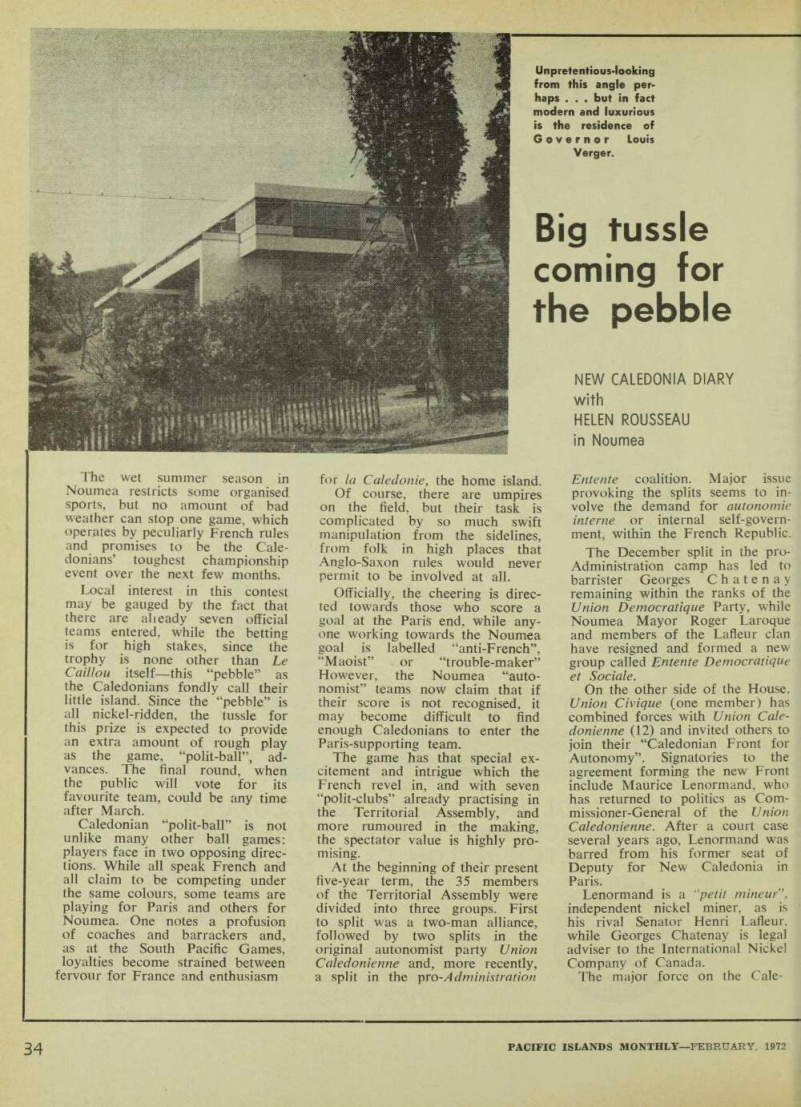
Unpretentious-looking from this angle per haps . . . but in fact modern and luxurious is the residence of Governor Louis Verger.
donian scene is, of course, the Paris-based nickel company, the Societe Le Nickel (SLN), which has also been busy trying to win friends and influence people.
While the SLN has long con trolled the daily newspaper La France Australe, since this year it also controls the twice-weekly Bulletin du Commerce, where SLN PR-man Remy Le Goff has now taken over as managing editor.
As forces converge, the tussle for the Caledonian nickel cake is obviously going to have some heavy-weights thrown in.
At what may be described as the end of the first round of encounters, in mid-January, Mr.
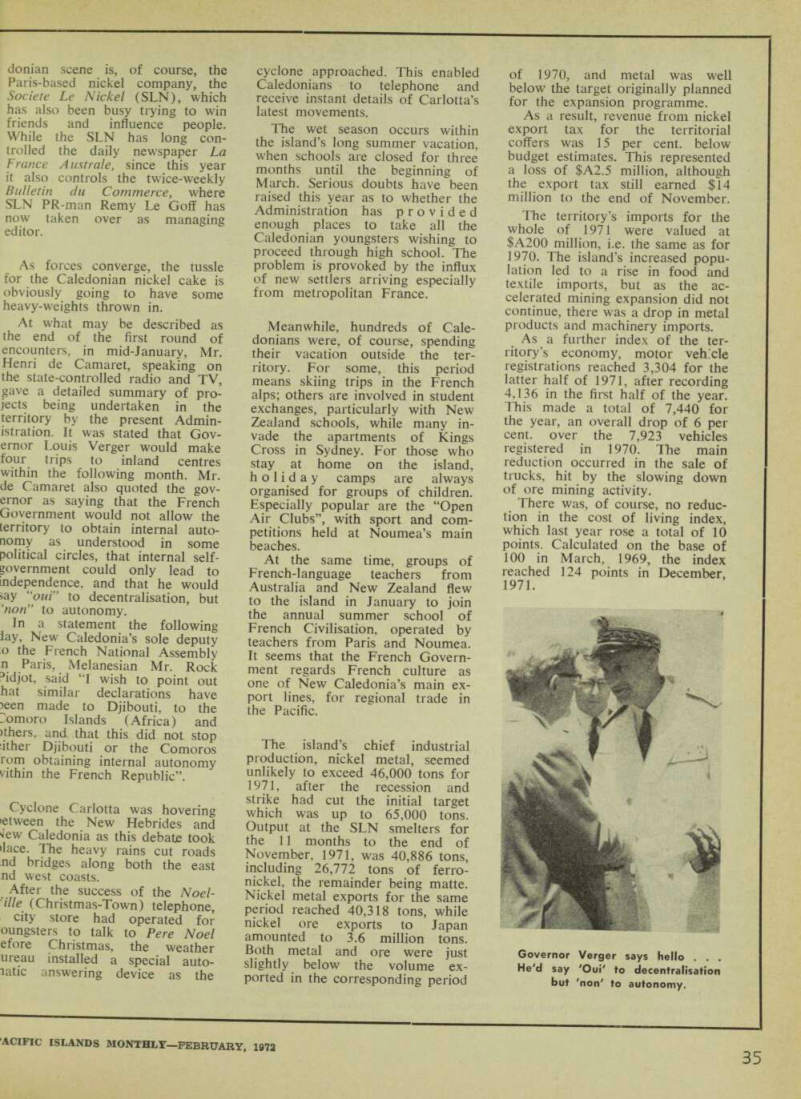
Henri de Camaret, speaking on the state-controlled radio and TV, gave a detailed summary of pro jects being undertaken in the territory by the present Admin istration. It was stated that Gov ernor Louis Verger would make four trips to inland centres within the following month. Mr. de Camaret also quoted the gov ernor as saying that the French Government would not allow the territory to obtain internal auto nomy as understood in some political circles, that internal self government could only lead to independence, and that he would >ay “oui” to decentralisation, but ‘non” to autonomy.
In a statement the following lay, New Caledonia’s sole deputy o the French National Assembly n Paris, Melanesian Mr. Rock 3 idjot, said “I wish to point out hat similar declarations have )een made to Djibouti, to the Comoro Islands (Africa) and )thers. and that this did not stop ither Djibouti or the Comoros rom obtaining internal autonomy vithin the French Republic”.
Cyclone Carlotta was hovering •etween the New Hebrides and *ew Caledonia as this debate took •lace. The heavy rains cut roads nd bridges along both the east nd west coasts.
After the success of the Noel
'Hle (Christmas-Town) telephone,
city store had operated for oungsters to talk to Pere Noel efore Christmas, the weather ureau installed a special auto latic answering device as the
cyclone approached. This enabled Caledonians to telephone and receive instant details of Carlotta’s latest movements.
The wet season occurs within the island’s long summer vacation, when schools are closed for three months until the beginning of March. Serious doubts have been raised this year as to whether the Administration has provided enough places to take all the Caledonian youngsters wishing to proceed through high school. The problem is provoked by the influx of new settlers arriving especially from metropolitan France.
Meanwhile, hundreds of Cale donians were, of course, spending their vacation outside the ter ritory. For some, this period means skiing trips in the French alps; others are involved in student exchanges, particularly with New Zealand schools, while many in vade the apartments of Kings Cross in Sydney. For those who stay at home on the island, holiday camps are always organised for groups of children.
Especially popular are the “Open Air Clubs”, with sport and com petitions held at Noumea’s main beaches.
At the same time, groups of French-language teachers from Australia and New Zealand flew to the island in January to join the annual summer school of French Civilisation, operated by teachers from Paris and Noumea.
It seems that the French Govern ment regards French culture as one of New Caledonia’s main ex port lines, for regional trade in the Pacific.
The island’s chief industrial production, nickel metal, seemed unlikely to exceed 46,000 tons for 1971, after the recession and strike had cut the initial target which was up to 65,000 tons.
Output at the SLN smelters for the 11 months to the end of November, 1971, was 40,886 tons, including 26,772 tons of ferro nickel, the remainder being matte.
Nickel metal exports for the same period reached 40,318 tons, while nickel ore exports to Japan amounted to 3.6 million tons.
Both metal and ore were just slightly below the volume ex ported in the corresponding period
of 1970, and metal was well below the target originally planned for the expansion programme.
As a result, revenue from nickel export tax for the territorial coffers was 15 per cent, below budget estimates. This represented a loss of $A2.5 million, although the export tax still earned $l4 million to the end of November.
The territory’s imports for the whole of 1971 were valued at SA2OO million, i.e. the same as for 1970. The island’s increased popu lation led to a rise in food and textile imports, but as the ac celerated mining expansion did not continue, there was a drop in metal products and machinery imports.
As a further index of the ter ritory’s economy, motor vehicle registrations reached 3,304 for the latter half of 1971, after recording 4,136 in the first half of the year.
This made a total of 7,440 for the year, an overall drop of 6 per cent, over the 7,923 vehicles registered in 1970. The main reduction occurred in the sale of trucks, hit by the slowing down of ore mining activity.
There was, of course, no reduc tion in the cost of living index, which last year rose a total of 10 points. Calculated on the base of 100 in March, 1969, the index reached 124 points in December, 1971.
Governor Verger says hello . . .
He'd say 'Oui' to decentralisation but 'non' to autonomy.