Business and Development
pp. 112-115 · Read in the full issue
Islander is still flying high
The 32 Britten-Norman Islander aircraft in the Pacific Islands will not be without service or spares be cause Britten-Norman Ltd. is in re ceivership. Britten-Norman went into receivership on October 26.
A new company, Britten-Norman Bembridge Ltd., has been formed to take over Britten-Norman Ltd., and is producing and servicing aircraft.
Its headquarters is now at Bembridge airport, Isle of Wight.
Eight companies are now tendering for Britten-Norman Bembridge Ltd., and this company will go to the highest bidder. Because of legal re quirements relating to the receiver snip it was not possible to offer Britten- Norman Ltd. for tender.
Islander Aircraft Sales Pty. Ltd., of Sydney, distribute Britten-Norman Islander aircraft and supply the spare parts in the South Pacific. Most oper ators do their own servicing, which is very little with these aircraft.
Britten-Norman Islanders carry nine passengers, and are powered by either 260 hp or 300 hp engines.
This is how they are distributed in the Pacific Islands: New Guinea, 12; Tahiti, 6; New Hebrides, 5; New Caledonia, 4; Fiji, 2; BSIP, 2 (one just going into ser vice), and Western Samoa, 1. There are a further 19 in Australia and New Zealand.
More than 300 Islanders are flying throughout the world.
Undoubtedly the sale of the Britten- Norman company is from a position of strength, as the basic trading position—a good aircraft selling well at a fair price—is excellent. The company ran into trouble when a big loan was called in. The founders, Mr. lohn Britten and Mr. Desmond Norman, are still on the board of the new company, Britten being re-
sponsible for operations and Norman for sales.
The receiver, Mr. Monty Eckman, has told all distributors that he aims to keep the company in operation and make it profitable.
Fiji’s domestic airline, Fiji Air Services, is confident that it won’t suffer any setback following the fin ancial troubles of Britten-Norman.
Fiji Air is to take delivery in January of its second $95,000 Britten- Norman Islander.
The distributors, Islander Aircraft Co. of Australia, became a significant shareholder in the newly-reconstruc ted Fiji airline in 1971.
“We have been led to believe that the recent appointment of a receiver to Britten-Norman will have no immediate effect on Fiji Air Services, “Mr. Crompton told PIM in Decem ber. .
“There are ample spare part stocks available for at least another 12 months without any further produc tion. The receiver is continuing to trade and the production line is pro ceeding as normal. We understand it
is likely that the manufacture of the Islander and Trislander aircraft will remain in the UK.
“The Islander is an extremely good product, highly marketable, and it’s our belief that if anything, all activities surrounding the Islander and Trislander will, in fact, grow as a result of the proposed take-over.
Mr. Crompton, 29, was seconded from Hawker de Havilland last year to supervise the restructuring and refinancing of Fiji Air Services, in which Hawker de Havilland has a major shareholding. He has now been recalled to Hawker de Havil land to become divisional general manager, general aviation. His suc cessor, also seconded from Hawker de Havilland where he was export manager, is Mr. Bryan O Loan.
Fiji Air Services, is forging ahead with encouraging vigour. Now re ported to be riding a “trend of profit ability”, it has long-term plans to go public, probably by the middle of 1973.
Its directors expect to see a con firmed dividend policy before then
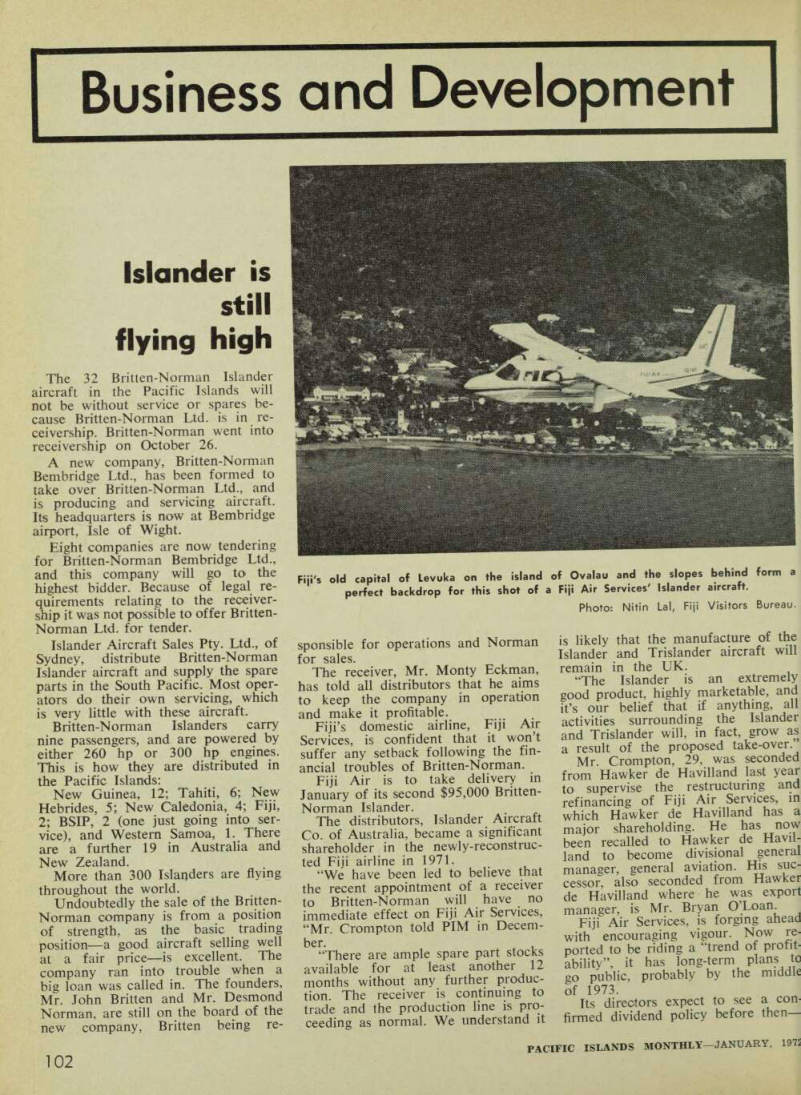
Fiji's old capital of Levuka on the island of Ovalau and the slopes behind form a perfect backdrop for this shot of a Fiji Air Services' Islander aircraft.
Photo: Nitin Lai, Fiji Visitors Bureau.
and Fiji Air’s 49 shareholders, 42 of them Fiji firms or individuals, are very happy with the way things are going.
Since being revitalised with new capital and efficient management, the airline has acquired land for an air strip at Sigatoka; opened a new office in Suva; negotiated for land to build a hangar at Nadi; inaugurated a fort nightly service to Futuna; taken de livery of one Islander and ordered another.
Arrival of the new Islander will enable Fiji Air to operate a whole network of services in areas where the lack of fast, comfortable trans port has been a drawback.
A new service will operate to the Plantation Village airstrip on the island of Malolo Lailai, starting on February 1.
It will cut the journey from Nadi Airport to Plantation Village to 13 minutes. From Plantation Village, guests bound for nearby Castaway resort will be transported by boat.
“We’ll operate 16 return services a week to the Castaway-Plantation strip, with morning and afternoon flights seven days a week and ad ditional midday services on Saturday and Sunday,” Mr. Crompton told
Pim.
“The cost per person is expected to be under $8 each way,”
The airline plans to operate in and out of the proposed 2,500 ft Sigatoka strip by February. This strip, being built on leased land two miles from The Fijian hotel, is being financed by Fiji Air itself.
It will obviate the need for road travel for guests at The Fijian, the Reef Hotel and Tubakula and for Sigatoka residents.
Sixteen direct return services between Nadi and Sigatoka are planned per week, in addition to the seven indirect services which are cur rently part of a Nadi-Korolevu-Suva coastal linkup.
A 2,500 ft airstrip at Deuba is neanng completion and Fiji Air ex pects to start flying there, mainly on a charter basis for Pacific Hotels and
Developments Ltd., this month.
Since the beginning of October, the airline has operated two return services a day (Monday to Friday) to the island of Ovalau.
Visitors can enjoy an all-inclusive Ovalau day tour—involving the return flight, sightseeing, lunch and afternoon tea —• for $lB.
Completion is expected this month of the airstrip being built at Lakeba in the Lau Group, and Fiji Air has set February 15 as the starting date for regular services between the isolated island group and Viti Levu.
Hie airline is budgeting to fly in excess of 3,000 hours during 1972, and has plans to acquire a further aircraft towards the end of the year.
Overspending earns
a rebuke in W, Samoa
The Samoa Times recently argued that the constitution could not be the supreme law of Western Samoa if government departments continued to spend far above their annual esti mates.
The constitution allows for over expenditure of 1 per cent, but during 1970 over-expenditure amounted to $308,853 or 4.6 per cent, of the total budget.
According to the report of the acting controller and chief auditor, Mr. Tom Overhoff, the departments
which exceeded their limits were: Agri culture $13,472, Broadcasting $4,554; Customs $37,166; Health $72,279; Post Office $12,501; Public Works (Civil Aviation) $496; Electric Power scheme $9,672; Public Works (Harbour equipment) $40,449; Radio $1,526; Treasury stores $116,738.
Said Mr. Overhoff: “It seems that government departments do not take the commitment returns seriously.
This was clearly demonstrated at the end of 1969 when audit established that amounts owing to firms as at December 31, came to over $120,000 while the commitment returns for that date produced a total figure of $1,633.”
He criticised many irregularities in government departments.
UK raises price
for Fiji sugar
A very bright spot amid Fiji’s Budget deliberations in December was the news that sugar sales to Britain during the next three years would earn an extra s2i million for the dominion.
The Prime Minister, Ratu Sir Kamisese Mara, told a delighted House of Representatives on Decem ber 17 that Britain had agreed to increase its basic price for Common
wealth-produced sugar from $9O a ton to $lO5.
Taking into account additional payments received by less-developed exporters, Fiji will receive from Britain a minimum of $l2O a ton and a maximum of $l2B a ton. The previous scale was minimum $94 a ton and maximum $99 a ton.
Thus, for 1972, 1973 and 1974, Fiji will get the basic $lO5 a ton for its Commonwealth quota of 140,000 tons —plus the extra pay ment, which will be calculated annu ally and will depend on the world price.
The Prime Minister explained that at the top and bottom ends of the scale, the maximum rate would apply when the world price of sugar fell below $69 a ton and the minimum when the world price was more than $B6 a ton. “In very rough terms it means getting well over s2i million extra per annum for Fiji from this source,” he said.
Burns Philp happier
For many years the chairman of Burns Philp and Co. Ltd., in his annual address to shareholders, has referred to the unprofitability of the shipping division. This year was no exception, but future similar refer ences are unlikely.
The company has now sold all its ships. The last was the Montoro, at the end of 1970, so the financial year, just ended had to bear the final voyage accounts of the Montoro, in addition to those of ships sold some months earlier.
The chairman, Mr. J. D. O. Burns, said at the annual meeting that the coming year should see Burns Philp enjoy financial benefits from shipping—in its role as an agent and by complete elimination of the heavy losses the company had suffered for so many years in running its
own ships.
BP’s role as shipowners is now con fined to inter-island vessels operated by subsidiary companies, in the islands where they form an integral part of the local trading pattern.
Mr. Burns, generally, was opti mistic, even allowing for depressed prices for copra and cocoa, and rising costs in the retail stores division.
Trading interests in Papua New Guinea continued to expand, more tea had been planted in the territory, and in spite of low prices, new plant ings of coconuts and cocoa were made as labour and conditions al lowed.
He was happy about the activities of Burns Philp (SS) Co. Ltd., even though that company suffered sub
stantially from the long dockworkers’ strike in Fiji.
He expected good results from the three Travelodges in Fiji, and expan sion of the tourist industry in Western Samoa and Tonga.
Mr. Burns gave some credit to the Prime Minister of Fiji, Ratu Sir Kamisese Mara, for Fiji’s smooth transition from colony status to that of an independent dominion. ‘This has, in no small measure, been due to the personal qualities of its Prime Minister and the unify ing influence he has brought to bear on its multi-racial customs and pro blems”, Mr. Burns said.
Results from the New Hebrides were satisfactory in spite of depressed copra prices.
New nickel project 1
After five years’ unsuccessful nego tiations in Paris, the International Nickel Co. of Canada (INCO) has just submitted to the French Govern ment a new project for treating nickel in New Caledonia.
The new INCO project was sub mitted at the request of the French Government, following the non-reali sation of the COFIMPAC project. In an official communique issued in Noumea on Christmas Eve, INCO announced that if a rapid agreement is reached with the French Govern ment, the first part of the new pro ject could enter into production to wards mid-1974.
The new factory, involving around $B5 million investment, would pro duce some 7,000 tons of nickel per year in the south of the island. About 1,100 people would be employed dur ing the construction stage with about 400 persons required to operate the new plant.
Questions still to be resolved with the French Government include a definition of the mining reserves, the establishment of a long term fiscal policy and the financial structure of the new company. It is expected that the new venture would allow INCO a majority shareholding, whereas in the old COFIMPAC project, French interests were to have had a majority
holding.
The production of the above initial 7,000 tons would be “Sinter” pro duced by the “IRAL” process in the first step of a three-stage project. The ultimate production target would be at least 100,000 tons of metal, al though the company declined to indi cate what process would be used at the final stage.
The starting date for construction of the first unit of the INCO plant now depends upon approval from the Paris government.