Footnotes
pp. 110-111 · Read in the full issue
Last Thoughts
From The
Assembly Floor
“TTiE House stands adjourned until a date and hour to be fixed by Mr. Speaker”.
So ran the traditional formula, but in fact Papua New Guinea’s second House of Assembly had run its appointed course. Three days later it was prorogued and writs had been issued for the election of a new and enlarged House early in 1972.
For me, that moment in the early evening of November 26 was my last on the floor of the Chamber, though I am still technically “Mem ber for Moresby” till polling closes on March 15 and, thereafter, I shall, no doubt, sometimes be seen watching the performance of my successors from the gallery. 1 say “successors” because with the rapid growth of Port Moresby my electorate has been split into two.
For me, too, it was inevitably a moment for looking back over the years which have passed
since 1 entered the then newly established House of Assembly in 1964.
Enjoying as I do debate for the sake of debate, the first House was a good House. We were all “independents”, tending to fall in to loose groupings, the make-up of which was in a state of constant flux according to the subject being debated. This may not have made for good Westminster-style gov ernment, but it did make for good debate. One could advance ar
guments with the expectation that they would be intelligently listened to and met by intelligent counter-arguments. And a member who spoke without having done his homework was liable to be shot down in flames.
The only trouble was that the official mem bers, who were in effect the “government of the day”, could never tell until the moment of divi sion which way the cat was going to jump.
Since 1968, during the life of the second House, the informal groupings of earlier days have gradually coagulated into parties. This has made for better government in the sense that the Administrator’s Executive Council, which has now become the government of the day, and
which comprises a majority of elected members holding ministerial rank, has been able to some extent, though not completely, to foresee the re ception likely to be given to its proposals.
On the other hand, the standard of debate has steadily deteriorated, derision and abuse more and more taking place of reasoned argument.
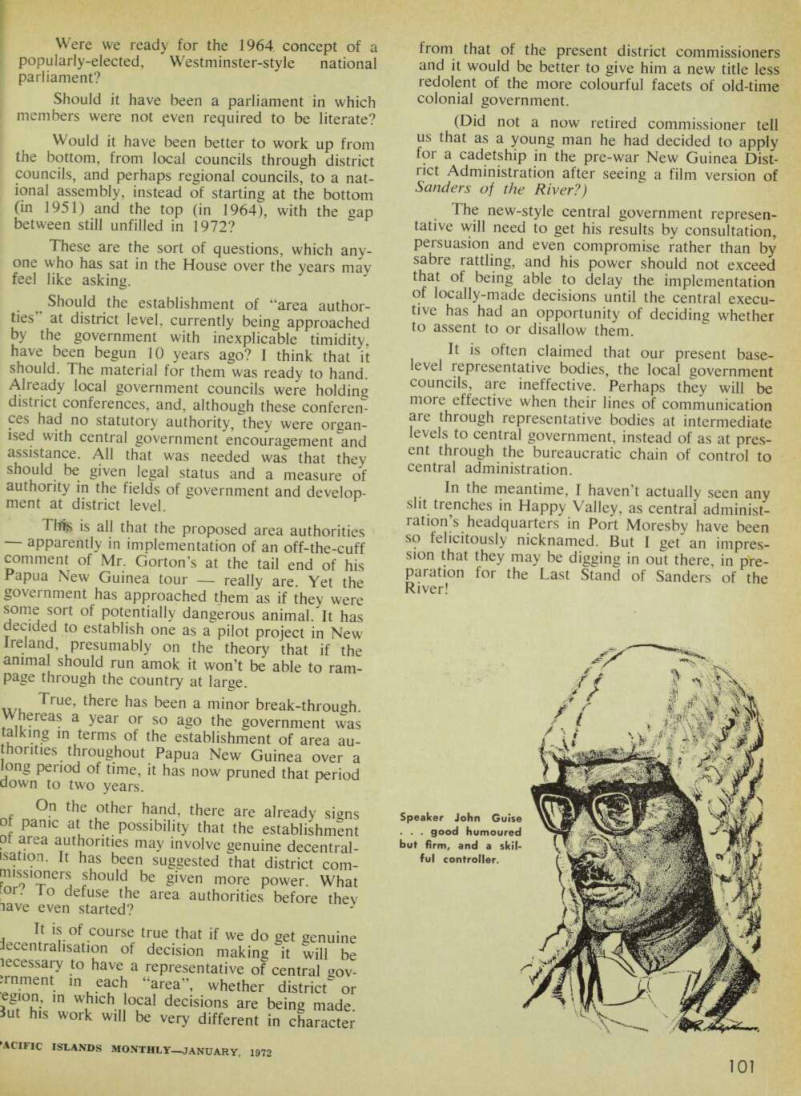
Only the skilful control exercised, generally good humouredly but always firmly, by Speaker John Guise, has prevented the abuse from becoming personal. In this respect at least we can claim
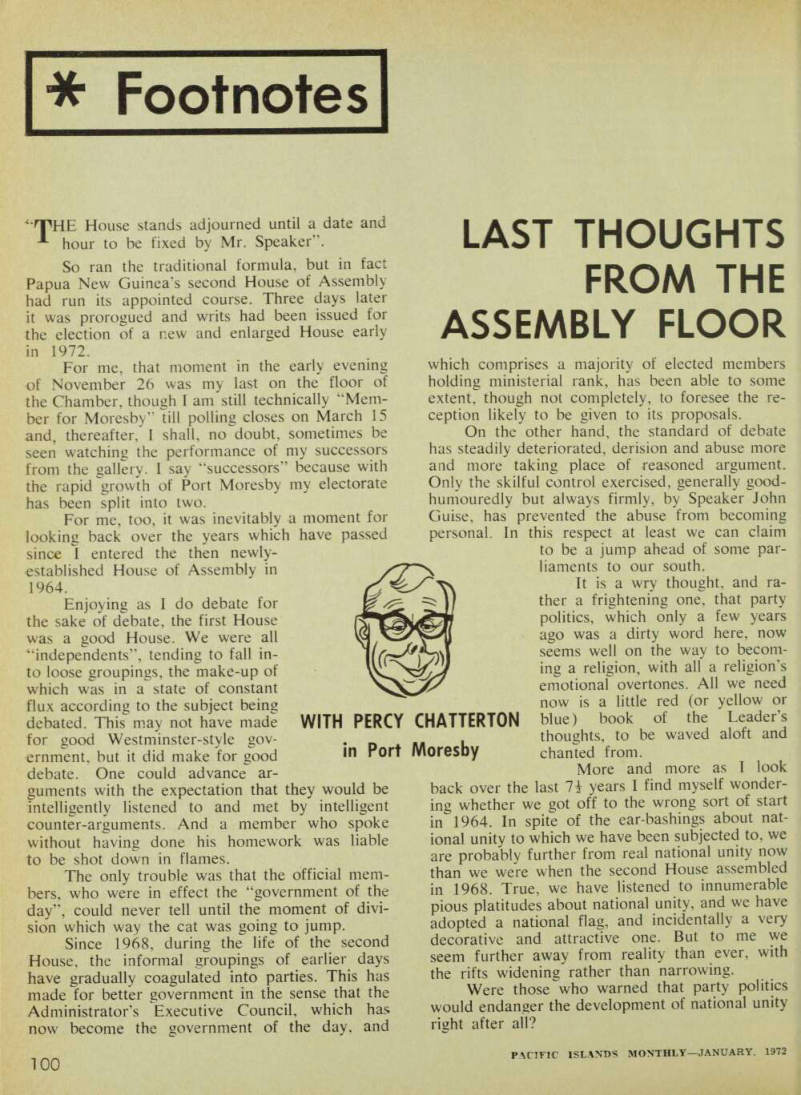
With Percy Chatterton
in Port Moresby
to be a jump ahead of some par liaments to our south.
It is a wry thought, and ra ther a frightening one, that party politics, which only a few years ago was a dirty word here, now seems well on the way to becom ing a religion, with all a religion’s emotional overtones. All we need now is a little red (or yellow or blue) book of the Leader’s thoughts, to be waved aloft and chanted from.
More and more as I look
back over the last 1\ years I find myself wonder ing whether we got off to the wrong sort of start in 1964. In spite of the ear-bashings about nat ional unity to which we have been subjected to, we are probably further from real national unity now than we were when the second House assembled in 1968. True, we have listened to innumerable pious platitudes about national unity, and we have adopted a national flag, and incidentally a very decorative and attractive one. But to me we seem further away from reality than ever, with the rifts widening rather than narrowing.
Were those who warned that party politics would endanger the development of national unity
right after ail?
Were we ready for the 1964 concept of a popularly-elected, Westminster-style national parliament?
Should it have been a parliament in which ■ members were not even required to be literate?
Would it have been better to work up from the bottom, from local councils through district councils, and perhaps regional councils, to a nat ional assembly, instead of starting at the bottom (in 1951) and the top (in 1964), with the gap between still unfilled in 1972?
These are the sort of questions, which any one who has sat in the House over the years may feel like asking.
Should the establishment of “area author ties’' at district level, currently being approached by the government with inexplicable timidity, have been begun 10 years ago? I think that it should. The material for them was ready to hand.
Already local government councils were holding district conferences, and, although these conferen ces had no statutory authority, they were organ ised with central government encouragement and assistance. All that was needed was that they should be given legal status and a measure of authority in the fields of government and develop ment at district level.
Thfig is all that the proposed area authorities apparently in implementation of an off-the-cuff comment of Mr. Gorton’s at the tail end of his Papua New Guinea tour really are. Yet the government has approached them as if they were some sort of potentially dangerous animal. It has decided to establish one as a pilot project in New Ireland, presumably on the theory that if the animal should run amok it won’t be able to ram page through the country at large.
True, there has been a minor break-through, hereas a year or so ago the government was talking m terms of the establishment of area au thorities throughout Papua New Guinea over a long period of time, it has now pruned that period down to two years.
On the other hand, there are already signs of panic at the possibility that the establishment ot area authorities may involve genuine decentral isation. It has been suggested that district com rmssioners should be given more power. What tor. lo defuse the area authorities before thev lave even started? y It is of course true that if we do get genuine iecentrahsation of decision making it will be tecessary to have a representative of central gov ernment in each “area”, whether district-or egion, in which local decisions are being made Jut his work will be very different in character
from that of the present district commissioners and it would be better to give him a new title less redolent of the more colourful facets of old-time colonial government. (Did not a now retired commissioner tell us that as a young man he had decided to apply for a cadetship in the pre-war New Guinea Dist rict Administration after seeing a film version of Sanders of the River?) The new-style central government represen tative will need to get his results by consultation, persuasion and even compromise rather than by sabre rattling, and his power should not exceed that of being able to delay the implementation of locally-made decisions until the central execu tive has had an opportunity of deciding whether to assent to or disallow them.
It is often claimed that our present base level representative bodies, the local government councils, are ineffective. Perhaps they will be more effective when their lines of communication are through representative bodies at intermediate levels to central government, instead of as at pres ent through the bureaucratic chain of control to central administration.
In the meantime, I haven’t actually seen any slit trenches in Happy Valley, as central administ ration s headquarters in Port Moresby have been so felicitously nicknamed. But 1 get an impres sion that they may be digging in out there, in pre paration for the Last Stand of Sanders of the River!
Speaker John Guise . . . good humoured but firm, and a skil ful controller.