nickel slump
pp. 40-42 · Read in the full issue
Food, wine and the nickel slump
New Caledonia Diary
with
Helen Rousseau
in Noumea
December was a difficult month of decision-making for the Cale donians—difficult in deciding what to eat over the festive season.
For dining at home, one Noumea supermarket offered over a hundred varieties of cheeses flown in from France; another store displayed some 40 different varieties of pate (liver paste), while for those dining out, one hotel offered an evening’s enter tainment at SAS7 per person.
As far as eating is concerned, of course, the French don’t have to wait for Christmas to give themselves a treat. Yet months before the end of the year one food exporting firm had circulated Noumea residents with a detailed catalogue of its wares, all from the one region of France. The colourful brochure invited its readers to take a “promenade through Perigord” and sample all manner of foods from snails cooked in champagne to birds such as larks stuffed with goose liver and truffles. The same ex porter offered partridge and pheasant roasted in port wine, besides jellied woodcock and thrush, or quail stuffed with grapes heated in cognac.
Similar birds, uncooked and
fully feathered, are offered in Noumea supermarket freezers, to gether with local and imported meats. The accompanying wines are marked at up to $12.50 per bottle.
When it comes to cheeses, one might almost conduct a personality test by studying a gourmet’s selec tion. At the Prisunic supermarket, Noumea shoppers may choose from the ‘“Delights of the Gods” (Delices des Dieux), cheeses “Verified by the Priest”, the “Purity of the Alpine Snow” and “Droppings of the Devil” or “flavoured with garlic and herbs”.
The tins of liver paste offer an equally amazing assortment, from duck’s liver in cognac to liver of turkey with truffles, those moulds that are sniffed out by animals under European forest trees.
Special festive season menus were offered by restaurants and hotels. It was the Chateau Royal which invited Caledonians, at $57 a head, to spend the night of Saint Sylvester (New Year’s Eve) dining and wining, with a six-course meal, preceded by aperitives and accompanied by unlimited quanti ties of white and red wine besides champagne. Onion soup was offered at 2 a.m. to subdue the
effects of these New Year revels.
Needless to say, the festive season brought a wide selection of gifts, although it looked as though some stores had extravagantly ordered their goods before news of the nickel market recession was well understood. One of the choicest imports was the $A17,000 Lamborghini car, shipped in for the sth Automobile Salon in December. Any man who had for gotten to order his wife a Lam borghini could still hope to redeem himself, however, with the aid of an elegant box of chocolates, flown in from France at $45 the box.
Those who found these options too embarrassing, still had the choice of flying off for a less inflated Christmas in Australia or New Zealand. ☆ ☆ ☆ Of course, not all December was Christmas. The month began with 40 cars hurtling 1,200 miles around the island in the sth Cale donian Safari. The event took on extra glamour with two racing drivers flying out from France to compete —Jean-Pierre Beltoise and Gerard Larousse. Though skilled on the racing circuits of Europe,
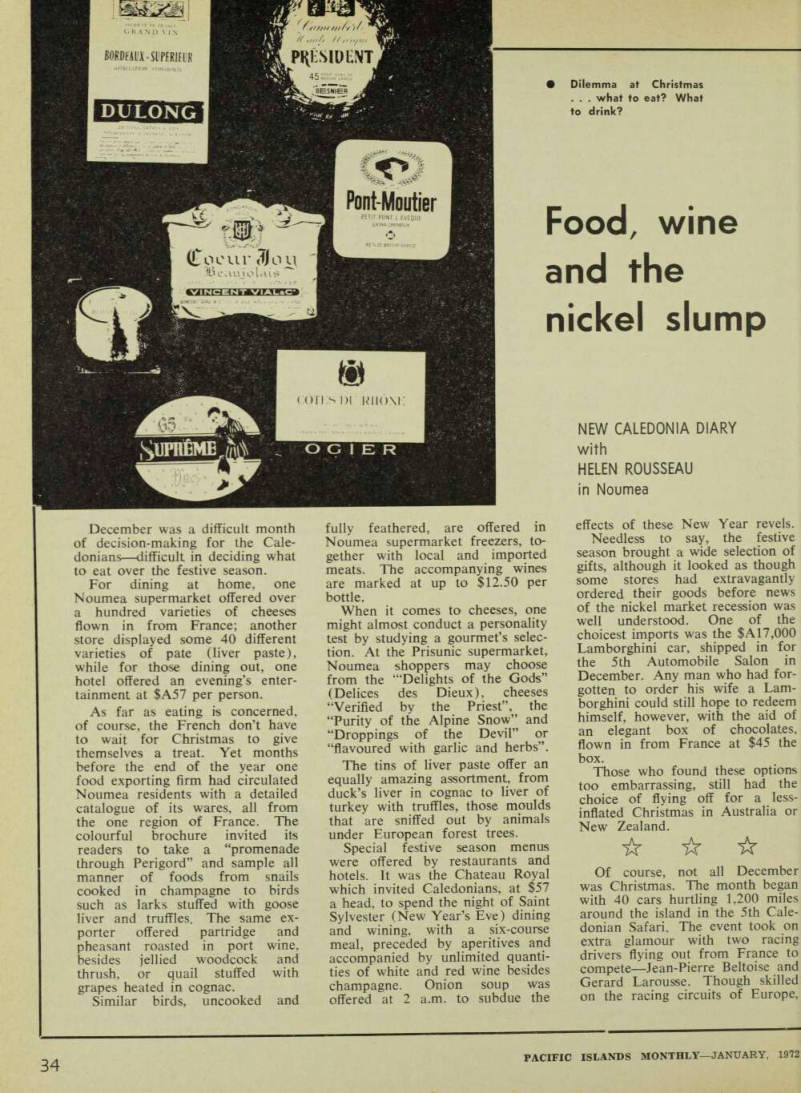
Dilemma at Christmas . . . what to eat? What to drink?
they were apparently ill-equipped for the Caledonian trial and both abandoned within 16 hours of the start.
Among the 23 finishers, one other metropolitan French couple came seventh, Caledonian drivers in Peugeot 504 s took three of the first four places, while Australians Evan Green and Doug Stewart finished 14th and 18th respectively.
The Australians were fortunate in being lent cars on arrival in Noumea, since their own specially prepared Chrysler Valiant Galants did not reach the island till after the trial, due to a wharf dispute in Sydney. The two cars were later able to give a spectacular speed display, however, on an ex pressway leading out of Noumea.
Between the Safari and the Automobile Show, Caledonians were able to turn their thoughts to the sea, when the Noumea Port Captain, Mr. Roland Morin, held an exhibition of his paintings and etchings at the city’s Cultural Centre. The centre itself, up be hind the cathedral, commands a remarkable view of the harbour and ships which Mr. Morin has taken so much pleasure in study ing. Many seamen who have fallen into difficulties in Cale donian waters know the Port Captain for his sympathetic assistance. It was thus hardly surprising to find one shipwreck among his pictures, the old wreck of the Neo-Hebridais which is particularly well preserved in the Bay of Kouaoua, an East Coast
nickel-loading point,
☆ ☆ ☆ Meanwhile, below the Cultural Centre exhibition, at the Territorial Assembly, the 35 councillors were working during December to steer the island into safe waters during what threatens to be the hard year of 1972.
The territorial budget was finally approved at approximately SABO million, of which $l4 million was earmarked for invest ment and equipment expenditure.
Major slices of this amount were allocated to housing and urban development ($A2.5 million), road and bridge construction ($3.3 million), Noumea port extensions ($1 million), construction of schools, dispensaries and adminis trative buildings ($3 million), be sides aid for primary production
to the value of almost $300,000.
Under the current depressed conditions operating on the nickel market, production by the Societe Le Nickel in 1971 was not expected to exceed 46,000 tons of metal. In 1972, the Administration claims the SLN is expected to produce over 50,000 tons of metal. As far as nickel ore is concerned, however, some Japanese buyers have stated that their country’s purchases in the Japanese financial year beginning April 1, 1972, cannot be expected to rise far above two million tons. This would be possibly no more than half the 4.3 million tons purchased during the French export quota days of 1970-71.
Territorial revenue will of course be jeopardised by these export sales dropping below the original optimistic provisions of the Sixth Plan.
Nickel export tax generally provides more than a quarter of the funds for the territorial budget.
When the nickel recession was announced late June, however, the revenue from this source began to fall below expectations. By the end of October, 1971, this tax was yielding over $l3 million for the year, but this was still $2 million below the estimates.
The flow of imports into the territory had also begun to show a slowing down by October.
although at that stage their value ($l7O million) was still 25 per cent, above that of the same 10 months in 1970.
In a bid to maintain the accele rated rate of investment witnessed throughout 1970, the Administra tion was awaiting almost SA2 million in loan money for further road construction, while also seek ing a $25 million loan from the island’s newest bank—the Banque de Paris et des Pays Bas (PARIBAS), scheduled to open in March.
The promises of a big nickel expansion programme have lured many new settlers to Noumea— some 15,000 in fact, during the 18 months to the end of June, 1971.
With this added population pressure, by the end of 1971 Noumea residents were weary of nights spent embarrassingly with out water, of office time wasted in waiting for saturated telephone wires to connect and of mornings spent without electricity as old services were reinforced.
As 1972 came into view, there must have been many a wish cast for the water pipes, the telephone lines and the electricity wires.
The passing of the old year also brought the departure of certain folk from the territory. Mr. Numa Daly, a director of Maison Barrau
• Continued on p. 36.
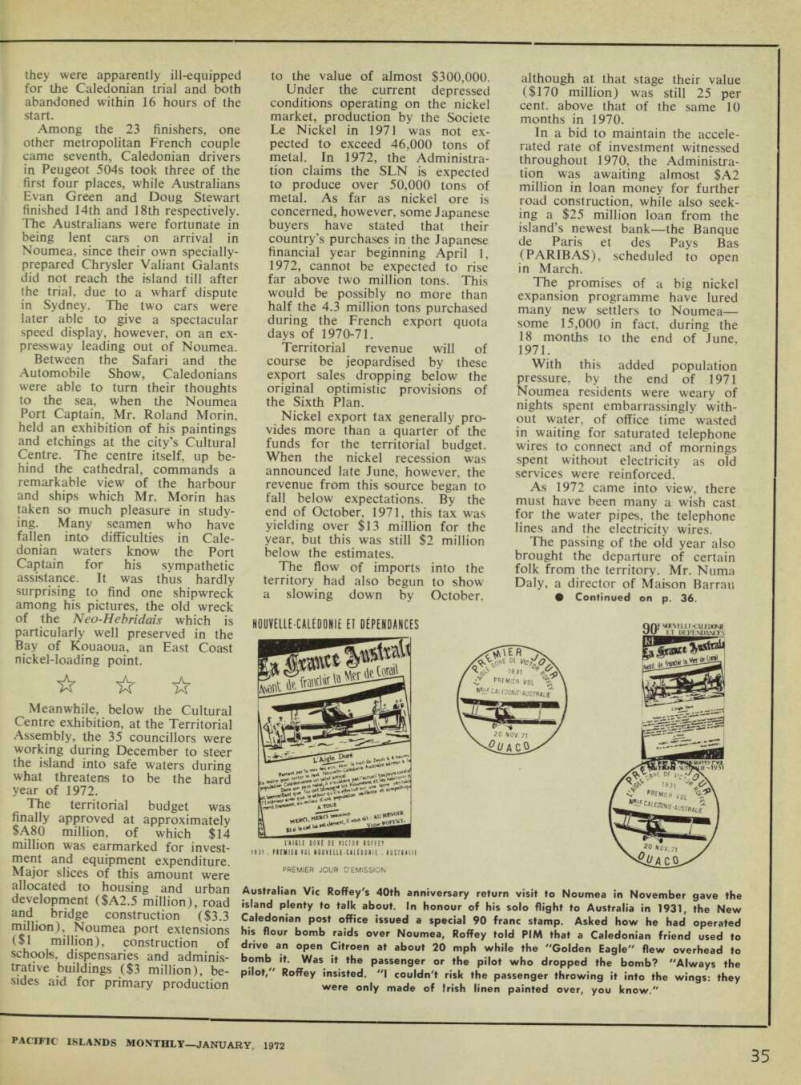
Australian Vic Roffey's 40th anniversary return visit to Noumea in November gave the island plenty to talk about. In honour of his solo flight to Australia in 1931, the New Caledonian post office issued a special 90 franc stamp. Asked how he had operated his flour bomb raids over Noumea, Roffey told PIM that a Caledonian friend used to drive an open Citroen at about 20 mph while the "Golden Eagle" flew overhead to bomb it. Was it the passenger or the pilot who dropped the bomb? "Always the pilot," Roffey insisted. "I couldn't risk the passenger throwing it into the wings: they were only made of Irish linen painted over, you know."
New Caledonia Diary
store and well-known to visiting businessmen, retired at the end of the year and was planning to settle in Sydney. Mr. Daly’s grand father, James Daly, had migrated to New Caledonia in 1862 with two other men from Australia— who thus became the founders of the Cheval and O’Donoghue families in Noumea.
Other departures included popu lar young couple Bob and Judy McCumstie, who left for Canberra after Bob had served for two years as economist at the South Pacific Commission.
Meanwhile, the new SPC secretary - general, Mr. Fred Betham, has been settling in at headquarters opposite Anse Vata beach. But Mr. Betham confessed he had had little time for swim ming since taking up his new duties. There are so many SPC dossiers to study that Mr. Betham in December had not had time to take out his golf sticks or use his tennis racquet in Noumea.
First impressions have obviously been happy ones as Mr. Betham says he expects a flow of family and friends from Western Samoa to visit him during his three-year term of office. And he has an other rather special item he would like to import from Western Samoa —some of the Vanda orchids which flower so beautifully in his home islands. The orchids grow so profusely that Mr.
Betham already had 4,000 plants in his own garden. Before arrang ing their importation to Noumea, however, the new secretary general was intending to visit Papua New Guinea (via Australia) in mid-January. He has also been busy preparing the 25th anni versary of the SPC, which falls on Sunday, February 6.
An Open Day is planned for the public to visit the commission on February 5. Official ceremonies, including a flag-raising, will be held on Monday, February 7.
Many islands are printing special stamps for the anniversary and the Caledonian issue is to be post marked at the SPC headquarters.
Further ahead on the com mission calendar, the opening of the next annual South Pacific Conference has now been set for September 18, 1972, in Apia, Western Samoa.