Tahiti
pp. 38-39 · Read in the full issue
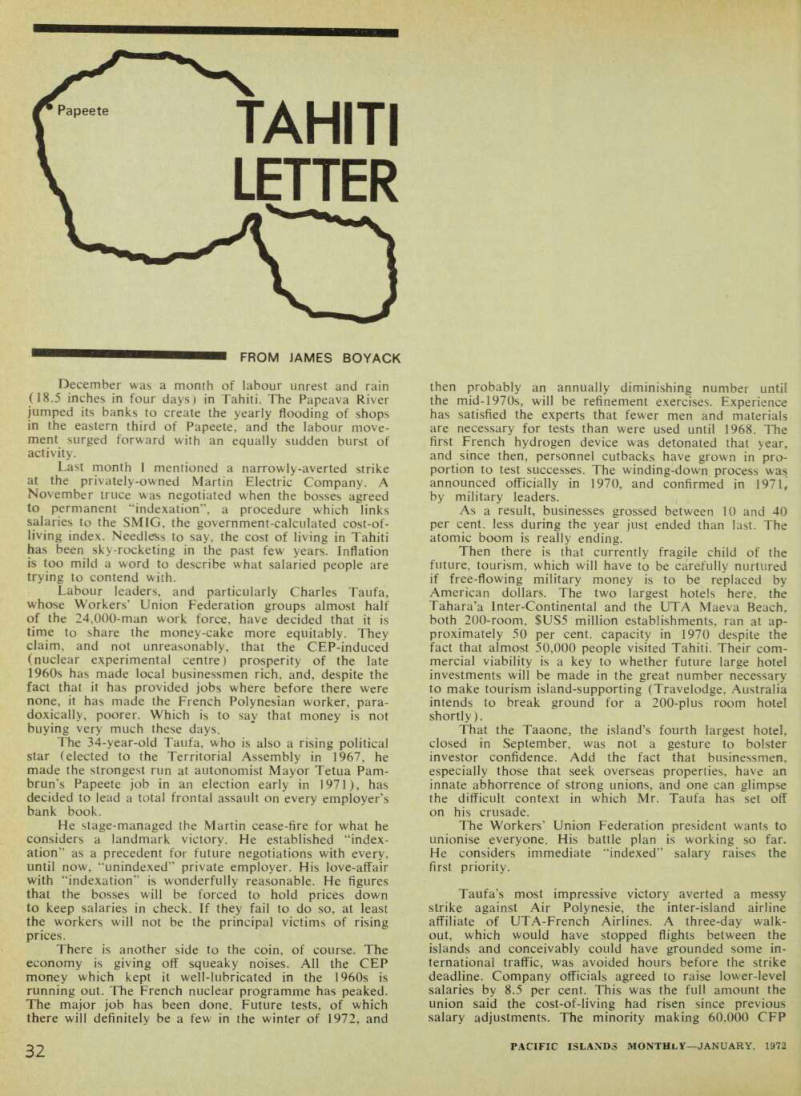
Letter
From James Boyack
December was a month of labour unrest and rain (18.5 inches in four days) in Tahiti. The Papeava River jumped its banks to create the yearly flooding of shops in the eastern third of Papeete, and the labour move ment surged forward with an equally sudden burst of activity.
Last month I mentioned a narrowly-averted strike at the privately-owned Martin Electric Company. A November truce was negotiated when the bosses agreed to permanent “indexation”, a procedure which links salaries to the SMIG, the government-calculated cost-of living index. Needless to say. the cost of living in Tahiti has been sky-rocketing in the past few years. Inflation is too mild a word to describe what salaried people are trying to contend with.
Labour leaders, and particularly Charles Taufa, whose Workers’ Union Federation groups almost half of the 24.000-man work force, have decided that it is time to share the money-cake more equitably. They claim, and not unreasonably, that the CEP-induced (nuclear experimental centre) prosperity of the late 1960 s has made local businessmen rich, and, despite the fact that it has provided jobs where before there were none, it has made the French Polynesian worker, para doxically, poorer. Which is to say that money is not buying very much these days.
The 34-year-old Taufa, who is also a rising political star (elected to the Territorial Assembly in 1967, he made the strongest run at autonomist Mayor Tetua Pam brun’s Papeete job in an election early in 1971), has decided to lead a total frontal assault on every employer’s bank book.
He stage-managed the Martin cease-fire for what he considers a landmark victory. He established “index ation” as a precedent for future negotiations with every, until now, “unindexed” private employer. His love-affair with “indexation” is wonderfully reasonable. He figures that the bosses will be forced to hold prices down to keep salaries in check. If they fail to do so, at least the workers will not be the principal victims of rising prices.
There is another side to the coin, of course. The economy is giving off squeaky noises. All the CEP money which kept it well-lubricated in the 1960 s is running out. The French nuclear programme has peaked.
The major job has been done. Future tests, of which there will definitely be a few in the winter of 1972, and
then probably an annually diminishing number until the mid-19705, will be refinement exercises. Experience has satisfied the experts that fewer men and materials are necessary for tests than were used until 1968. The first French hydrogen device was detonated that year, and since then, personnel cutbacks have grown in pro portion to test successes. The winding-down process was announced officially in 1970, and confirmed in 1971, by military leaders.
As a result, businesses grossed between 10 and 40 per cent, less during the year just ended than last. The atomic boom is really ending.
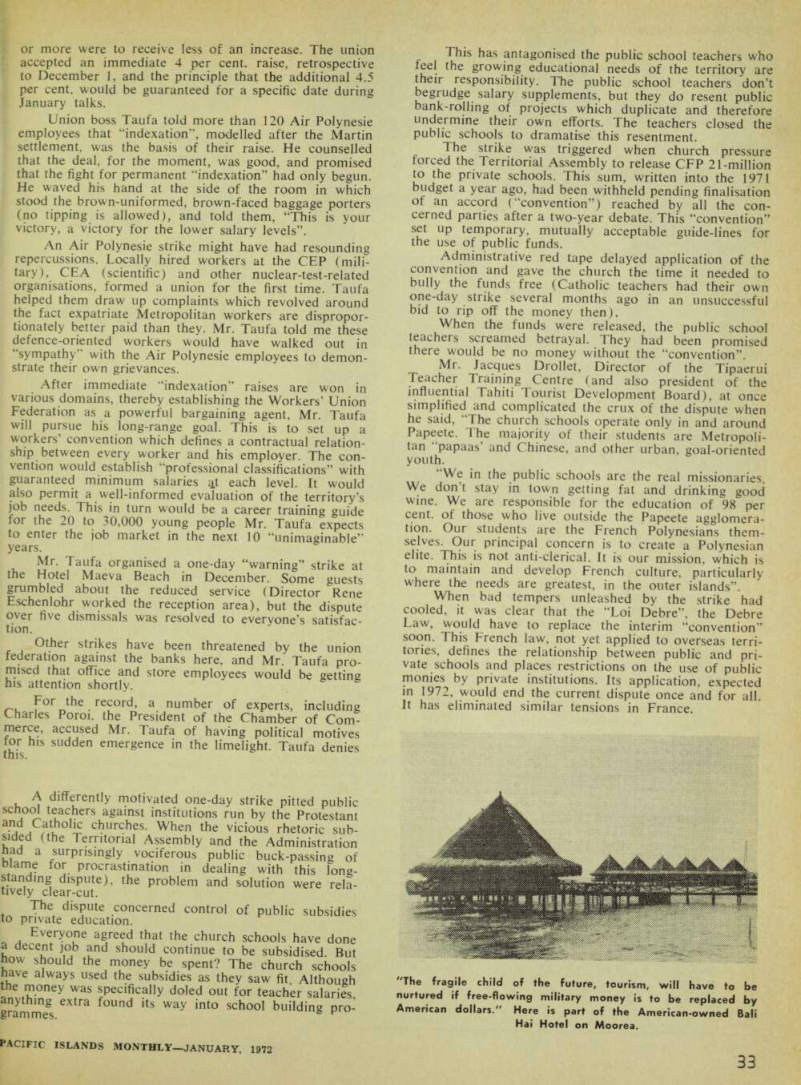
Then there is that currently fragile child of the future, tourism, which will have to be carefully nurtured if free-flowing military money is to be replaced by American dollars. The two largest hotels here, the Tahara’a Inter-Continental and the UTA Maeva Beach, both 200-room, lUSS million establishments, ran at ap proximately 50 per cent, capacity in 1970 despite the fact that almost 50,000 people visited Tahiti. Their com mercial viability is a key to whether future large hotel investments will be made in the great number necessary to make tourism island-supporting (Travelodge, Australia intends to break ground for a 200-plus room hotel shortly).
That the Taaone, the island’s fourth largest hotel, closed in September, was not a gesture to bolster investor confidence. Add the fact that businessmen, especially those that seek overseas properties, have an innate abhorrence of strong unions, and one can glimpse the difficult context in which Mr. Taufa has set off on his crusade.
The Workers’ Union Federation president wants to unionise everyone. His battle plan is working so far.
He considers immediate “indexed” salary raises the
first priority.
Taufa’s most impressive victory averted a messy strike against Air Polynesie, the inter-island airline affiliate of UTA-French Airlines. A three-day walk out, which would have stopped flights between the islands and conceivably could have grounded some in ternational traffic, was avoided hours before the strike deadline. Company officials agreed to raise lower-level salaries by 8.5 per cent. This was the full amount the union said the cost-of-living had risen since previous salary adjustments. The minority making 60,000 CFP
or more were to receive less of an increase. The union accepted an immediate 4 per cent, raise, retrospective to December 1, and the principle that the additional 4.5 per cent, would be guaranteed for a specific date during January talks.
Union boss Taufa told more than 120 Air Polynesie employees that “indexation”, modelled after the Martin settlement, was the basis of their raise. He counselled that the deal, for the moment, was good, and promised that the fight for permanent “indexation” had only begun.
He waved his hand at the side of the room in which stood the brown-uniformed, brown-faced baggage porters (no tipping is allowed), and told them, “This is your victory, a victory for the lower salary levels”.
An Air Polynesie strike might have had resounding repercussions. Locally hired workers at the CEP (mili tary), CEA (scientific) and other nuclear-test-related organisations, formed a union for the first time. Taufa helped them draw up complaints which revolved around the fact expatriate Metropolitan workers are dispropor tionately better paid than they. Mr. Taufa told me these defence-oriented workers would have walked out in sympathy with the Air Polynesie employees to demon strate their own grievances.
After immediate “indexation” raises are won in various domains, thereby establishing the Workers’ Union Federation as a powerful bargaining agent, Mr. Taufa will pursue his long-range goal. This is to set up a workers’ convention which defines a contractual relation ship between every worker and his employer. The con vention would establish “professional classifications” with guaranteed minimum salaries at each level. It would also permit a well-informed evaluation of the territory’s job needs. This in turn would be a career training guide for the 20 to 30,000 young people Mr. Taufa expects to enter the job market in the next 10 “unimaginable” years.
Mr. Taufa organised a one-day “warning” strike at the Hotel Maeva Beach in December. Some guests grumbled about the reduced service (Director Rene Eschenlohr worked the reception area), but the dispute over five dismissals was resolved to everyone’s satisfac tion.
Other strikes have been threatened by the union federation against the banks here, and Mr. Taufa pro mised that office and store employees would be getting his attention shortly. f or the record, a number of experts, including Charles Poroi. the President of the Chamber of Com merce, accused Mr. Taufa of having political motives this " 1S SUdden emer B ence in the limelight. Taufa denies A differently motivated one-day strike pitted public school teachers against institutions run by the Protestant cl ? urc hes. When the vicious rhetoric sub sided (the Territorial Assembly and the Administration had a surprisingly vociferous public buck-passing of biame for procrastination in dealing with this long standing dispute), the problem and solution were rela tively clear-cut.
The dispute concerned control of public subsidies to private education.
Everyone agreed that the church schools have done a decent job and should continue to be subsidised. But how should the money be spent? The church schools have always used the subsidies as they saw fit. Although the money was specifically doled out for teacher salaries anything extra found its way into school building pro-
This has antagonised the public school teachers who reel the growing educational needs of the territory are their responsibility. The public school teachers don’t begrudge salary supplements, but they do resent public bank-rolling of projects which duplicate and therefore undermine their own efforts. The teachers closed the public schools to dramatise this resentment.
The strike was triggered when church pressure forced the Territorial Assembly to release CFP 21-million to the private schools. This sum, written into the 1971 budget a year ago, had been withheld pending finalisation of an accord (“convention”) reached by all the con cerned parties after a two-year debate. This “convention” set up temporary, mutually acceptable guide-lines for the use of public funds.
Administrative red tape delayed application of the convention and gave the church the time it needed to bully the funds free (Catholic teachers had their own one-day strike several months ago in an unsuccessful bid to rip off the money then).
When the funds were released, the public school teachers screamed betrayal. They had been promised there would be no money without the “convention”.
Mr. Jacques Drollet, Director of the Tipaerui Teacher Training Centre (and also president of the influential Tahiti Tourist Development Board), at once simplified and complicated the crux of the dispute when he said, “The church schools operate only in and around Papeete. The majority of their students are Metropoli tan papaas’ and Chinese, and other urban, goal-oriented youth.
We in the public schools are the real missionaries We don't stay in town getting fat and drinking good wine. We are responsible for the education of 98 per cent, of those who live outside the Papeete agglomera tion. Our students are the French Polynesians them selves. Our principal concern is to create a Polynesian elite. This is not anti clerical. It is our mission, which is to maintain and develop French culture, particularly where the needs are greatest, in the outer islands”.
When bad tempers unleashed by the strike had cooled, it was clear that the “Loi Debre”, the Debre Law, would have to replace the interim “convention” soon. This French law, not yet applied to overseas terri tories, defines the relationship between public and pri vate schools and places restrictions on the use of public monies by private institutions. Its application, expected in 1972, would end the current dispute once and for all.
It has eliminated similar tensions in France.
"The fragile child of the future, tourism, will have to be nurtured if free-flowing military money is to be replaced by American dollars." Here is part of the American-owned Bali Hai Hotel on Moorea.