The Gazelle, 1971-72
pp. 33-34 · Read in the full issue
From “TO NGINARAO”, in Rabaul
The Gazelle Peninsula has be- C9me synonomous with strife and disorder Fully equipped riot squads tour the region in trucks.
Riot squads, again fully equipped, parade m the streets of Rabaul. A man has been killed. People are on tna for his murder. People are in gaol for not paying their council tax. Administration officers only vi sit vfiJages wffh an armed escort. r i\ s ere “fis tension—this air of all pervasive violence? And yet other people can move around the Gazelle, into and out of the villages, without escort. Why can they do this? We are told that the strife on the Gazelle is between the various groups within the Tolai community between the Council group, the Mataungan and the Warbete.
There have been many outstanding Administration officers m the Gazelle who have worked h f . people over the years.
The Tolai Cocoa Project was an outstanding example of what was done by the people and these officers together. These men from many different departments consuited with the people and sought their views before acting. And yet we still have strife on the Gazelle and one of the best of these officers, District Commissioner Jack Emanuel, has died. Why?
Unfortunately there have always been some Administration officers who take the attitude, “we are here to rule” The Gazelle has had its share of these men and therein lies one of the causes of the present situation. When some of them looked down on” the Tolai people, showing it by actions and
words, this naturally built up re sentment.
There are, too, far too many examples of the following- A senior Administration officer, the chief speaker at a very important Gazelle function, said in Pidgin in referring to the then dissenting groups, “They are like dogs who eat the crumbs that fall from the council table”. This kind of thing has made many non-dissenters into dissenters. The present campaign to discredit the leaders of the dis senting groups on the Gazelle is only a continuance of this atti tude and can only add to the bit terness. How can anybody seek to settle problems with people when they are deliberately setting out to destroy them in the eyes of their own people?
There are other causes that are also basic to the problem. Land is an obvious one. Forty-one per cent, of the total land is alienated.
The population density on the re mainder is something like 350 to the square mile, including rocks, cliffs, mountains—the lot. The pre sent holders of the alienated land have paid for it in good faith even though it is held under a system that no Melanesian can understand because it is foreign to him. The Administration is largely only the inheritor of this problem but as such is deeply involved, A third obvious source of griev ance is the Tolai Cocoa Project, This was built through loans that have now largely been repaid by growers agreeing to receive less for their beans on the clear under standing that they, the growers, would own the project. The project
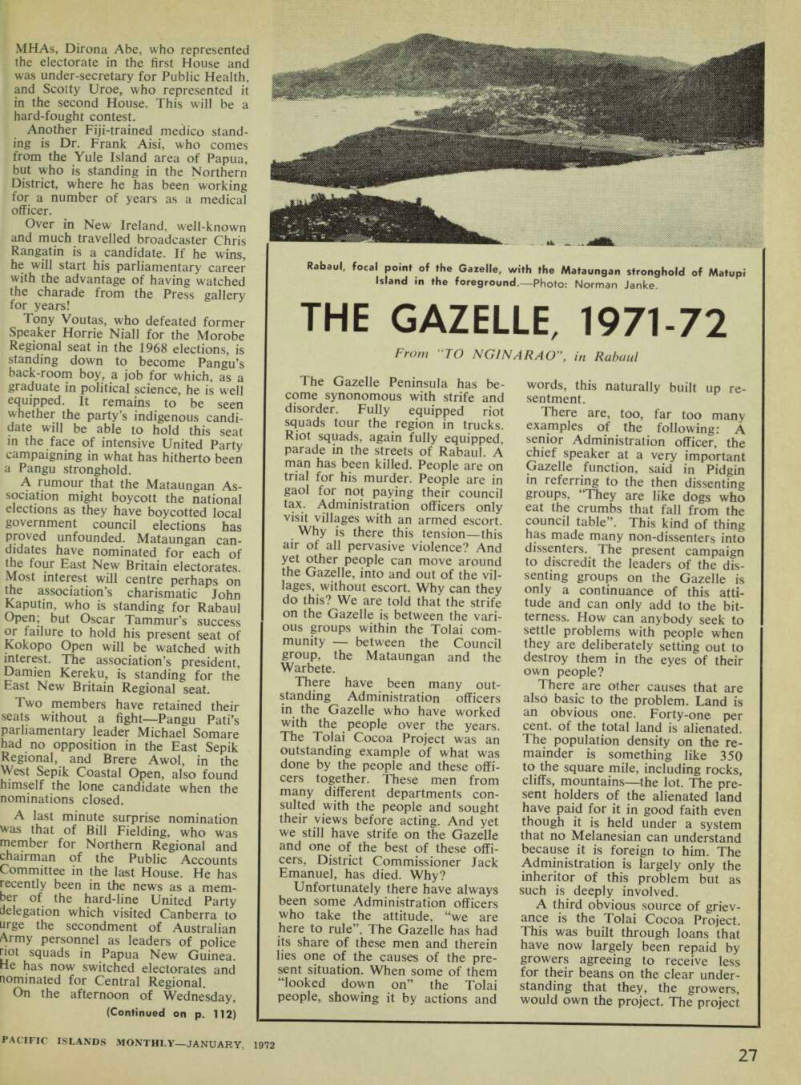
Rabaul, focal point of the Gazelle, with the Mataungan stronghold of Matupi Island in the foreground.— Photo: Norman Janke.
is now being taken over by a com pany in which the growers must purchase shares if they wish to participate. The growers believe they have already paid for equity in the company and that no one has any right to the assets of the project except the growers them selves.
There are many more problems on the Gazelle but the three men tioned illustrate the depths to which they go. The vast majority of the Tolai people see these mat ters as problems which must be solved.
Are they to be solved in the Mataungan way of non-co-opera tion, so that the seriousness of the situation is so dramatised that it is completely intractable, and collapses, and they can pick up the bits?
Are they to be solved in the council way of co-operating with the Administration and so winning some kind of solution for the people while, like the Mataungans. the council uses whatever means are at its disposal to coerce people into following its leadership?
Are they to be solved in the Warbete way of withdrawal from involvement?
Are they to be solved in the Ad ministration way of riot squads on intimidation patrols, road blocks and marches through Rabaul streets?
It is strange to see the mild re action of the Administration to the hooliganism and lawlessness in the Western Highlands where a Euro pean has also been killed, com pared with its reaction on the Gazelle, where the majority of the people believe, rightly or wrongly, that they have legitimate griev ances.
All four groups on the Gazelle have been indulging in mutual re criminations designed to destroy each other’s leadership. There is no future in this and absolutely no possibility of a solution whilst it is indulged in. It is an expensive hobby that our country cannot afford.
There can be no solution to the Gazelle situation until more-crea tive approaches are made to the problems by all parties. Amongst the three Tolai groups it could come through a careful look by the various leaders at their basic prob
lems and a recognition that real solutions to these problems will not be found while they are divided.
Then there needs to be some truly imaginative action by the Ad ministration, the House of As sembly and the Australian Govern ment. This could involve the “early retirement” of certain quite senior officers and a more careful psycho logical assessment of the attitudes of overseas recruits. The Adminis trator has said that the country has no room for those who create racial strife. And yet ... !
Then the land problem needs the kind of approach that Britain made to this problem in the so called white highlands of Kenya.
This will cost real money and would apply to other areas besides the Gazelle. The House of As sembly would need to bring pres sure on the Australian Govern ment for what could easily amount to $3O million as a special grant.
This would allow for the re purchase of the alienated land and its return to the people of Papua New Guinea where there are real land needs. This would mean the present holders of the land would be justly compensated and the just needs of the people met. But will the new House of Assembly have the courage to seek this kind of money from Australia?
And the Tolai Cocoa Project?
Surely the actual growers, whether they be Mataungans or council or Warbete, collectively own the pro ject? The Mataungans do not own it. The council has absolutely no moral right to claim to own it. The Warbete would not claim to own it. The growers are the true share holders.
Maybe too, we need to take a new look at what localisation means. Does it simply mean put ting New Guineans into positions formerly held by overseas people to do the job exactly as the over seas people did it? Or must it ulti mately come to changing methods and approach so that things are done in the Melanesian way? Don’t cry “inefficiency” because the overseas way is proving peculiarly inefficient in its ability to reach many people in any really effective way. This too is part of the Gazelle problem.
Jack Emanuel has died. Why did he die? Perhaps the forthcoming trial of the 14 accused will really look for the reasons behind his tragic, unnecessary death.