uncertainty at PNG polls
pp. 32-122 · Read in the full issue
New, younger voters pose uncertainty at PNG polls
From a Port Moresby correspondent
Nominations closed on December 29 for the PNG general elections that begin on February 19.
Party-wise the situation is confused, for several reasons. Two of the three main parties recently held party con ventions and endorsed candidates for various electorates. However, many candidates have qualifications making them eligible to stand in any one of several electorates, and some, en endorsed for one electorate, have sub sequently decided to stand in another in which they feel they have a better chance of success, to the embarrass ment of their party which has already endorsed another candidate for that electorate. In another case a sitting member who had announced that he would not stand again executed a Melba and re-nominated after another member of his party had put in his nomination.
To add still further to the con fusion some candidates standing as in dependents are probably doing so be cause they think they have a better chance of winning that way, and if and when elected will declare their party affiliation.
These, of course, are just a part of the growing pains of party politics, still so new to Papua New Guinea.
So by and large the chances of the three major parties—United Party, Pangu, and People’s Progress Party are very much wrapped in mystery.
Then there is that dark horse, the New Guinea National Party, of which energetic young Highland progressive, Thomas Kavali, was the only repre sentative in the last House, but which is credited with having ambitions to capture a number of Highlands seats.
Adding to the uncertainty, a very substantial proportion of the voting strength will be that of new voters.
In 1968 the voting age was 21; in 1972 it is 18.
This means that not only those young people now between 18 and 21, but also those between 22 and 24, will be voting for the first time. How they will vote is anybody’s guess, but it may be said that they represent the most sophisticated and politically aware sector of the voting com munity.
A good deal of interest will centre on the Port Moresby urban situation.
The former member for Moresby Open, Percy Chatterton, is not re
nominating, and with the growth of Port Moresby’s population the elec torate has been split into two, Moresby Coastal and Moresby In land.
Voting in the Moresby Coastal Electorate will be dominated by the traditional Motu and Koitapu vil lages now swallowed up by the town, though the migrant settlement vote will be important too.
The most likely contender for this seat seems to be Mahuru Rama Rarua, a leading figure in the co operative movement in Papua, and, a decade ago, a nominated member of the old Legislative Council. He will have to fight off a strong attack, how ever, from Pangu’s national president and trade union leader, Gavera Rea.
In the Moresby Inland Electorate the voting strength rests with expat riates and non-local indigenes, includ ing a large number of Highlanders.
In 1968, the latter had the option of voting in their home electorate, and many did so. This time, provided that they have been living in the electorate for more than six months, they will have to choose between voting in it or not voting at all.
Albert Maori Kiki, secretary of Pangu Pati, well-known trade union
leader and author of Papua New Guinea’s first New Guinean autobio graphy, is the most likely contender for this seat; but he could lose it if the Highlanders in his electorate united to bring about his downfall.
The Central Regional Electorate, covering the whole of Papua’s Cen tral District, is to have a woman can didate, and a very erudite one too.
Originally from Papua’s south-eastern extremity, Miss J. M. Abaijah, young, attractive and sophisticated, received her secondary education in Australia, joined the Department of Public Health, and specialised in Health Edu cation.
In this field she has undergone specialist training at the University of London and in the Philippines, and has visited a number of other coun tries. Accustomed as part of her job to talking with villagers, particularly with village women, and standing on a “fair go for Papua” platform, she should be able to give her male op ponents a run for their money. In deed, those who have called for re served seats for women on the ground that they have no hope of winning in an open contest with men may have to eat their words.
Another high-ranking candidate from the Department of Public Health is Dr. Reuben Taureka, one of the first indigenous medicos to graduate from the Fiji School of Medicine in the days before Papua New Guinea had its own medical college, and one of the founders of Pangu Pati, is contesting the Rigo- Abau Electorate in the eastern part of the Central District—his home ground. He is opposed by two former
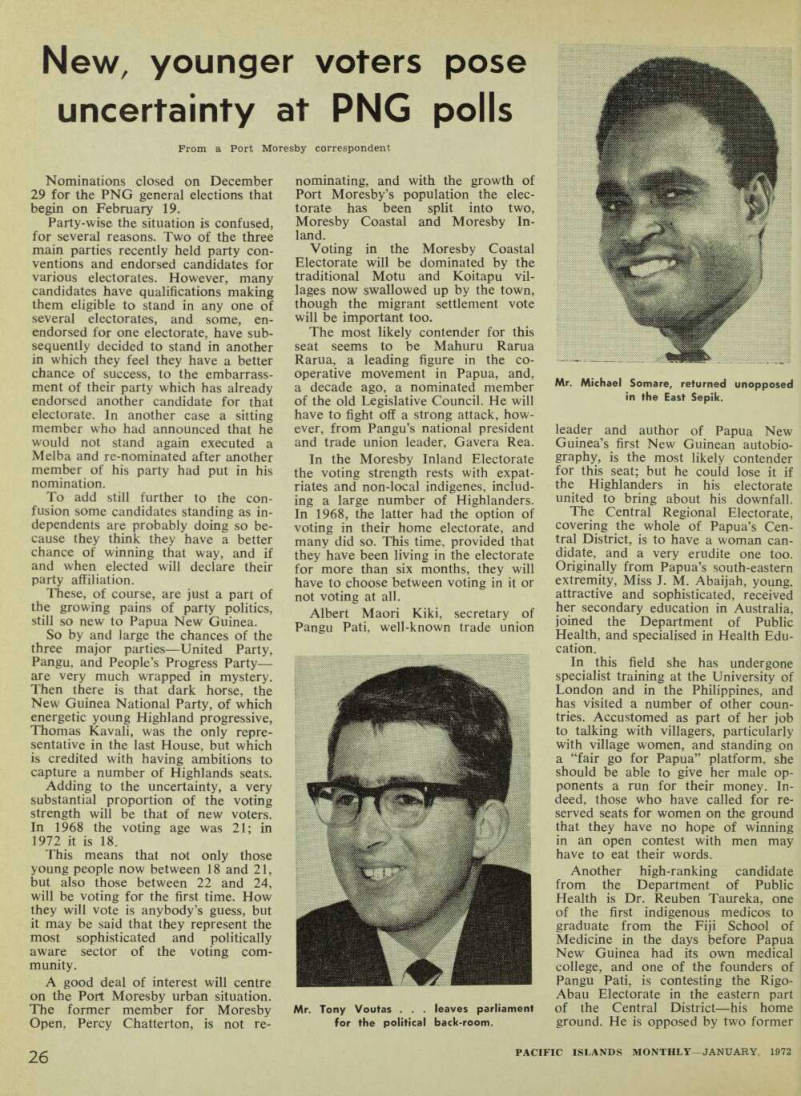
Mr. Tony Voutas . . . leaves parliament for the political back-room.
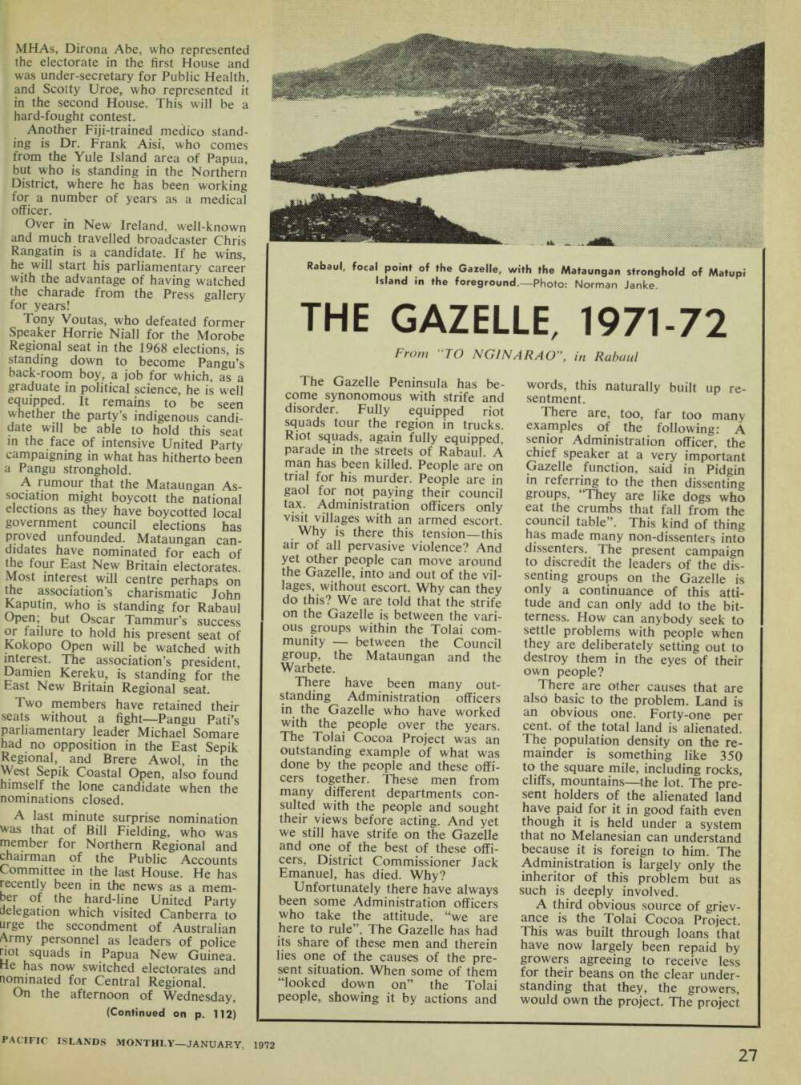
Mr. Michael Somare, returned unopposed in the East Sepik.
MHAs, Dirona Abe, who represented the electorate in the first House and was under-secretary for Public Health, and Scotty Uroe, who represented it in the second House. This will be a hard-fought contest.
Another Fiji-trained medico stand ing is Dr. Frank Aisi, who comes from the Yule Island area of Papua, but who is standing in the Northern District, where he has been working for a number of years as a medical officer.
Over in New Ireland, well-known and much travelled broadcaster Chris Rangatin is a candidate. If he wins, he will start his parliamentary career with the advantage of having watched the charade from the Press gallery for years!
Tony Voutas, who defeated former Speaker Horrie Niall for the Morobe Regional seat in the 1968 elections, is standing down to become Pangu’s back-room boy, a job for which, as a graduate in political science, he is well equipped. It remains to be seen whether the party’s indigenous candi date will be able to hold this seat in the face of intensive United Party campaigning in what has hitherto been a Pangu stronghold.
A rumour that the Mataungan As sociation might boycott the national elections as they have boycotted local government council elections has proved unfounded. Mataungan can didates have nominated for each of the four East New Britain electorates Most interest will centre perhaps on the association’s charismatic John Kaputm, who is standing for Rabaul Open; but Oscar Tammur’s success or failure to hold his present seat of Kokopo Open will be watched with interest. The association’s president Damien Kereku, i s standing for the East New Britain Regional seat.
Two members have retained their seats without a fight—Pangu Pati’s parliamentary leader Michael Somare had no opposition in the East Sepik Regional, and Brere Awol, in the West Sepik Coastal Open, also found himself the lone candidate when the nominations closed.
A last minute surprise nomination was that of Bill Fielding, who was member for Northern Regional and chairman of the Public Accounts Committee in the last House. He has recently been in the news as a mem ber of the hard-line United Party delegation which visited Canberra to urge the secondment of Australian Army personnel as leaders of police not squads in Papua New Guinea.
He has now switched electorates and nominated for Central Regional.
On the afternoon of Wednesday,
(Continued on p, 112)
December 29, the nomination period having closed at noon, the number of candidates notified to the Chief Electoral Office in Port Moresby for the 100 seats of the Third House of Assembly was 530, with the likeli hood of further last minute nomina tions being notified from outlying returning officers during the next few days.
There will be several electorates with more than 10 candidates. These include Moresby Coastal with 11 contestants, seven of them from Hanuabada. This should be a nice exercise in mutual throat-cutting!