Preserving Norfolk Island
pp. 84-85 · Read in the full issue
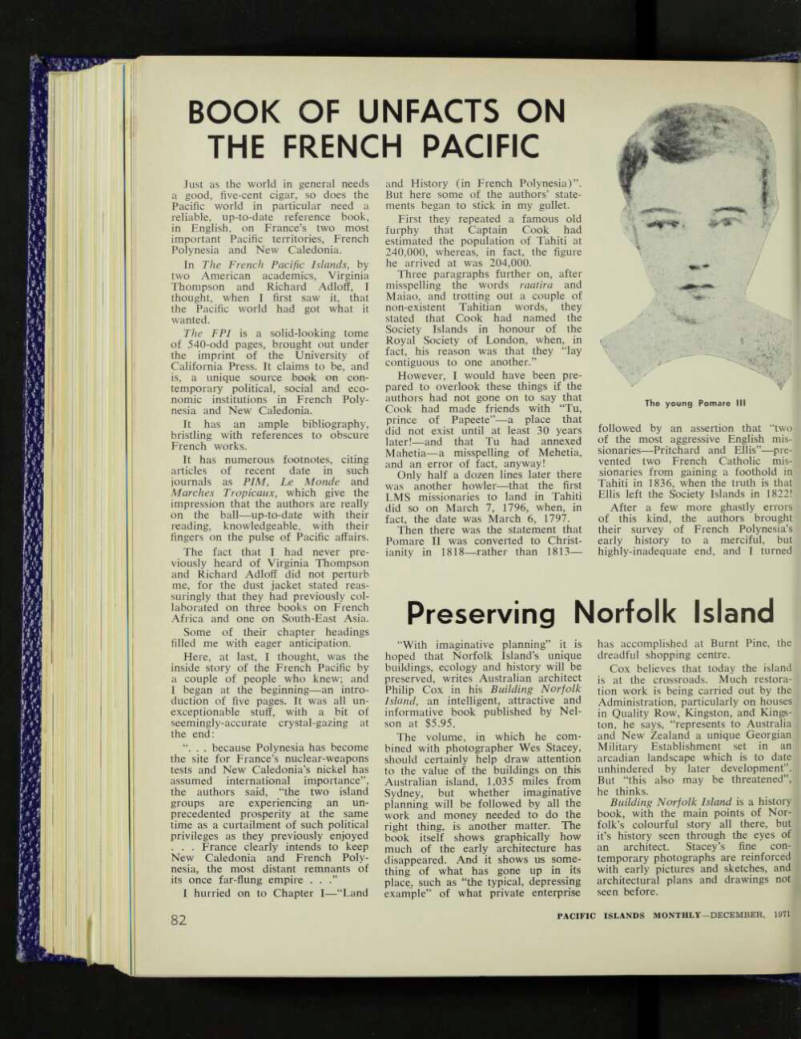
“With imaginative planning” it is hoped that Norfolk Island’s unique buildings, ecology and history will be preserved, writes Australian architect Philip Cox in his Building Norfolk Island, an intelligent, attractive and informative book published by Nelson at 55.95.
The volume, in which he combined with photographer Wes Stacey, should certainly help draw attention to the value of the buildings on this Australian island, 1,035 miles from Sydney, but whether imaginative planning will be followed by all the work and money needed to do the right thing, is another matter. The book itself shows graphically how much of the early architecture has disappeared. And it shows us something of what has gone up in its place, such as “the typical, depressing example” of what private enterprise
has accomplished at Burnt Pine, the dreadful shopping centre, Cox believes that today the island i s a t the crossroads. Much restora tion work is being carried out by the Administration, particularly on houses i n Quality Row, Kingston, and Kings ton, he says, “represents to Australia and New Zealand a unique Georgian Military Establishment set in an arcadian landscape which is to date unhindered by later development”.
But “this also may be threatened”, he thinks.
Building Norfolk Island is a history book, with the main points of Nor folk’s colourful story all there, but it’s history seen through the eyes of an architect. Stacey’s fine con temporary photographs are reinforced with early pictures and sketches, and architectural plans and drawings not seen before.
to the section on New Caledonia hoping, charitably, that that, at least, could not be so bad. But, alas, it was.
The authors began by claiming that the credit for discovering New Cale donia was disputed between partisans of Bougainville (who never got nearer to the place than Malekula, New Hebrides!) and Captain Cook.
Then, in the next breath, they averred that Cook—a doughty Yorkshireman —had named his dis covery New Caledonia because it “so resembled his native Scotland.”
A few lines further on was the statement that Louis XVI of France ordered La Perouse to explore New Caledonia and “assess its economic potential,” whereas La Perouse’s instructions merely stated that he was “to coast along the western shore” of the island and satisfy himself “whether it be one single island only or a cluster of several.”
Other wildly-inaccurate or mislead ing statements followed, so that I was inclined to view the rest of the book with a jaundiced, hypercritical eye.
However, some of the other chapters are, I am glad to say, con siderably more accurate.
The chapters on recent politics in both French Polynesia and New Caledonia, for example, are, as far as I can detect—without having some of the authors’ sources at my finger tips—quite reasonable summaries of events.
But always there are enough small, noticeable errors to make one suspect that there might be more, and bigger ones. The surname of the Tahitian politician Frantz Vanizette is always spelled with an ‘s’; Georges Ahnne has an ‘n’ missing from his surname; and the political parties Pupu Here Aia and Pupu Tiama Maohi are both spelled wrongly.
On p. 356, there is a positively classic booboo of this kind: the Prime Minister of Fiji, Ratu Sir Kamisese Mara, is described as Sir Ramisesi Ratu!!
But the item in the book that I read with the greatest relish was con tained in a chapter on “Education and Cultural Activities” in French Polynesia. It is there stated that: “It was in Moorea that the LMS mission set up two schools at the turn of the [l9th] century. Among the Polynesians
who began attending them in in creasing numbers was young King Pomare 111. Because the main pur pose of the mission schools was to train Polynesians for the ministry, teaching was done in the vernacular.
The LMS schools continued to flourish until the English missionaries were superseded by those of the Societe des Missions Evangeliques de Paris, who had not embarked on their educational work in the islands until 1842.”
Now, the facts of the matter are these. The LMS school that Pomare 111 attended —the celebrated South Seas Academy—was not set up until 1824. Polynesians did not attend it in “increasing numbers”. Pomare 111 was the only child of his race ac cepted—a fact that caused Com modore Wilkes of the US Exploring Expedition to criticise it severely on racial grounds. Its purpose was not to train Polynesians for the ministry, but to give an education to the mis sionaries’ children, and this was done in English. Finally, the LMS schools were not superseded by the Societe des Missions Evangeliques in 1842, but in 1863 (as the authors correctly state elsewhere in their book).
It would be easy to go on and multiply the list of errors of this kind. But that would be spoiling the fun for anyone who wants to buy the book and find them for himself.
Robert Langdon.
(The French Pacific Islands. By
Virginia Thompson and Richard Adloff.
University of California Press. $U516.75).