Book Of Unfacts On
p. 84 · Read in the full issue
The French Pacific
Just as the world in general needs a good, five-cent cigar, so does the Pacific world in particular need a reliable, up-to-date reference book, in English, on France’s two most important Pacific territories, French Polynesia and New Caledonia.
In The French Pacific Islands, by two American academics, Virginia Thompson and Richard Adloff, I thought, when I first saw it, that the Pacific world had got what it wanted.
The FPI is a solid-looking tome of 540-odd pages, brought out under the imprint of the University of California Press. It claims to be, and is, a unique source book on con temporary political, social and eco nomic institutions in French Poly nesia and New Caledonia.
It has an ample bibliography, bristling with references to obscure French works.
It has numerous footnotes, citing articles of recent date in such journals as PIM, Le Monde and Marches Tropicaux, which give the impression that the authors are really on the ball—up-to-date with their reading, knowledgeable, with their fingers on the pulse of Pacific affairs.
The fact that I had never pre viously heard of Virginia Thompson and Richard Adloff did not perturb me, for the dust jacket stated reas suringly that they had previously col laborated on three books on French Africa and one on South-East Asia.
Some of their chapter headings filled me with eager anticipation.
Here, at last, I thought, was the inside story of the French Pacific by a couple of people who knew; and 1 began at the beginning—an intro duction of five pages. It was all un exceptionable stuff, with a bit of seemingly-accurate crystal-gazing at the end: “. . . because Polynesia has become the site for France’s nuclear-weapons tests and New Caledonia’s nickel has assumed international importance”, the authors said, “the two island groups are experiencing an un precedented prosperity at the same time as a curtailment of such political privileges as they previously enjoyed . . . France clearly intends to keep New Caledonia and French Poly nesia, the most distant remnants of its once far-flung empire . . .”
I hurried on to Chapter I—“ Land
and History (in French Polynesia)”.
But here some of the authors’ state ments began to stick in my gullet.
First they repeated a famous old furphy that Captain Cook had estimated the population of Tahiti at 240,000, whereas, in fact, the figure he arrived at was 204,000.
Three paragraphs further on, after misspelling the words raatira and Maiao, and trotting out a couple of non-existent Tahitian words, they stated that Cook had named the Society Islands in honour of the Royal Society of London, when, in fact, his reason was that they “lay contiguous to one another.”
However, I would have been pre pared to overlook these things if the authors had not gone on to say that Cook had made friends with “Tu, prince of Papeete”—a place that did not exist until at least 30 years later!—and that Tu had annexed Mahetia—a misspelling of Mehetia, and an error of fact, anyway!
Only half a dozen lines later there was another howler—that the first LMS missionaries to land in Tahiti did so on March 7, 1796, when, in fact, the date was March 6, 1797.
Then there was the statement that Pomare II was converted to Christ ianity in 1818—rather than 1813—
followed by an assertion that “two of the most aggressive English mis sionaries—Pritchard and Ellis”—pre vented two French Catholic mis sionaries from gaining a foothold in Tahiti in 1836, when the truth is that Ellis left the Society Islands in 1822!
After a few more ghastly errors of this kind, the authors brought their survey of French Polynesia’s early history to a merciful, but highly-inadequate end, and I turned
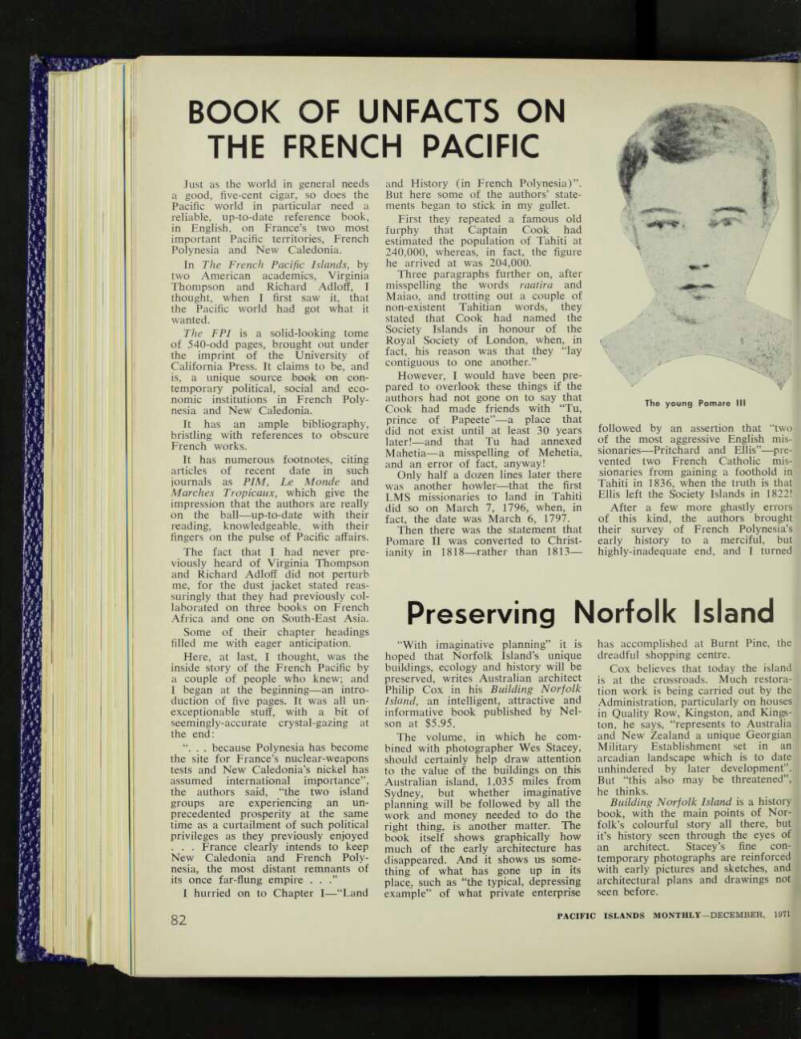
The young Pomare III