Tahiti
pp. 42-44 · Read in the full issue

Letter
From James Boyach
Some people in Tahiti are still out of breath. Their headlong dash through the South Pacific Games’ month of September has them still tumbling forward weeks later, although they broke the tape for victory in record time and form.
Breathing hardest during his October victory lap is Dr. Pierre Cassiau, the President of the Games’ Organis ing Committee. His face relaxes into a weary smile when you ask him what he thought about the Games.
“They were a success, n’est-ce pasT His confidence that a difficult job was well done does not ring the false note of arrogant pride. It is softly stated, an example of Polynesian diffidence. He leaves the rhetoric for others.
The man most responsible for the Games, who has promoted sports in French Polynesia for 25 years (in 1947 he created the first sports federation) has earned the right to satisfaction.
That is why he was disappointed by the post-Games campaign in the New Caledonian newspapers to kill all the goodwill and understanding that these biggest ever Games created between the far-flung peoples of the South Pacific. He was heart-broken and not a little bit angry with the Caledonians for attempting to dis credit the Polynesian spirit of hospitality.
Dr. Cassiau knew how Tahiti mobilised itself. There was an unprecedented common effort to make the Games unforgettable. He was not thinking about the superb facilities, or the endless hours which were re quired to pinpoint all the details and problems built into the organisation of anything so grandiose. That part of the Games’ production was normal. He was thinking about the hundreds of volunteers who made the Games possible, and expressing concern for the thousands of people in Tahiti who were so happy to welcome their Pacific counterparts, and who often went out of their way to do so. He knew that the Games, more than anything, were the only opportunity for these Islanders to share the sense of community which most certainly does unite them.
Dr. Cassiau “deplored” the campaign in the Cale donian Press which distorted the substance of normal rivalry between the two French territories. He said
it was regrettable to make a national issue of hostility, to prolong bad feelings which should never have occurred in the first place. Dr. Cassiau, who spoke for all those here outraged and disappointed by the petty Caledonian interpretation of events, said it was one thing to boo one’s rival, but it was another thing to hate him.
Ironically, it was a New Caledonian athlete whose exemplary sportsmanship is one of my fondest memories of the Games, and whose conduct gave the lie to Cale donian accusations.
Lightweight Noel Mahe entered the lion’s den when he showed his smiling face to the crowd at the Fautaua arena for the boxing finals. Boxing fans are notoriously vociferous; the Tahitian buff is among the most rabid anywhere. The crowd for the finals was the same one which, that morning, had verged on riot when a Tahitian lost a close decision.
Noel Mahe was the only Caledonian in the finals, and , his opponent was a Tahitian. If ever the stage was set for a showdown in the New Caledonia-Tahiti rivalry, this was it.
The curdling screams for his blood did not stop Noel Mahe from smiling. As he moved through the crowd towards the ring, he smiled at those booing in his ears.
He waved at everyone. He fought in the best amateur tradition—skilfully, not brutally. The referee (who was not a Tahitian, in spite of what the Caledonian Press reported there were no Tahitian referees) awarded a close decision to the Tahitian.
Noel’s seconds jumped from the ring mat, gesticulating in protest over the decision. But Noel simultaneously threw his arms around the winner, Joseph Toi, em bracing him, patting him on the back. He raised the Tahitian’s arm to demonstrate that he recognised his own defeat.
It was too much, even for the crazy Papeete boxing fans. When that young man left the ring still smiling, the Tahitian audience gave him a standing ovation. That is what these Games were about, albeit that the Cale donian Press, counting medals and examples of hos tility as if they were tons of nickel, did not notice. ☆ ☆ ☆ This spirit of internationalism and conciliation carried over into Tahiti’s political arena in the weeks before and after the Games. Overseas Territories Minister Pierre Messmer, one of the most influential men in the French Government, visited Tahiti in September to open the Games and initiate discussions with political leaders about the territory’s future (PIM, Oct., p. 24).
The minister’s efforts were welcomed in all political camps, although some of those in the Territorial Assembly majority which favours “autonomic interne —greater local self-government—moderated their en thusiasm with the proviso that only in the future would a full assessment be possible of the consequences of the minister’s visit.
Political commentary after his departure, however, left no doubt that Mr. Messmer made a very strong and positive impression here, and people thought he had a sincere desire to help work out the problems faced by this small territory in the middle of the Pacific and the 20th century. , , , , The man generally considered to be the leader ot the autonomy movement, French National Assembly deputy Francis Sanford, told the Journal de Tahiti m an exclusive interview that he was very satisfied with the ministerial visit, which “should prove very con structive”. J Mr. Sanford, whose Te E’A Apt (New Road) party holds 11 of the Territorial Assembly’s 30 seats, more
than any other single political group, went on to explain that, as he had pledged in his campaign, he had drawn up and submitted a proposition to the iNationai Assembly which, if adopted, would give French Polynesia self government. Ihe Assembly majority, which adopted this proposal, was able to discuss it with the minister during his visit.
“It is obvious,” Mr. Sanford said, “that we did not expect that Overseas Territories Minister to pass judg ment on this question while he was here. That is the prerogative of the deputies and senators [in France].
But, all the same, it gave us great satisfaction to see, for the first time, the opening of frank dialogue with the representative of the government on a subject which had always been taboo.”
Mr. Sanford’s satisfaction must have been shared by his colleagues. According to Daniel Millaud, the Te E’A Api official spokesman, the Assembly delegates, in a rare display of agreement between the majority and the minority, voted overwhelmingly to discuss economic and social matters in priority during closed-door debate with the minister. Political problems were placed last on the agenda.
Mr. Millaud, who would take over Pouvanaa A Oopa’s new seat in the French senate were the 73year-old representative to die, said, “Even though we knew that he doesn’t necessarily agree with us, Mr.
Messmer’s visit definitely heralds a change in the rela tionship between the Assembly majority and the central government”.
The very articulate Assembly counsellor, who is part- Tahitian and part-French, noted that previous holders of the title of Overseas Minister, Billotte and Rey, categorically refused to talk politics with the Assembly.
He recalled that in 1968 an Assembly mission sent to Paris to discuss “autonomie interne” was refused an audience with Mr. Billotte.
The Papeete dentisripolitician stressed the fact that politics could not be divorced from economic questions, because decisions which affected the economy were necessarily made by politicians. The minister had been emphatic when he said that the responsibility for French Polynesia’s economic future rested with the Polynesians themselves. It was for this reason, Mr. Millaud said, that the Territorial Assembly would continue to seek greater authority.
“Our position is better now,” he said. “We demon strated that we are not savages, that we speak French, that our feet are on the ground. We have never asked
for independence. We know we cannot go it alone because we would be swallowed up by somebody else.”
On the same day the assembly met with Mr. Messmer, the French National Assembly deputy who heads the commission studying the “autonomie interne” propo sition arrived in Tahiti. He had come here at the minister’s request for a week of discussions with the Assembly about the projected law.
Mr. Messmer himself was also happy with his visit here. In reply to a question posed by the French newsagency correspondent about the improved political climate in the territory, Mr. Messmer said that reaction to his Assembly speech and his conversations was favourable. Those who ardently supported the political setup as it is, were “very pleased” with his stand, he said, and those who sought to modify the situation had expressed “satisfaction to note that my visit has opened closed doors, even if in the near future I do not foresee an evolution in the territory’s statute”.
Mr. Frantz Vanizette, who is a political independent in the Assembly minority group, was one of those who were very pleased.
Director of the government Social Welfare Depart ment, a proponent of gradual and rational “Tahitianisa tion” of both the public and private sector, he said that his analysis of the situation was in accord with the minister’s. Mr. Vanizette said that he was enthused by the concept of an Economic and Social Council which the minister suggested could be created here (such a body operates in France at the national level with Polynesian representation).
This elected council, if formed, would bring to the territorial level debate and options about French Polynesia’s economic and social future. It would according to Mr. Vanizette, certainly be a large step towards local autonomy of management (“gestion”).
Currently, a planning commission concerned with such problems meets only to discuss individual Five Year Plans. The new advisory council would hold regular meetings.
Mr. Pierre Messmer is a very important French leader. There are four levels to the French ministerial hierarchy, and Mr. Messmer is at the top. He received his higher education at the French National Overseas University. With the technical knowledge thus acquired, he was appointed High Commissioner in two different French African federations and thereby gained solid experience in French overseas affairs. He knows Tahiti well. He was President de Gaulle’s Defence Minister for 10 years and he supervised the establishment of the Pacific Experiments Centre (CEP) in French Polynesia.
He was responsible for determining the impact of such an installation here and for solving the human problems thus created. He remains one of the most important Gaullist officials, with enormous influence in the Gaullist Parliament, and at all levels of government.
Liberal anti-autonomist Vanizette believes that all these qualifications give Minister Messmer the political leverage, experience and foresight to administer an official and progressive “Tahitianisation” of these islands within the structure of the present political statute.
He believes that such an accomplishment could satisfy partisans on both sides of the debate about Tahiti’s political future. & ☆ French Polynesia’s Governor Pierre Angeli in mid- October may have provided the best indication that Mr. Messmer s visit was the beginning of a new re lationship between the autonomists and the French government.
The governor proposed, and the executive Govern
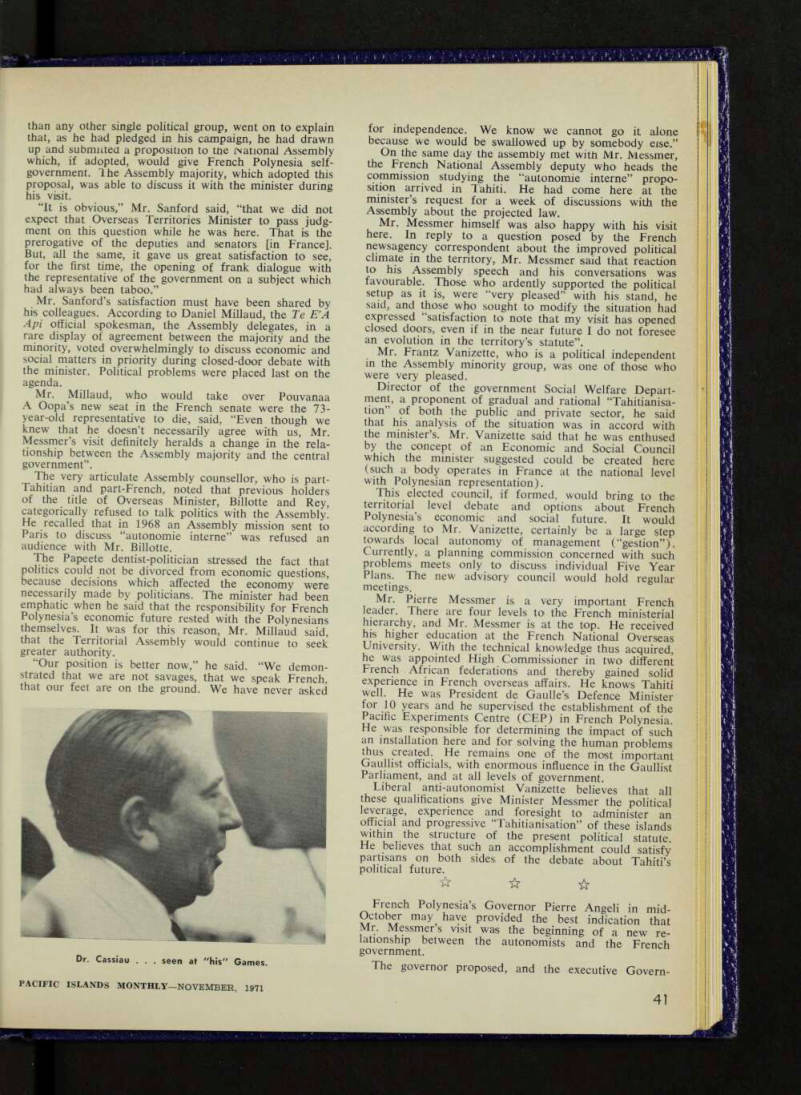
Dr. Cassiau . . . seen at "his" Games.
ment Council adopted, the cancella tion of a September 8, 1970, decree which banned controversial French notary public Marcel Lejeune from the major islands in French Poly nesia.
“Maitre” Lejeune was, in effect, ex pelled from the territory because his political activities at the time had led the French Government to believe that his continued presence here posed a threat to “public order”.
The then Overseas Territories Minis ter, Henri Rey, was about to make an official visit to Tahiti. The “Maitre” had been involved in a fierce administrative battle during the month of August, 1970, to win concessions for his Air Moorea-Air Tahiti air taxi service. When Mr. Le jeune concluded, and publicly an nounced, that a government plot was preventing his successful competition (he wanted import licences to import new aircraft) with the UTA-French Airlines’ subsidiary RAI, the scheduled inter-island airline, he moved his fight from an economic and administrative level to the poli tical war zone The government came to the con clusion that he intended to help organise perhaps violent demonstra tions during the minister’s visit a few days later. It justified the “Maitre’s” expulsion on these grounds* The Government Council’s com munique announcing that “Maitre”
Lejeune could return here said, in part, “It now appears, in effect, that there is no longer reason to prolong the application of this exceptional measure [the expulsion], motivated at the time by considerations of public order, now that a relaxed climate is evident in the territory and of which the recent visit of the State Minister was an indication . . .”
In a completely separate decision, however, the Government Council decreed that “Maitre” Lejeune will not be allowed to resume his func tion as a notary public for five years.
The communique said “Maitre”
Lejeune had broken the rules of his
profession.
The decision to suspend his notariat for five years was based on a lengthy investigation of his acti vities here by the Superior Notariat Council, and demands made by the state prosecutor and advice offered to the government by Superior Court of Appeals in Papeete. “Maitre” Le jeune had pleaded his case here late last month through a Paris lawyer.