Australia
pp. 123-124 · Read in the full issue
Will Display
In Suva
A three-day trade display in Suva in November will be Australia’s first really concerted effort to generate new markets in the Islands for its industrial and other manufactured equipment.
Australia is moving away from a rural economy.
Australian equipment related to economic development—such as heavy machinery for agriculture—is already playing an important role in Fiji’s development, through Austra lia’s South Pacific aid programme.
During the six-year period up until June. 1972 Australian aid to Fiji in the form of agricultural equipment will have totalled approx imately SA7 80,000, much of it directed towards the Rewa and Navua rice-growing schemes.
On the trade side, Australia—with around 25 per cent, of the overall market—does very well indeed in Fiji. It aims to do even better and is placing the emphasis during the trade fair on light, medium and heavy manufactured goods for industry and agriculture.
Main Australian imports at present balance out fairly evenly between foodstuffs, capital equipment and sophisticated industrial supplies a total of almost S2O million worth during 1969-1970.
The November promotion has been directed towards the whole of the South Pacific, with invitations going out to VIPs and businessmen from New Caledonia, the New Hebrides, the Solomons, the Samoas, Tonga and Tahiti.
“We see Fiji and New Caledonia as the two biggest potential markets in the S. Pacific for equipment related to economic development,” said Aus tralian Trade Commissioner in Fiji, Mr. L. Martin. “We’ve put a lot of effort into diversifying our markets elsewhere, but with the whole of this region poised on the brink of new development in industry and agricul
ture, it’s logical that we should organise a trade display in Fiji at this ti me “Australia has the back-up of supplies and we can get the goods here quickly. South Pacific merchants will be able to assess the merits of Australian manufactures, at first hand.”
The trade display will be at the Tradewinds Hotel between November 9-11. More than 70 manufacturers will take part.
Interest among Australian manufacturers in the exhibition was so high that the Department of Trade was unable to accommodate all those who wanted to take part. It decided to draw up a “wait” list in case any of those allotted space had to withdraw.
The Australian economy no longer rides on the sheep’s back. In the last 20 years there has been quite a dramatic change. Although the export of primary products is still important, and a mineral boom in the last two or three years has helped to lift exports, manufactures covering a huge range of goods are coming increasingly into the picture.
When the inevitable happens and the United Kingdom goes into the Common Market, Australia will lose a big market for many of her primary products. However her growing industries will help to take up much of the “slack”. ~. r , , With a population of less than L million Australia for some time has been seeking markets outside her shores for her growing range of products.
Australia has many natural advantages in trade with Pacific Islands, these include air services, at least daily in many cases, and enter-
prising shipping companies, always looking for new ports, (it is ironical that about this time Fiji has j os t the service to and from Australia offered by the CSR’s Rona, anc j t hat there is no replacement in s i g ht at present), Another advantage is that three of the big trading companies in Fiji, Burns Philp (SS) Co. Ltd., W. R.
Carpenter and Morris Hedstrom are all almost wholly-owned in Australia, Their links with their head offices, plus Island trading know-how in the Australian headquarters are of great value to Australian exporters seeking to trade with Fiji, Fiji has a growing and diversifying economy, and it has become more an£ l more the target of Australian ( anc * Zealand) businessmen.
Australia is now the biggest single exporting nation to Fiji. Through hard sell techniques, Australia is making sure she at least maintains that position.
The display at the Tradewinds Hotel will cover 13,000 square feet 0 £ S p ace? including a special annexe a( jded to the hotel’s existing display area to ca t er f or the large number 0 f exhibitors. Naturally, the exhibitors will not confine their activities to the Tradewinds Hotel. They will be making contact with Fiji businessmen, talking with Government officials,
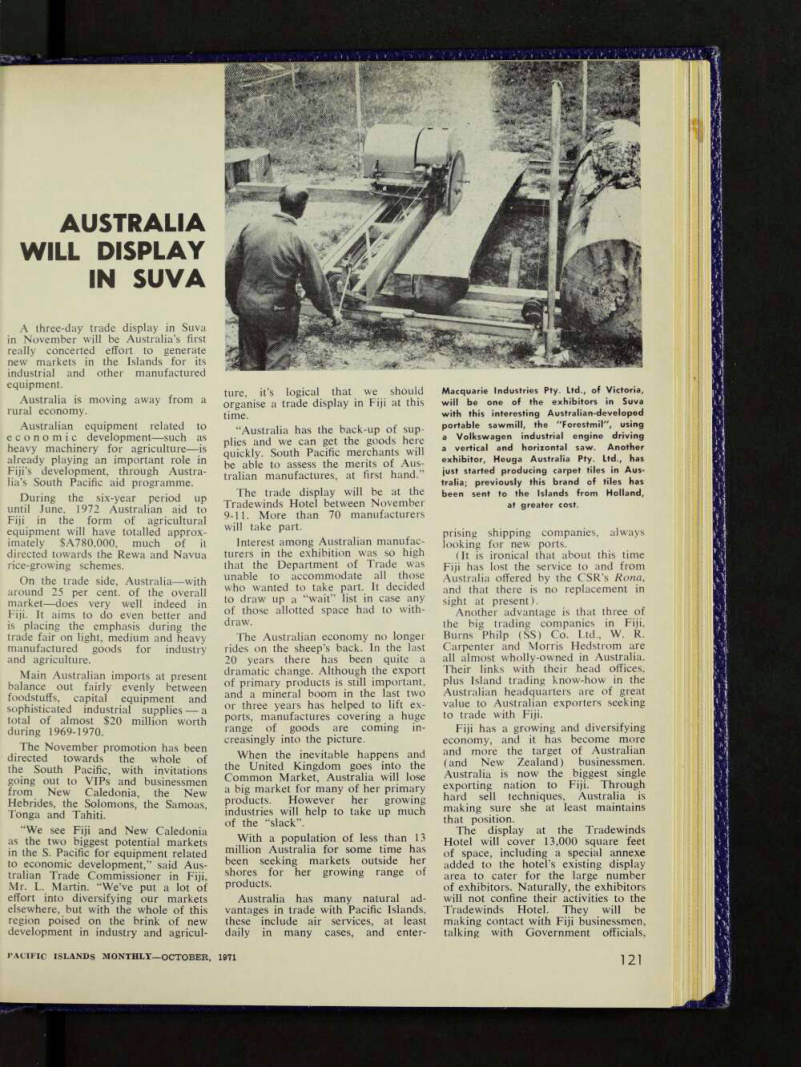
Macquarie Industries Pty. Ltd., of Victoria, will be one of the exhibitors in Suva with this interesting Australian-developed portable sawmill, the "Forestmil", using a Volkswagen industrial engine driving a vertical and horizontal saw. Another exhibitor, Heuga Australia Pty. Ltd., has just started producing carpet tiles in Aus tralia; previously this brand of tiles has been sent to the Islands from Holland, at greater cost.
exploring what is offering in the way
Aboi“ e 2o°of K
play a variety of products—food appliances, durables, fittings and a variety of other goods—which have a role somewhere in the tourist industry.
Fiji, for its size, has a big rural economy, and here the farmer will be able to see many of the aids which have been developed to make life easier for him. Included in the range of products to be chosen are- Agricultural equipment, farming machinery, chemicals, sawmills, buildmg equipment and materials, tools, hardware, abrasives, safety equipment, electrical and electronic equipment, pumps, automotive accessories, food processing equipment, commercial catering equipment, LP gas equipment, refrigeration and cold room equipment, furniture, commercial paper, books, stationery, records, educational equipment, liquors, sports goods, fashions and jewellery.
The exhibition will enable Australia to show Fiji or rather reemphasise in Fiji that she is capable of making as good a product as any of the older manufacturing countries.
The Fiji
wr margarine 0 Tn eW slpt\m W ber! foiling‘a ? c lncrease in the price of local It was retailing at 46-48 c a Pound—iand in some of the smaller sho P s ’ at 50c - The Battle of the Butter began when New Zealand upped its own prices, and Fiji prices followed Fiji butter is blended with the New Zealand product.
Primp M.n.ctpr d f c - v Mnr m£ Mim^ ter atu S* r Kamisese hi * C t u**™ Zeala " d Fi ji_ an f I^s5 ld<Was not P Zealand B butter whde
Zealand DaiwEd
T" j Jf H airy Board altered pnces K ‘ . .
A previous condition with New Zealand was that we would buy our butter there on condition they gave us a rebate equal to a sum below *he world price, which amounted to $l2B a ton at that time. Under that agreement we should have consultatlons if the price changed,” the Prime Minister said.
They have whittled away this rebate unilaterally to $4O a ton and are now suggesting $5 a ton and
wish to have a condition that they
Isrss
P ared >° enler into a " open-ended ?^® e “ ent *° go on buying butter -* ,^ ealland u “<?S r J 3 condition "?' ch would prevent Fiji from buying wUfi P elsewbere ' “ agreement ” the PM said”” a fU '
tu x? ’ 1,, !f .
r i* e Zealand Dairy Board re ? ied 1 , d had . increased the price m consultation with Fiji Government officials and said it was “surprised and concerned” at the Prime Minister ’ s remarks, The Minister for Commerce and Industry, Mr. Vijay R. Singh, de dared in return that there had been no cons ultations but that the ministry had been advised in June of an im pending increase, and of two further increases since, In 1968, the Government placed a ban on imports of Continental butter into Fiji, although at the time it was selling for 6c a pound less than the Fiji-New Zealand blend The embargo was ordered as a means of supporting local industry Fiji’s dependence on New Zealand butter was clearly illustrated during the month-long dock strike when supplies dried up completely