'Do more!' exhorts Fiji
p. 122 · Read in the full issue
dock union leader
“Come on boys—let’s see an honest day’s work!”
Voicing this sentiment during a meeting to explain Mr. Justice I. R.
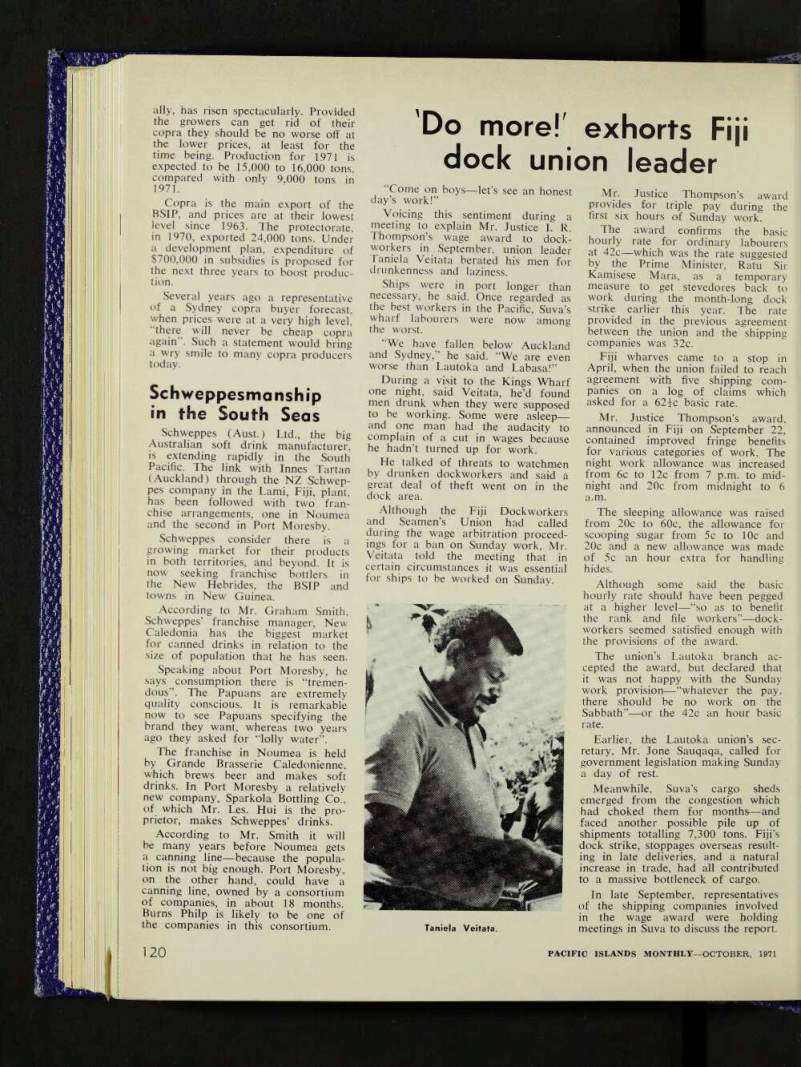
Thompson’s wage award to dock workers in September, union leader Taniela Veitata berated his men for drunkenness and laziness.
Ships were in port longer than necessary, he said. Once regarded as the best workers in the Pacific, Suva’s wharf labourers were now among the worst.
“We have fallen below Auckland and Sydney,” he said. “We are even worse than Lautoka and Labasa!”
During a visit to the Kings Wharf one night, said Veitata, he’d found men drunk when they were supposed to be working. Some were asleep— and one man had the audacity to complain of a cut in wages because he hadn’t turned up for work.
He talked of threats to watchmen by drunken dockworkers and said a great deal of theft went on in the dock area.
Although the Fiji Dockworkers and Seamen’s Union had called during the wage arbitration proceed ings for a ban on Sunday work, Mr.
Veitata told the meeting that in certain circumstances it was essential for ships to be worked on Sunday.
Mr. Justice Thompson’s award provides for triple pay during the first six hours of Sunday work.
The award confirms the basic hourly rate for ordinary labourers at 42c—which was the rate suggested by the Prime Minister, Ratu Sir Kamisese Mara, as a temporary measure to get stevedores back to work during the month-long dock strike earlier this year. The rate provided in the previous agreement between the union and the shipping companies was 32c.
Fiji wharves came to a stop in April, when the union failed to reach agreement with five shipping com panies on a log of claims which asked for a 62ic basic rate.
Mr. Justice Thompson’s award, announced in Fiji on September 22, contained improved fringe benefits for various categories of work. The night work allowance was increased from 6c to 12c from 7 p.m. to mid night and 20c from midnight to 6 a.m.
The sleeping allowance was raised from 20c to 60c, the allowance for scooping sugar from 5c to 10c and 20c and a new allowance was made of 5c an hour extra for handling hides.
Although some said the basic hourly rate should have been pegged at a higher level—“so as to benefit the rank and file workers”—dock workers seemed satisfied enough with the provisions of the award.
The union’s Lautoka branch ac cepted the award, but declared that it was not happy with the Sunday work provision—“whatever the pay, there should be no work on the Sabbath”—or the 42c an hour basic rate.
Earlier, the Lautoka union’s sec retary, Mr. Jone Sauqaqa, called for government legislation making Sunday a day of rest.
Meanwhile, Suva’s cargo sheds emerged from the congestion which had choked them for months—and faced another possible pile up of shipments totalling 7,300 tons. Fiji’s dock strike, stoppages overseas result ing in late deliveries, and a natural increase in trade, had all contributed to a massive bottleneck of cargo.
In late September, representatives of the shipping companies involved in the wage award were holding meetings in Suva to discuss the report.
Taniela Veitata.