put McPhee
p. 74 · Read in the full issue
Demand for his work put McPhee 'on velvet'
By R. W. Robson
An announcement by the Ameri can National Club (Sydney) to its members that it had bought, “from an Islands studio”, for $1,200, four McPhee paintings on velvet, sent my memory back about 25 years.
I was in Suva, in the sample room of Hutchinson Co., and my eye was caught by a couple of paintings on the wall brilliant portrayals of Samoan village scenes.
They were signed “McPhee”. I had never heard of McPhee. Neither had the man with me. When he saw that they were for sale at two guineas each, he sneered. “Some art ist without any arse in his pants,” he said. “They’re always wandering into Fiji.”
I know little of music or art. In that field, my friends write me off as a barbarian. But the few things I like, I like very much. I liked McPhee.
I bought those two paintings, and later I got three more. The lot cost less than £2O. They’ve been promin ent on the walls of my home for many years.
I’ve forgotten how, but eventually I met McPhee a small, bearded, middle-aged man, full of the zest of life and we formed a friendship that lasted. He then was wandering around Upolu with his easel and brushes, but what he was getting from picture sales did little more than buy paint. The publicity I gave his work in PIM helped his morale and his pocket, I think.
One artist, commenting in PIM of June, 1944, warmly praised
McPhee’s Samoan paintings for “their full and vivid colour, their light effects and their superior drawn lines”.
A couple of years later, I found McPhee settled happily in Papeete, with a charming Tahitian wife, Elizabeth. She had land rights and this, with some demand for his work, made life easier.
McPhee introduced me to the re markable work of Leeteg, who had settled in Tahiti, and who was gain ing a world reputation for his paint ing on velvet. McPhee had become an admirer and disciple of Leeteg.
The French, at that time, were conducting a campaign against for eigners whom they thought had in sufficient means of support. Tahiti always has attracted a wastrel type.
They got after McPhee. McPhee de fied them successfully for a long time, through his marriage to Eliza beth; but eventually they drove him out.
By then, he had acquired some thing of the art of Leeteg. I have forgotten the order of the events, but I think he and Elizabeth were
living in an Auckland suburb when Leeteg died in Tahiti, and they man aged to get a permit to return to Tahiti.
A number of artists tried to fol low Leeteg, but none had gained the skill and feeling which McPhee now displayed in the difficult art of painting on velvet. I know that he wrote to me about this time, and described his success, and the grow ing demand for his work, especially in portraiture.
I lost touch with Charles McPhee in recent years. I believe he left Tahiti eventually, and has since re sided in New Zealand. I have heard that he got anything up to $2,000 for his paintings, in America.
McPhee was bom in Albany, West Australia, in 1910, and for many years led a wandering, adven turous life. He early showed an apti tude for drawing, and gradually de veloped his skill as a designer and display artist. He drifted to Samoa in 1937, and spent most of the fol lowing years in and around Poly nesia.
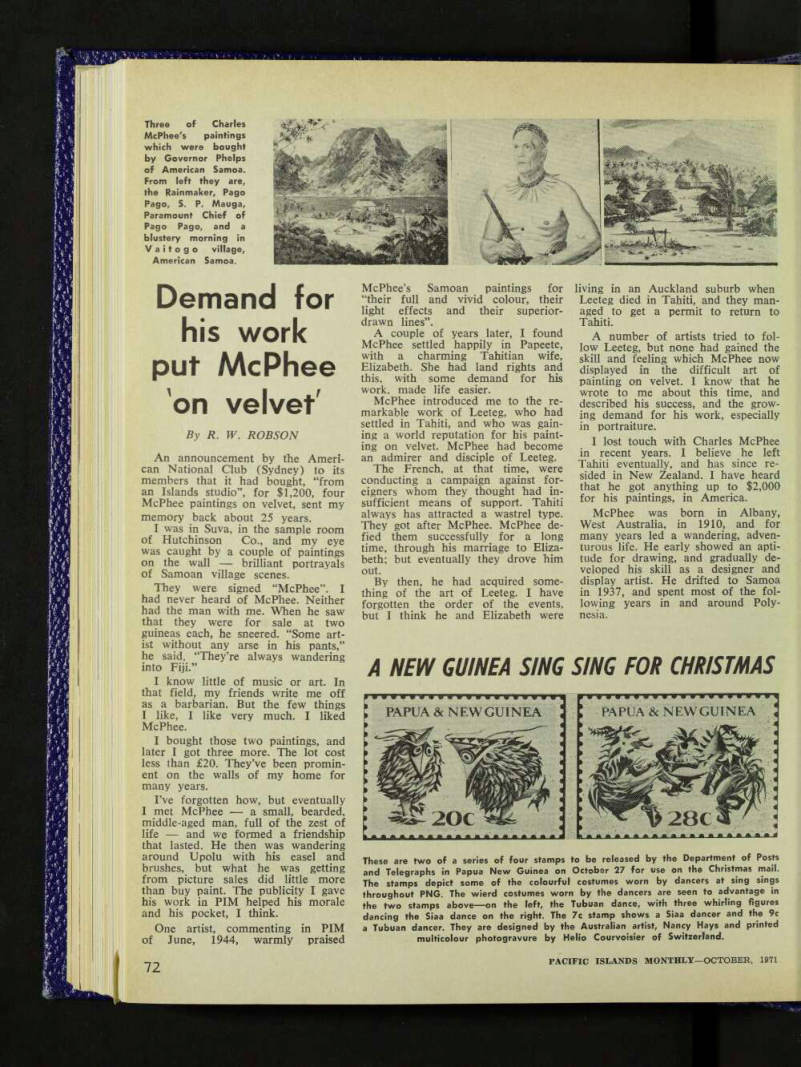
Three of Charles McPhee's paintings which were bought by Governor Phelps of American Samoa.
From left they are, the Rainmaker, Pago Pago, S. P. Mauga, Paramount Chief of Pago Pago, and a blustery morning in Vaitogo village, American Samoa.