Magazine Section
pp. 71-153 · Read in the full issue
Royal Navy Gunboat Diplomat
Kept Peace In The Pacific
They were thrilling, and cruel, days in the 19th Century when the Royal Navy carried out a kind of gunboat diplomacy in those areas of the South Seas where responsible government had not been established. The correspondence below, taken from official records, gives graphic illustrations of contemporary life and attitudes among the men who manned the Royal Navy ships. The record is left to speak for itself.
HMS Miranda, under the command of Commander W. A. D. Acland, RN, was on station in the New Hebrides from May to October 1884. She had left Sydney on May 14 with instruc tions from Commodore James Erskine to “visit the principal trading or mis sion stations in the New Hebrides, supervising the actions of the labour vessels, and rendering every assist ance and protection in your power to all British subjects or others carrying on their lawful occupations, or located in those islands.”
Commander Acland To
COMMODORE ERSKINE. Reporting the investigation of the shooting on the boats of the labour vessel “Flora” by the natives of Masovona, Santa, Maria Island, Banks Group. HMS “Miranda”, at Santa Maria Island, 17 July, 1884.
Sir, —I have the honor to inform you that Bishop Selwyn gave me a letter addressed to him by the captain of the Flora, stating that his boats had been fired on at Matalal, a point on the north end of Santa Maria, with a request from the captain that a man of-war should investigate the cause. I proceeded to that island for this pur pose on July 14th. It appears that the Flora’s boats were recruiting, and that they refused to buy any yams unless they got some recruits. They did not get any, and as the boats were sailing off to their ship they were fired on by the natives, who belong to the Masovona tribe.
It was settled that the Miranda should anchor at Losolava, five miles from Matalal, to find out who the
guilty people were. Bishop Selwyn, with his native teacher, Edmund Oaratu, most kindly acted as inter preters, and to their exertions I attri bute the successful issue of my mis sion.
On the 16th the Bishop went to Masovona (where these men live) early in the morning and gave to them the following letter: To those men concerned in shoot ing at the boats belonging to an Eng lish vessel: My friend Bishop Selwyn, who is also a friend of yours, has come to
tell you that I am captain of the Eng lish man-of-war “Miranda”.
I have been told by the captain of the English ship “Flora” that you have shot at his boats. It is my duty to investigate the cause of any dis putes between Englishmen and the natives, so I have come to see what is the matter.
I ask you to meet me without arms; I will also come without arms and speak with you.
If I find that the white man has done harm to you I will punish him.
If I find that you have fired on white men without reason, you must pay me a penalty for it.
I wish to speak friendly with you, and if you will come I will promise not to harm you until we have spoken.
If you will come to the man-of-war you will see the ship, and I will let you go on shore when you wish with out harm.
If you do not pay me the fine then I shall tell my chief, who will make war with you.
W. A. D. Acland,
Commander, HMS “Miranda”, 16 July, 1884.
I proceeded to Masovona and an chored at noon. In the afternoon the tribe came off, including the three men, Puluswelgan, Warmul, Vuro goro, who had fired five, four, five shots respectively.
We held a meeting on the quarter deck, and I spoke as follows: “I have sent for you because you have shot at an English boat; I am glad to see that you have come and
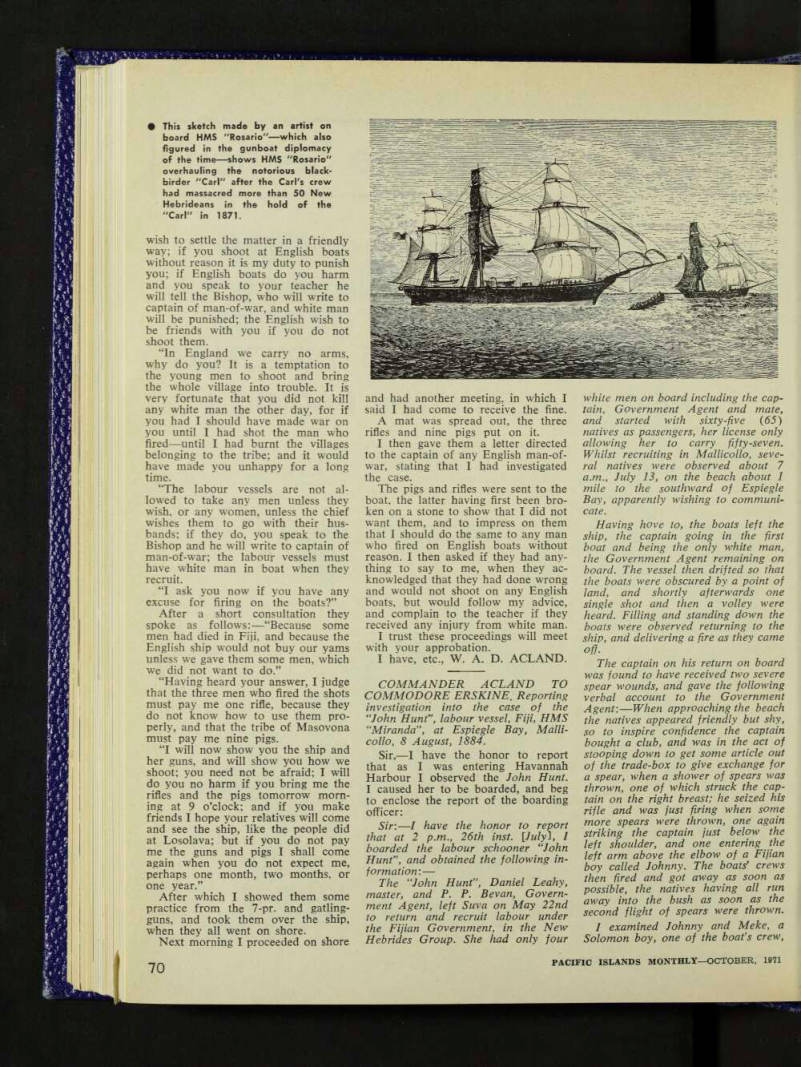
Bishop John Selwyn, who, often at the risk of his life, acted as interpreter and conciliator between ships' officers and natives.
wish to settle the matter in a friendly way; if you shoot at English boats without reason it is my duty to punish you; if English boats do you harm and you speak to your teacher he will tell the Bishop, who will write to captain of man-of-war, and white man will be punished; the English wish to be friends with you if you do not shoot them.
“In England we carry no arms, why do you? It is a temptation to the young men to shoot and bring the whole village into trouble. It is very fortunate that you did not kill any white man the other day, for if you had I should have made war on you until I had shot the man who fired—until I had burnt the villages belonging to the tribe; and it would have made you unhappy for a long time.
“The labour vessels are not al lowed to take any men unless they wish, or any women, unless the chief wishes them to go with their hus bands; if they do, you speak to the Bishop and he will write to captain of man-of-war; the labour vessels must have white man in boat when they recruit.
“I ask you now if you have any excuse for firing on the boats?”
After a short consultation they spoke as follows:—“Because some men had died in Fiji, and because the English ship would not buy our yams unless we gave them some men, which we did not want to do.”
“Having heard your answer, I judge that the three men who fired the shots must pay me one rifle, because they do not know how to use them pro perly, and that the tribe of Masovona must pay me nine pigs.
“I will now show you the ship and her guns, and will show you how we shoot; you need not be afraid; I will do you no harm if you bring me the rifles and the pigs tomorrow morn ing at 9 o’clock; and if you make friends I hope your relatives will come and see the ship, like the people did at Losolava; but if you do not pay me the guns and pigs I shall come again when you do not expect me, perhaps one month, two months, or one year.”
After which I showed them some practice from the 7-pr. and gatling guns, and took them over the ship, when they all went on shore.
Next morning I proceeded on shore
and had another meeting, in which I said I had come to receive the fine.
A mat was spread out, the three rifles and nine pigs put on it.
I then gave them a letter directed to the captain of any English man-of war, stating that I had investigated the case.
The pigs and rifles were sent to the boat, the latter having first been bro ken on a stone to show that I did not want them, and to impress on them that I should do the same to any man who fired on English boats without reason. I then asked if they had any thing to say to me, when they ac knowledged that they had done wrong and would not shoot on any English boats, but would follow my advice, and complain to the teacher if they received any injury from white man.
I trust these proceedings will meet with your approbation.
I have, etc.,
W. A. D. Acland.
Commander Acl And To
COMMODORE ERSKINE. Reporting investigation into the case of the “John Hunt”, labour vessel, Fiji, HMS “Miranda”, at Espiegle Bay, Malli collo, 8 August, 1884.
Sir, —I have the honor to report that as I was entering Havannah Harbour I observed the John Hunt.
I caused her to be boarded, and beg to enclose the report of the boarding officer; Sir: —I have the honor to report that at 2 p.m., 26th inst. [July), I boarded the labour schooner “John Hunt”, and obtained the following in formation: — The “John Hunt”, Daniel Leahy, master, and P. P. Bevan, Govern ment Agent, left Suva on May 22nd to return and recruit labour under the Fijian Government, in the New Hebrides Group. She had only four
white men on board including the cap tain, Government Agent and mate, and started with sixty-five (65) natives as passengers, her license only allowing her to carry fifty-seven.
Whilst recruiting in Mallicollo, seve ral natives were observed about 7 a.m., July 13, on the beach about 1 mile to the southward of Espiegle Bay, apparently wishing to communi cate.
Having hove to, the boats left the ship, the captain going in the first boat and being the only white man, the Government Agent remaining on board. The vessel then drifted so that the boats were obscured by a point of land, and shortly afterwards one single shot and then a volley were heard. Filling and standing down the boats were observed returning to the ship, and delivering a fire as they came off.
The captain on his return on board was found to have received two severe spear wounds, and gave the following verbal account to the Government Agent:—When approaching the beach the natives appeared friendly but shy, so to inspire confidence the captain bought a club, and was in the act of stooping down to get some article out of the trade-box to give exchange for a spear, when a shower of spears was thrown, one of which struck the cap tain on the right breast; he seized his rifle and was just firing when some more spears were thrown, one again striking the captain fust below the left shoulder, and one entering the left arm above the elbow of a Fifian boy called Johnny. The boats' crews then fired and got away as soon as possible, the natives having all run away into the bush as soon as the second flight of spears were thrown.
I examined Johnny and Meke, a Solomon boy, one of the boat’s crew,
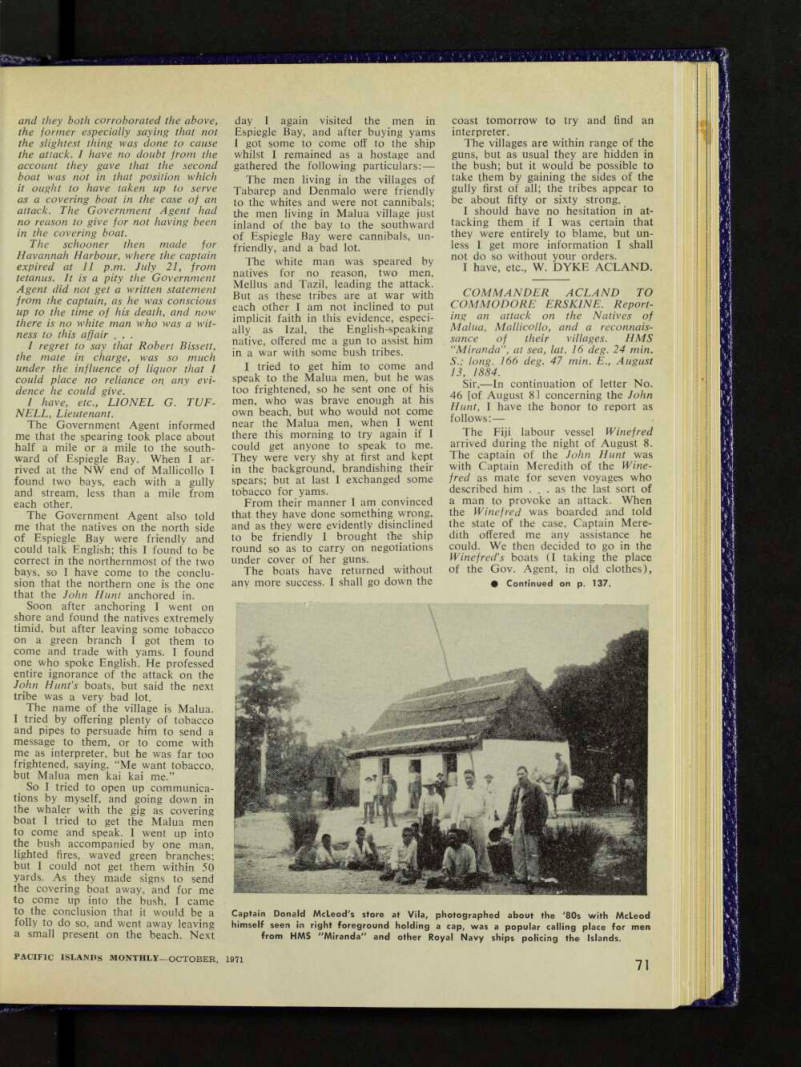
This sketch made by an artist on board HMS "Rosario"—which also figured in the gunboat diplomacy of the time—shows HMS "Rosario" overhauling the notorious black birder "Carl" after the Carl's crew had massacred more than 50 New Hebrideans in the hold of the "Carl" in 1871.
and they both corroborated the above, the former especially saying that not the slightest thing was done to cause the attack. I have no doubt from the account they gave that the second boat was not in that position which it ought to have taken up to serve as a covering boat in the case of an attack. The Government Agent had no reason to give for not having been in the covering boat.
The schooner then made for Havannah Harbour, where the captain expired at 11 p.m. July 21, from tetanus. It is a pity the Government Agent did not get a written statement from the captain, as he was conscious up to the time of his death, and now there is no white man who was a wit ness to this affair , . . / regret to say that Robert Bissett, the mate in charge, was so much under the influence of liquor that I could place no reliance on any evi dence he could give.
I have, etc., LIONEL G. TUF NELL, Lieutenant.
The Government Agent informed me that the spearing took place about half a mile or a mile to the south ward of Espiegle Bay. When I ar rived at the NW end of Mallicollo I found two bays, each with a gully and stream, less than a mile from each other.
The Government Agent also told me that the natives on the north side of Espiegle Bay were friendly and could talk English; this I found to be correct in the northernmost of the two bays, so I have come to the conclu sion that the northern one is the one that the John Hunt anchored in.
Soon after anchoring I went on shore and found the natives extremely timid, but after leaving some tobacco on a green branch I got them to come and trade with yams. I found one who spoke English, He professed entire ignorance of the attack on the John Hunt’s boats, but said the next tribe was a very bad lot.
The name of the village is Malua.
I tried by offering plenty of tobacco and pipes to persuade him to send a message to them, or to come with me as interpreter, but he was far too frightened, saying, “Me want tobacco, but Malua men kai kai me.”
So I tried to open up communica tions by myself, and going down in the whaler with the gig as covering boat I tried to get the Malua men to come and speak. I went up into the bush accompanied by one man, lighted fires, waved green branches; but I could not get them within 50 yards. As they made signs to send the covering boat away, and for me to come up into the bush, I came to the conclusion that it would be a folly to do so, and went away leaving a small present on the beach. Next
day I again visited the men in Espiegle Bay, and after buying yams 1 got some to come off to the ship whilst I remained as a hostage and gathered the following particulars: The men living in the villages of Tabarep and Denmalo were friendly to the whites and were not cannibals; the men living in Malua village just inland of the bay to the southward of Espiegle Bay were cannibals, un friendly, and a bad lot.
The white man was speared by natives for no reason, two men, Melius and Tazil, leading the attack.
But as these tribes are at war with each other I am not inclined to put implicit faith in this evidence, especi ally as Izal, the English-speaking native, offered me a gun to assist him in a war with some bush tribes.
I tried to get him to come and speak to the Malua men, but he was too frightened, so he sent one of his men, who was brave enough at his own beach, but who would not come near the Malua men, when I went there this morning to try again if I could get anyone to speak to me.
They were very shy at first and kept in the background, brandishing their spears; but at last I exchanged some tobacco for yams.
From their manner I am convinced that they have done something wrong, and as they were evidently disinclined to be friendly I brought the ship round so as to carry on negotiations under cover of her guns.
The boats have returned without any more success. I shall go down the
coast tomorrow to try and find an interpreter.
The villages are within range of the guns, but as usual they are hidden in the bush; but it would be possible to take them by gaining the sides of the gully first of all; the tribes appear to be about fifty or sixty strong.
I should have no hesitation in at tacking them if I was certain that they were entirely to blame, but un less 1 get more information I shall not do so without your orders.
I have, etc.,
W. Dyke Acland.
Commander Ac Land To
Commodore Erskine. Report
ing an attack on the Natives of Malua, Mallicollo, and a reconnais sance of their villages. HMS “Miranda”, at sea, lat. 16 deg. 24 min.
S.; long. 166 deg. 47 min. E., August 13, 1884.
Sir, —In continuation of letter No. 46 [of August 83 concerning the John Hunt, I have the honor to report as follows: The Fiji labour vessel Winefred arrived during the night of August 8.
The captain of the John Hunt was with Captain Meredith of the Wine fred as mate for seven voyages who described him ... as the last sort of a man to provoke an attack. When the Winefred was boarded and told the state of the case, Captain Mere dith offered me any assistance he could. We then decided to go in the Winefred’s boats (I taking the place of the Gov. Agent, in old clothes),
• Continued on p. 137.
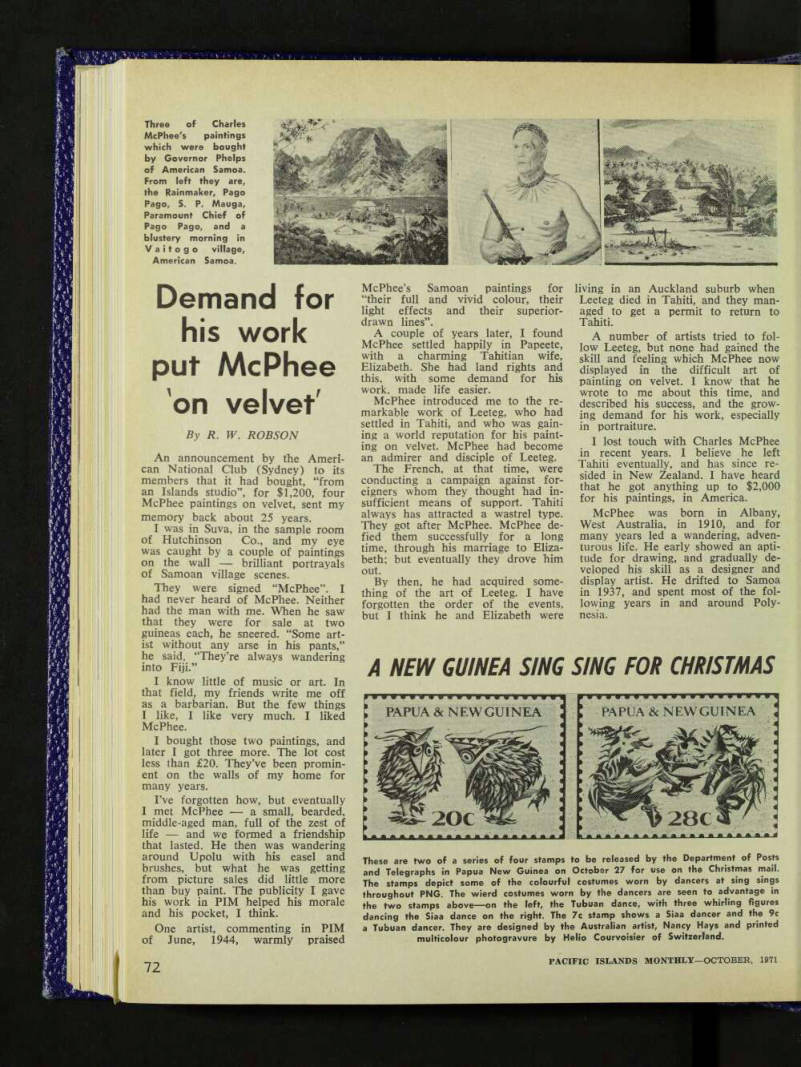
Captain Donald McLeod's store at Vila, photographed about the 'Bos with McLeod himself seen in right foreground holding a cap, was a popular calling place for men from HMS "Miranda" and other Royal Navy ships policing the Islands.
and went down to several villages as if recruiting.
Captain Meredith, who affected to know nothing about the “man-of war”, and wanting to know why the natives were frightened, was told in every place that they were afraid of “man-of-war” and in each instance after a good deal of trade in yams and tobacco, we were told all about it, each story agreeing that Melius and Tazil belonging to the Malua tribe were the guilty parties.
At one village about 10 miles from the ship we were told that it was be cause a boat painted white with a red bottom had stolen a man, but at each of the others and by many natives we were told “Malua men very foolish”, “too much fight”, “bad man”, etc.
We tried to open up communica tions with the Malua men, but in vain.
On Sunday I again spent the day in the Winefred’s boats with Captain Meredith, who talks Fijian, “Jimmy” the boat-steerer, who was with the Diamond’s party at Api, and two in terpreters, and after a long time we got the Malua men to speak with us.
I told them that I wished to be friends, but that they must give up Melius and Tazil (the former was pointed out to me), and pay me a fine. I would judge the men, and would settle what I would do with them, after a talk with the chief. If I did not get them by noon on Mon day, I should declare war.
After endless palaver, they agreed to bring them down in one hour, but at the end of the time they mustered in force in the bush, and refused to give them up, using threatening ges tures.
I told them again that if they were not down by noon on Monday I should make war.
During the palaver I used every argument that I could think of to endeavour to obtain the men without force, and hoped at one time that I should get them.
On Monday the natives came down again. Captain Meredith and the interpreters went in to communicate.
Lieutenant Tufnell going in as my ambassador.
I append the latter’s report: Sir: I have the honor to report that at 10 a.m. yesterday [August 77] I proceeded on shore in one of the “Winefred’s” six boats, accompanied by Captain Meredith, Jim, and the in terpreter, to renew the negotiations with the natives for the delivery of the two men Melius and Tazil.
As the boat touched the beach, and before 7 had time to land, the natives, in greater numbers than we had pre viously seen them, appeared to be very hostile, and all came forward towards the boat with their spears ready. I stood up, and showing them that 7 was unarmed, induced some of them to put down their spears, and I then jumped ashore and sat down, getting a palm-leaf and sticking it up to show I was friendly.
By means of Jim and the inter preter 1 sent five different messages, each time using every argument I could think of to persuade them to give up the men. I drew their atten tion to the guns pointed at them, and told them how many fighting men, etc., we had. I then said that if my request was complied with I would shake hands and make friends and buy their pigs, etc., but I refused, until I had the men, to either accept a present or even “speak to them my self’.
My fifth message was to the effect that I had now got impatient, and must either have the men given up immediately, or make war.
They again refused, making hostile gestures, and said they would fight; so I declared war by breaking the palm-leaf in two and throwing it into the sea. They followed us down to the boat, and, I think, were on the point of attacking us, as the bush was full of men all round us. On reach ing the boats, and before shoving off, I again told them that I was now at war, and in a minute should hold up my hand for the big guns to shoot Lastly, when about 20 yards from the shore, I gave them one more chance, and said I would return and make friends if they would give me the men; but they only answered by bran dishing their spears. No sooner had the ship opened fire than a flight of poisoned arrows was fired at us, one falling alongside, touching the boat, and another striking the water about five yards off. I then returned on board, having been a little over an hour trying to bring the natives to terms.
I have, etc., LIONEL G. TUF NELL, Lieutenant.
As the natives appeared very hostile I cleared away the guns and gatling, and loaded with shell.
When Lieutenant Tufnell signalised that the natives refused to give the men up and wished to fight, I opened fire on them to protect the boats as they pulled off to the ship, the natives shooting at the boat with bow and arrows.
As soon as the men had dinner I
landed the force detailed [BB officers and men] and marched to make a reconnaissance in the direction of the village, intending if the village was within practical distance to destroy it.
From information received since I sent letter No. 46, I gathered that the Malua tribe were some 500 strong, with about 250 to 300 fighting men, armed with spears, clubs, etc., and lived in three or four villages behind a ridge about 2,000 yards from the ship, but on gaining the crest of the ridge I found the villages were some way inland. After marching over some rough country to a distance of about four miles from the ship, I came to within about one mile from the villages; the plantations could be seen and a few of the huts. By this time it was getting late, and the men were somewhat fagged, so I returned on board, getting back at 7 p.m. I ordered an extra allowance of soluble chocolate to be issued to the men on their return.
On the way up the ship fired shell ahead of the landing party to clear the bush, and when out of range of her guns the natives were seen set ting fire to the bush, so I ordered them to be fired on. I believe that several were killed and wounded, but as the bush was very thick I cannot tell the exact number.
The men behaved very well, but it is evident that they want more train-
This old New Hebrides native—90 years old when the picture was taken in the mid-fifties —was typical of the tribesmen with whom Commander Acland clashed.
The old man is holding his Snider musket which he said he bought in his young days. He boasted that he shot at the first missionary to land near his village.
A distasteful ordeal
ing in bush fighting before they could compete with the natives, supposing them to be armed equally well.
I wish to bring to your notice the conduct of Captain Meredith, of the schooner Winefred. He has, at the risk of being speared, performed the duties of interpreter, assisted by Jimmy, a half-caste Fijian, when it was useless to endeavour to get the natives to meet a man-of-war boat.
He got interpreters to come, when they were afraid to go to a man-of war; and he lent us his boats and crews, and accompanied me along the coast getting information. I have writ ten him a letter of thanks.
I have given full details of the negotiations, in order that you may know that I have left nothing undone to avoid actual conflict with the natives.
I gave them every chance of giving the murderers up. The interpreters used every argument they could think of.
I waited for a long time before I gave what wa« to me a most distaste ful order—“to open fire”; but I saw they were very hostile, and not the least inclined to give in.
I have had to expend £3 worth of trade-gear in paying the interpreters and guides, and making presents to friendly natives. I also gave Jimmy, the Fijian, 325. worth of cloth for his service.
I waited one day to see if the Malua men wished to come to terms, but they were too frightened to come near us, so I left, having given Lieu tenant and Commander Cross orders to return in a few days to gain any additional information he could, thinking that perhaps he might be able to communicate when the Miranda was absent.
I have issued a notice, warning labour vessels of what has occurred.
I have, etc., W. A. DYKE AC LAND, Commander.
Commander Acland To
COMMODORE ERSKINE. Reporting attack on Marachi Villages, Api Is land. HMS “Miranda” at Api Island, August 30, 1884.
Sir, —I have the honor to report that on my arrival at Yem Yu Cove, Api Island, I sent a message to the Mar achi tribe to the effect that I had come to receive the remainder of the fine inflicted by Captain Dale last year, also that Kora, the murderer of the Government Agent, must be given up [these were matters of unfinished naval business].
It appears that Borar Nasoun, the chief, had died about three days ago.
Act of treachery
and that Kora was now chief of the Marachi men; he sent a message back saying “he would not come down or send the guns, but he wished to fight me.”
Meanwhile I had got hold of seve ral of the influential men of Barati, Yem Yu, Rewa, and Bulitumbui, and told them that I had come to get Kora and the rifles, that I did not wish to fight them, that unless they brought me Kora in four days I should destroy the villages of Barati, Yem Yu, Yettching, Tumusaboan, Marachi, Rewa and Bulitumbui, which were all implicated. I pointed out that it was much better for them to combine and get Kora than to have to fight me.
My reasons for this policy were— -Ist. That if we attacked Marachi, by the time we got there Kora would have been far in the bush, and my chief object was to get hold of him, which I could not do without some act of treachery on my part. 2nd. That as I had no field-gun to land like HMS Diamond did last year, an at tack might have entailed loss of life on our side without any consummate advantages. 3rd. That it seemed to me to be good policy to make all the tribes which were easily attacked know that if murder was committed on their ground with their connivance they would be held responsible to a certain degree.
After a long talk in which I ex plained that if I did not get Kora this time I would come back again, they agreed to try and get Kora and the rifles.
On Wednesday I saw the represen tatives of Barati, Yettching, Yem Yu, and Rewa, who agreed to look for Kora, but they came back and said that the Marachi men were all frightened and had gone bush, I then told them that they had two days to bring Kora, and after much argument they promised to go and look for him again.
On Thursday a party went up and came back with a message that Kora would not come down but offered to send a pig, some rifles, and some money; I told them this would not do, but that I would leave for four more days and would come back again.
HMS Undine arrived on Thursday, so we both went to sea for four days.
My reason for giving the extra time was that the coast tribes were very friendly with Peter Cullen [a local planter], and as he had assisted me very much in explaining to the tribes that my sole object was to obtain Kora and the remainder of the fine, I thought that if I extended the time
Negligent white men
it might prevent them from becom ing unfriendly when we left the island for good. Moreover, I did not wish to be hard on them, and wanted to give them every chance of saving their villages.
On my return to Yem Yu Cove, on August 26, I again saw the neutral tribes, and sent a message that I would land a force on the 28th, but that if any village, Marachi excepted, would pay me three Sniders, or their equivalent in guns, I would spare that village.
The Barati men and the Yem Yu men paid their fine, and the guns were broken in their presence. They all came down to the beach, and I formally made peace by exchanging green branches and small presents.
I was told that if I granted another day I should get more rifles, so I post poned the attack until the 29th. On Thursday the men from Rewa, Yettch ing, and Tumusaboan came down and brought some guns; they declared that they had no more and offered some pigs which I declined, but said that I would not destroy their villages this year unless they attacked my landing party.
These men all made friends with the usual formalities, and having only one village unfriendly (the Bulitum bui men having joined the Marachi village), I considered our party strong enough to attack without undue risk, so I landed the force named [lO5 offi cers and men] at 5 a.m. on Friday the 29th under the command of Lieuten ant Fisher. (I enclose his report which I have approved.) I hired three guides at £1 a head to carry messages and to show us the way. I have had to pay interpreters 16s. in trade and money; also at Malua I had to expend £4/11/11 in getting information, a total of £B/7/11 (eight pounds seven shillings and eleven pence), in addi tion to the value of ammunition ex pended.
In both these cases of massacre [a boat crew and a government agent] the white man was negligent and did not carry out his instructions, and thus to a certain extent laid himself open to attack. I venture to suggest whether these expenses of investigation should not fall on the owners of the vessels if it is proved that any of their em ployees have been negligent.
I have sent a message to the Mar achi men that I am still at war with them and shall remain so until Kora is given up and a fine of nine Sniders or their equivalent in guns is paid. 1 have made peace with the Barati men, and have an armistice with the Yem Yu, Yettching, Tumusaboan, and
Attack and destroy
Rewa tribes on the condition that they help me and not Kora.
Peter Cullen has assisted me very much in my communications with the natives.
I trust that these proceedings will meet with your approval.
I have, etc..
W. A. Dyke Acland,
Commander.
Commander Acl And To
Lieutenant W. B. Fisher.
MEMO. —You are to take command of the armed party detailed as under and land at 5 a.m. 29th instant.
You will attack and destroy Mar achi, and if quite feasible, Bulitumbui and Rewa, and on your way back destroy Yettching, Tumusaboan, Yem Yu, and Barati, unless their guns have been paid.
You are to use every precaution against being surprised by an ambush, but you are not to fire (unless fired on) before reaching the Marachi dis trict.
Should Kora be given up to you and a fine of eighteen guns paid, you are to leave Marachi untouched, for the object of the expedition will then be obtained.
The men are to have a meat meal before they start, and carry a day’s provision with them, and you are to return to the ship before dark if pos sible.
The fines are as follows: Yettching, 3 Sniders or their equiv.
Tumusaboan, 3 Sniders or their equiv.
Yem Yu, 3 Sniders or their equiv.
Barati, 3 Sniders or their equiv.
Marachi, 6 Sniders or their equiv.
Bulitumbui, 3 Sniders or their equiv.
Rewa, 3 Sniders or their equiv.
W. A. D. Acland,
Commander and Senior Officer.
PS—The Barati, Yem Yu, Yettch ing, Tumusaboan, and Rewa tribes having paid their fine, I have con cluded peace with them; you are to be careful that none of their property is destroyed.
Lieutenant Fisher To Com
MANDER AC LAND. Report of attack on and destruction of Marachi villages. HMS “Miranda,” August 30, 1884.
Sir, —I have the honor to inform you that, in compliance with your memorandum, I landed the morning of the 29th instant in command of the party detailed, for the purpose of attacking and destroying Marachi and villages and huts connected with its tribe, and which I accomplished in the following manner ;— We landed at 5.20 a.m., and com menced our march at 5.30 a.m. After
Burnt plantations
passing Tumusaboan on the way up, before attacking Marachi, I sent a guide up to communicate with Kora, who said at first he would give himself up. I sent back to tell him that if he did so I would not destroy Marachi, but if he did not I would attack it in 10 minutes.
The guide told us that four more villages had joined with Kora, and were waiting to resist us in Marachi.
After waiting 10 minutes Kora sent back to say he would not give him self up, but would defend the village if we attacked it.
I then advanced on Marachi, arriv ing there at 8.10 a.m., which place, consisting of three villages, I burnt, cutting down and destroying all the banana and other plantations, pigs, etc., as well as everything we could find, except the bread-fruit and coco nut-trees, which I spared in compli ance with station orders.
Three rifles, one rifle-barrel, three tomahawks, and some rifle ammuni tion we found in the villages, and which (with the exception of one rifle broken and burnt by mistake ) we brought back with us, returning to the ship at 1.30 p.m.
The path to Marachi is, for a native track, very good, better in fact than most paths in these islands, but from the dense foliage on each side of it, would be difficult to travel if a few resolute men defended it at almost any point on the route.
The tribe of Marachi inhabit three villages, consisting of about 30 huts, These are placed in commanding posi tions on one side and the head of a deep ravine. The crest and sides of the ravine where they are placed are situ ated in a position which from natural causes would, if defended by a few determined men, be most difficult to capture, the only path as far as I know being halfway up the opposite side of the ravine before referred to, and is entirely commanded by the vil lages on the other side.
I consider the distance to be about four-and-a-half miles by the path from Yem Yu Cove, as we went up slowly, resting occasionally, and only took two-and-a-half hours in reaching the farthest Marachi village. On receipt of Kora's answer of defiance, we fired three volleys across the ravine to clear the houses and path up to the village, the natives firing some shots in re turn which took no effect. We then advanced to the attack, passing through a small village about 300 yards below the summit of the hill.
The advanced company, under
Found fires burning
Lieutenant Tufnell, skirmished through this before the remainder of the party came up. The houses of course we did not then burn, as we had to return by the same path. We then advanced on the upper village, on arriving at which we found that the inhabitants had only just left, as we found fires burning, and several indications which showed that they had been there very recently.
This village we also cleared by skirmishing through it and about 100 yards the farthest side, firing volleys into the bushes and cover likely to harbour any natives should they have been in ambush.
On the skirmishers falling back the pioneers, covered by two sections, de stroyed the fences and plantations, and men were detailed to burn the huts, which consisted of about ten or twelve, scattered over an area of about three acres. Three small tom toms we found and burnt, also two loaded rifles, dropped probably when the natives retreated, and two heads of 9-pr. shrapnel shells, evidently fired last year by the field gun of HMS “Diamond”, were found in the village.
After destroying the plantations and burning the huts, the men stood easy for half an hour for refreshment; no water is procurable here.
Finding that Bulitumbui was about four miles farther on, and only con < sisted of about two or three huts, and the chances of capturing Kora there very remote, we commenced our re turn at 10 a.m., burning and de stroying the village and plantations we had passed through on our way up.
On reaching the side of the ravine we had marched along, and looking across it, we found we had not de stroyed two huts and plantations lower down the hill. Evidently the guide had missed the path to it, or had not pointed it out to us; so we returned again and found the path to it. This village is quite hidden in the trees, except two small huts seen from the ravine; but is, I think, the most important, as there are more than 15 huts, well built and fenced, and is in the most commanding posi tion for defending the ravine.
The banana plantations are very extensive, and evidently support the greater part of the Marachi tribe.
This village we also burnt and de stroyed all its plantations.
Having done this we returned. On our way back we met some Rewa men, whom 1 told to inform the Marachi people that until Kora was given up and their fine paid, we should still be at war with them, and
50 fighting men
would return again to destroy Marachi, perhaps in one month, per haps two months, or even a year’s time; but we would return again.
The guide brought us back by a path which though shorter is harder to travel, being a dry waterbed, the stones in some places being very awkward to walk on, with a heavy hill to ascend or descend, going up or returning, as the case might be. 1 should think that there are not less than one hundred and fifty people in Marachi, fifty of whom are fighting men, judging from the size and num ber of the huts.
We destroyed about 30 huts, 300 banana plants, 20 pigs, as well as some dynamite and ammunition.
In concluding this report, I wish to bring to your notice the zeal of the officers and men in carrying out the demolition of the villages and plantations, and the steadiness and conduct of the men when advancing to attack them.
The destruction of the plantations was from the steepness of the hills and nature of the ground an arduous and unpleasant undertaking.
The men were throughout most obedient to command.
I wish particularly to bring to your notice also the great assistance ren dered by Lieutenants Tufnell and Martin, who had command of the companies, as well as that by Mr.
Dawson, sub-lieutenant, and Mr.
Glading, boatswain, who all were most active and zealous in leading their men to attack, and by their per sonal exertions and example were mainly the cause of the expedition succeeding in a comparative short time. Staff-surgeon Barry showed great zeal and attention to his duties connected with the ambulance party and their disposition, and this party performed their duties most satisfac torily.
Lieutenants Cross {‘‘Undine”) and Clarke {“Miranda”) accompanied the expedition, and assisted greatly in leading to attack, as well as by their subsequent exertions in the demolish ment.
The following POs and men were conspicuous by their zeal and exer tions during the days: — -Colour- Sergeant Mearles; G. Sheaff, 2 CFC; S. Burroughs, 2 CFT; R. Ledlie, Lg.
S.; and P. Lynch, Carp. Crew (Pioneer).
I have, etc..
William B. Fisher,
Lieutenant in command of expedition.