Yesterday
p. 81 · Read in the full issue
August is usually a pleasant month in the South Pacific Islands; winter, balmy breezes blown in by the Trades, little rain, lots of sunshine, low humidity, lovely, languorous.
That's how it must have been in August, 1951—beautiful and peaceful, no one eager to do much, to make news headlines. That's for sure because PIM of that August had nothing big to chronicle. There were a few wrangles, "a teacupful of storm" PIM called one row over a wharf at Fiji's sugar centre of Lautoka. The citizens wanted a new wharf. They were told some months before they could have one for £335,000 but the government knocked it back on the ground that it was too dear. So the people blamed Suva for having tried, through jealousy, to get in Lautoka's way, and blamed the CSR Co., owners of the existing wharf for not wanting a new wharf for financial reasons. Well, the teacupful of storm blew over and Lautoka got its wharf, about the middle 1960s and for much more than £335,000.
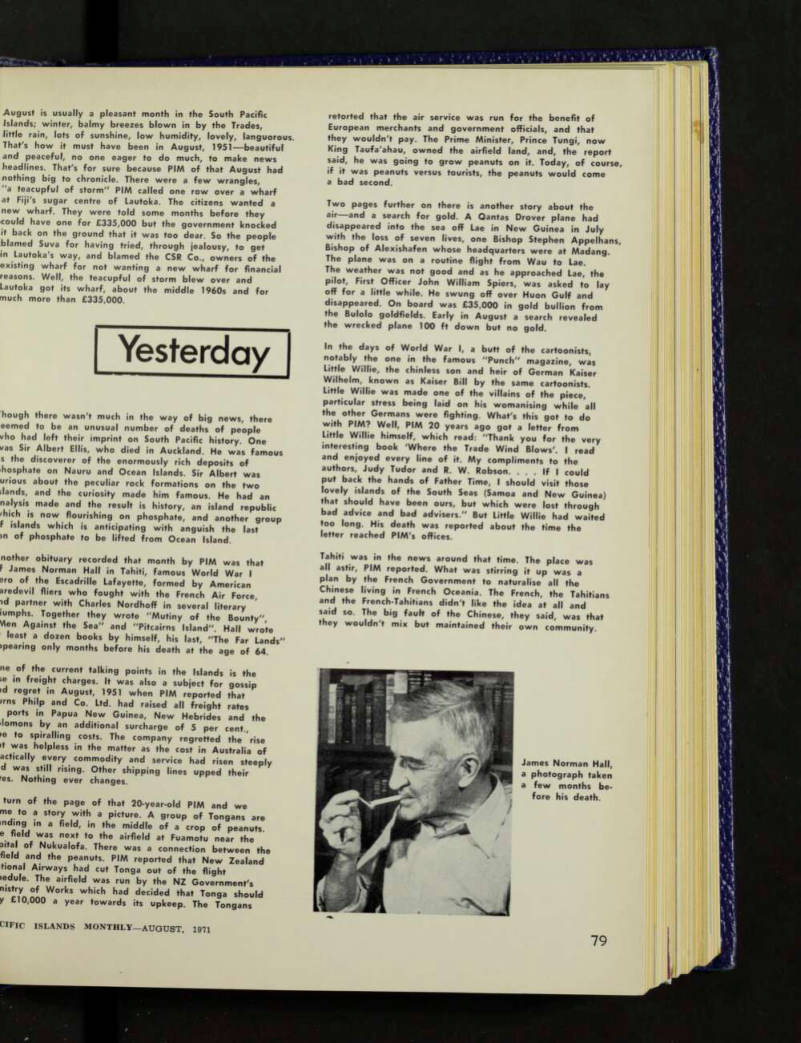
hough there wasn't much in the way of big news, there eemed to be an unusual number of deaths of people vho had left their imprint on South Pacific history. One vas Sir Albert Ellis, who died in Auckland. He was famous s the discoverer of the enormously rich deposits of hosphate on Nauru and Ocean Islands. Sir Albert was urious about the peculiar rock formations on the two (lands, and the curiosity made him famous. He had an nalysis made and the result is history, an island republic <hich is now flourishing on phosphate, and another group f islands which is anticipating with anguish the last >n of phosphate to be lifted from Ocean Island. nother obituary recorded that month by PIM was that F James Norman Hall in Tahiti, famous World War I ero of the Escadrille Lafayette, formed by American aredevil fliers who fought with the French Air Force id partner with Charles Nordhoff in several literary lumphs. Together they wrote "Mutiny of the Bounty", , n Against the Sea" and "Pitcairns Island". Hall wrote least a dozen books by himself, his last, "The Far Lands" >pearing only months before his death at the age of 64. ne of the current talking points in the Islands is the ;e in freight charges. It was also a subject for gossip id regret in August, 1951 when PIM reported that »rns Philp and Co. Ltd. had raised all freight rates ports in Papua New Guinea, New Hebrides and the Jomons by an additional surcharge of 5 per cent., ie to spiralling costs. The company regretted the rise it was helpless in the matter as the cost in Australia of actically every commodity and service had risen steeply d was still rising. Other shipping lines upped their fes. Nothing ever changes. turn of the page of that 20-year-old PIM and we me to a story with a picture. A group of Tongans are "dmg m a field, in the middle of a crop of peanuts. 6 \ e d z^. aS . neXt tO the airfield at F u a ™tu near the □ital of Nukualofa. There was a connection between the tield and the peanuts. PIM reported that New Zealand tional Airways had cut Tonga out of the flight •edule. The airfield was run by the NZ Government's " ,S l7a W ° rks Which had decided *at Tonga should / £lO,OOO a year towards its upkeep. The Tongans
retorted that the air service was run for the benefit of European merchants and government officials, and that they wouldn't pay. The Prime Minister, Prince Tungi, now King Taufa'ahau, owned the airfield land, and, the report said, he was going to grow peanuts on it. Today, of course, if it was peanuts versus tourists, the peanuts would come a bad second.
Two pages further on there is another story about the a,r an£ J a search for gold. A Qantas Drover plane had disappeared into the sea off Lae in New Guinea in July with the loss of seven lives, one Bishop Stephen Appelhans, Bishop of Alexishafen whose headquarters were at Madang.
The plane was on a routine flight from Wau to Lae.
The weather was not good and as he approached Lae, the pilot, First Officer John William Spiers, was asked to lay off for a little while. He swung off over Huon Gulf and disappeared. On board was £35,000 in gold bullion from the Bulolo goldfields. Early in August a search revealed the wrecked plane 100 ft down but no gold.
In the days of World War I, a butt of the cartoonists, notably the one in the famous "Punch" magazine, was Little Willie, the chinless son and heir of German Kaiser Wilhelm, known as Kaiser Bill by the same cartoonists.
Little Willie was made one of the villains of the piece, particular stress being laid on his womanising while all the other Germans were fighting. What's this got to do with PIM? Well, PIM 20 years ago got a letter from Little Willie himself, which read: "Thank you for the very interesting book 'Where the Trade Wind Blows'. I read and enjoyed every line of it. My compliments to the authors, Judy Tudor and R. W. Robson. ... If I could put back the hands of Father Time, I should visit those lovely islands of the South Seas (Samoa and New Guinea) that should have been ours, but which were lost through bad advice and bad advisers." But Little Willie had waited too long. His death was reported about the time the letter reached PlM's offices.
Tahiti was in the news around that time. The place was all astir, PIM reported. What was stirring it up was a plan by the French Government to naturalise all the Chinese living in French Oceania. The French, the Tahitians and the French-Tahitians didn't like the idea at all and sa,d so. The big fault of the Chinese, they said, was that they wouldn't mix but maintained their own community
James Norman Hall, a photograph taken a few months be fore his death.