Magazine Section
pp. 73-79 · Read in the full issue
Behind The Japanese Lines On
Wartime Guadalcanal
It was May, 1942, and I was awakened one morning by a ship’s searchlight turned on my house at Berande, Guadalcanal—and I realised that the Japs had actually arrived. It was time to leave for Goldridge in the truck that I had fully loaded with stores only the day before.
At daylight I could see many ships in the Tulagi area and a screen of destroyers and cruisers patrolling about outside. A little later I heard the roar of aircraft coming across the Guadalcanal mountains, and the air craft passed over me and went in to attack the Japanese shipping.
The first wave seemed to take the Japs completely by surprise and it certainly came as a surprise to me, as I had no idea there were any American aircraft in the vicinity.
'These were obviously from an air craft carrier.
I grabbed a small Brownie camera and climbed up onto the roof of the bungalow. The Jap’s ships were in a proper panic, and were coming out of Tulagi at full speed, zig-zagging in all directions.
The American bombers pressed home their attack and seven or eight ships in my line of vision received direct hits and three sank almost im mediately. One was a large transport, which must have given the sharks a good feed. Two cruisers which were burning fiercely were heading north west, still being attacked, when I lost sight of them. The air seemed to be full of planes and ack-ack bursts.
In an action of this nature it is difficult to give an accurate descrip tion because there is so much to see.
I had taken six pictures, but in the excitement of the battle I had forgot ten to turn the spool!
This fascinating fight turned out to be the southern flank of the Battle of the Coral Sea. I really believe the de feat of the Jap fleet in the Coral Sea Battle saved Australia from invasion and people in Australia can thank the Americans that they are not now pulling rickshaws.
After the American planes left I had two double whiskies and set off in my loaded truck, with three natives and my two dogs, Nickie and Susie.
As I went across the grassy plain, Nickie fell off. I pulled up, and as I did so two Jap float planes over-shot me, their guns blazing.
The dog hopped in again and I turned the truck off the road into the high grass and beyond that to a patch of jungle. By the time the planes turned to have another crack at me I was well hidden.
The planes scouted about for me for about five minutes before going off in the direction of Tulagi, and I was able to continue my journey to Bamboo Creek, which was as far as I could take the truck. I found my native guards there still in charge of the big dump of stores that I had hid den for emergencies, and I unloaded the truck and hid it in the jungle.
Two or three days later I arrived at Goldridge, which had been the headquarters of the Solomon Gold Exploration Co. Ltd. All the field staff had been evacuated, with the excep-
When war came to the Solomons in December, 1941, planter Ken Dalrymple-Hay, who had already fought in World War I, stayed behind to see if he could help. The Japs did not land until the fol lowing May, and then Hay took to the hills as a coastwatcher— and remained on the job until the following February, when Guadalcanal had been retaken.
This account of his personal war is extracted from an un published MS which was among his papers when he died in Sydney in May at the age of 74. The MS is now in the pos session of his sister Margaret, of Sydney. An earlier extract was published in PTM in July.
tion of a Fijian named Kelemendi, who had stayed behind to look after their plant. He was a well-educated, exceptionally nice bloke.
Goldridge was about 2,800 ft above sea level and was an ideal observa tion point, as all the shipping activi ties over a wide area could be seen.
You had a clear view of the grass plains and foreshores from Kukum to Tasimboko, a distance of about 20 miles.
Already at Goldridge was Lt. D. S.
Macfarlan, the Australian naval liai son officer. Macfarlan, Kelemendi and myself settled down in the house of E. G. Theodore, which was the only respectable dwelling on Goldridge.
Macfarlan had a teleradio and this was now a coastwatcher’s camp.
From native reports and from our observation of shipping, it was obvi ous that the Japs were firmly estab lishing themselves on Tulagi. The Japs had also made small landings on Savo Island and at Lunga and Tenaru, along the Guadalcanal coast, where they were killing cattle and sending them across to Tulagi on barges.
I sent two trustworthy natives down to have a look at the situation at Berande, the plantation I had been managing for Burns Philp, and after a week they returned to tell me that the plantation had been looted by the local natives. They had even removed the bath and kitchen stove. A lot of the cattle had been speared, some of which were still alive in the paddocks with spears through their bellies.
The looters had made a systematic search of the garden and by probing with spears they located my house hold silver and other valuables (which they later gave to the Japs as pre sents). They took all the food from my store dump and they poured out 20 cases of Gordon’s Gin, 22 cases of vermouth, and 20 cases of Scotch whisky, so they could use the bottles for water! (over)
The same people later made a call at the Bamboo Creek cache of stores and repeated the whole process. When this news was received I felt very much down in the mouth, since our emergency food supplies were now limited to the one remaining dump at Kolio.
For the next few weeks there was little to do at our coastwatching camp except listen to the news from London, Australia, America, Rome, Berlin and Tokyo, and then have long discussions as to which news was likely to be correct.
Early in June, planter Snowy Rhoades, who was in the jungle fur ther up the coast of Guadalcanal with a radio, reported seeing 13 enemy ships approaching Savo Island from the north-west. Two days later the Navy said it had made an extensive search by air and had not been able to find the shipping. It could not have been a thorough search, as we could see from our post eight large cargo ships, escorted by five warships, dis charging cargo at Lunga and Kukum. and they stayed there for four days without interference from our air craft.
From native reports we heard that a Japanese named Ishimoto, who had been a carpenter on Tulagi for years and who was now “political officer” for the Jap forces, had contacted most of the coastal natives and told them that the British Empire was finished and that they would now become Japanese citizens. They were all issued with a small square of Kauri gum boat-planking with some Japanese writing on it to hang around their necks.
Ishimoto told them that to com plete their entry into Japanese citi-
zenship they would have to go to Lunga and work on the airfield for one month without pay. After that, pay would start. This airfield is what later became Henderson Field, and the Japs were wasting no time getting it built.
The request by the Japanese for labour gave us the opportunity to send some reliable natives to work on the airfield and apply for Jap citizen ship. About 10 days later they re turned. bursting with all kinds of valuable information.
They told us that there might be 10,000 Japanese there. They told us how every morning at seven o’clock the Japs would line up in the coco nut plantation at Lunga and march off to work.
We carefully inquired how many coconut trees would be hidden by the first rank of the line, and how many lines of labourers there were. By allowing 25 Japs between the trees, which are about 30 ft apart, we de cided that there must be about 3,000 of them on the airstrip, not 10,000, and this figure later proved to be
about right.
Our native spies also told us where the power house and wireless station were, and gave us details of progress on the construction of the airfield. We coded this information and sent it off.
Japanese flying-boats were now well established at Tanambogo, where the RAAF had been, about 20 miles across the water from our observa tion point up on the hills. When visibility was good you could see them at their moorings. Daily at 8 a.m. these boats would fly directly over our position, returning in the after noon, and we had to be careful not
to show signs that our camp was occu pied.
American Flying Fortresses were now making fairly frequent visits both to Lunga and Tulagi and apparently there were a lot of casualties and damage at these places. At Lunga the power house received a direct hit.
It was at this stage that we began receiving numerous native reports that Jap patrols were coming up the moun tains to take us. But the rumours proved to be false, as the Japs were keeping strictly to the coast, concen trating all efforts on building the air field. The rumours were circulated by the coastal natives who thought the news might force us further inland and thus allow them to loot our remaining supplies. Nevertheless. F.
M. Campbell [a former District Offi cer turned miner] who had moved to Tin’o’meat mining lease below us, moved up to our camp. We kept up daily teleradio schedules with Snowy Rhoades, in the hills behind Cape Nagle; with Martin Clemens, another District Officer, who had gone inland to Vungana, and with the government station still based on Malaita.
About this time, Macfarlan received a signal from the Navy which said that they would rescue his party within a month —which we decided meant an attack was being planned on the enemy positions in the Solo mons, because such an attack would have to be made before the Japs could complete their airfield.
Meanwhile our luck was out. On July 12 two Zero float planes sud denly dived down on our position, machine gunning us energetically.
Macfarlan decided we would have to move at once, as the float plane pilots would report our position. Rhoades
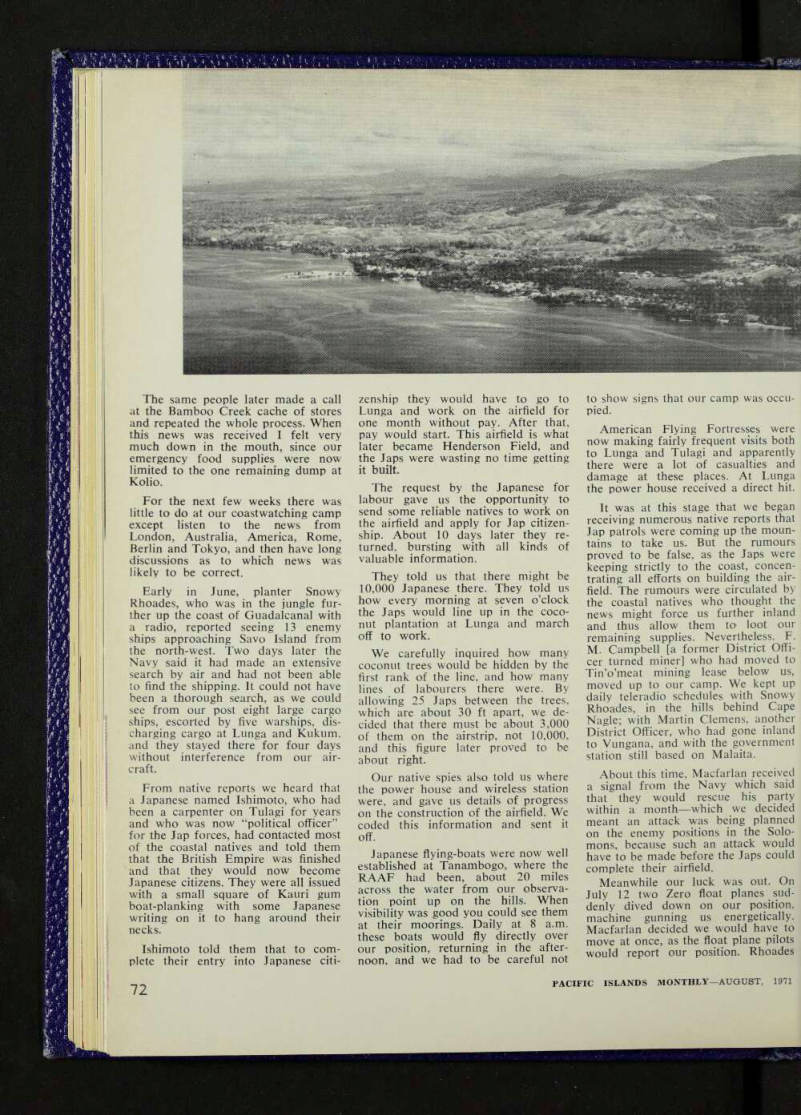
In the middle distance in the recent aerial photo at left are Point Cruz and Honiara, and behind the town are the hills in which Ken Dalrymple-Hay operated as a wartime coastwatcher.
Henderson Field is on the plains at far left of the photo. Goldridge gave a panorama up and down the coast and for 30 to 40 miles out to sea.
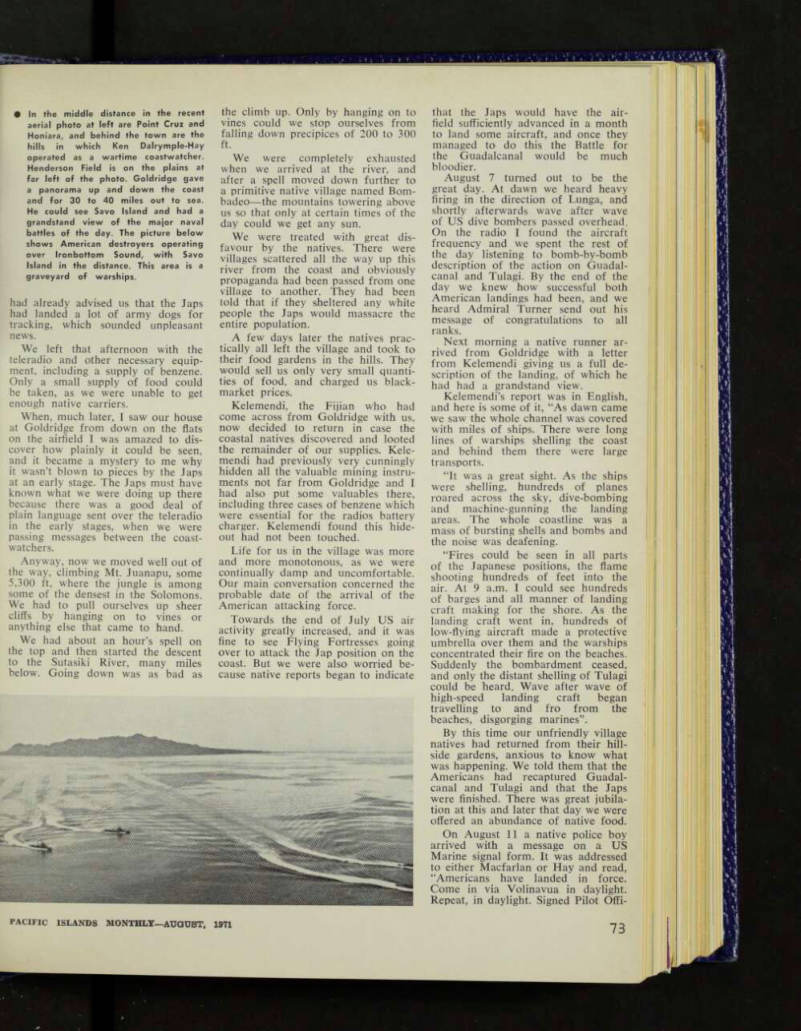
He could see Savo Island and had a grandstand view of the major naval battles of the day. The picture below shows American destroyers operating over Ironbottom Sound, with Savo Island in the distance. This area is a graveyard of warships.
had already advised us that the Japs had landed a lot of army dogs for tracking, which sounded unpleasant news.
We left that afternoon with the teleradio and other necessary equip ment, including a supply of benzene.
Only a small supply of food could be taken, as we were unable to get enough native carriers.
When, much later, I saw our house at Goldridge from down on the flats on the airfield I was amazed to dis cover how plainly it could be seen, and it became a mystery to me why it wasn’t blown to pieces by the Japs at an early stage. The Japs must have known what we were doing up there because there was a good deal of plain language sent over the teleradio in the early stages, when we were passing messages between the coast watchers.
Anyway, now we moved well out of the way, climbing Mt. Juanapu, some 5,300 ft, where the jungle is among some of the densest in the Solomons.
We had to pull ourselves up sheer cliffs by hanging on to vines or anything else that came to hand.
We had about an hour’s spell on the top and then started the descent to the Sutasiki River, many miles below. Going down was as bad as
the climb up. Only by hanging on to vines could we stop ourselves from falling down precipices of 200 to 300 ft.
We were completely exhausted when we arrived at the river, and after a spell moved down further to a primitive native village named Bom badeo—the mountains towering above us so that only at certain times of the day could we get any sun.
We were treated with great dis favour by the natives. There were villages scattered all the way up this river from the coast and obviously propaganda had been passed from one village to another. They had been told that if they sheltered any white people the Japs would massacre the entire population.
A few days later the natives prac tically all left the village and took to their food gardens in the hills. They would sell us only very small quanti ties of food, and charged us black market prices.
Kelemendi, the Fijian who had come across from Goldridge with us, now decided to return in case the coastal natives discovered and looted the remainder of our supplies. Kele mendi had previously very cunningly hidden all the valuable mining instru ments not far from Goldridge and I had also put some valuables there, including three cases of benzene which were essential for the radios battery charger. Kelemendi found this hide out had not been touched.
Life for us in the village was more and more monotonous, as we were continually damp and uncomfortable.
Our main conversation concerned the probable date of the arrival of the American attacking force.
Towards the end of July US air activity greatly increased, and it was fine to see Flying Fortresses going over to attack the Jap position on the coast. But we were also worried be cause native reports began to indicate
that the Japs would have the air field sufficiently advanced in a month to land some aircraft, and once they managed to do this the Battle for the Guadalcanal would be much bloodier.
August 7 turned out to be the great day. At dawn we heard heavy firing in the direction of Lunga, and shortly afterwards wave after wave of US dive bombers passed overhead.
On the radio I found the aircraft frequency and we spent the rest of the day listening to bomb-by-bomb description of the action on Guadal canal and Tulagi. By the end of the day we knew how successful both American landings had been, and we heard Admiral Turner send out his message of congratulations to all ranks.
Next morning a native runner ar rived from Goldridge with a letter from Kelemendi giving us a full de scription of the landing, of which he had had a grandstand view.
Kelemendi’s report was in English, and here is some of it, “As dawn came we saw the whole channel was covered with miles of ships. There were long lines of warships shelling the coast and behind them there were large transports.
“It was a great sight. As the ships were shelling, hundreds of planes roared across the sky, dive-bombing and machine-gunning the landing areas. The whole coastline was a mass of bursting shells and bombs and the noise was deafening.
“Fires could be seen in all parts of the Japanese positions, the flame shooting hundreds of feet into the air. At 9 a.m. I could see hundreds of barges and all manner of landing craft making for the shore. As the landing craft went in, hundreds of low-flying aircraft made a protective umbrella over them and the warships concentrated their fire on the beaches.
Suddenly the bombardment ceased, and only the distant shelling of Tulagi could be heard. Wave after wave of high-speed landing craft began travelling to and fro from the beaches, disgorging marines”.
By this time our unfriendly village natives had returned from their hill side gardens, anxious to know what was happening. We told them that the Americans had recaptured Guadal canal and Tulagi and that the Japs were finished. There was great jubila tion at this and later that day we were offered an abundance of native food.
On August Ila native police boy arrived with a message on a US Marine signal form. It was addressed to either Macfarlan or Hay and read, “Americans have landed in force.
Come in via Volinavua in daylight.
Repeat, in daylight. Signed Pilot Offi-
cer C. V. Widdy”. Widdy, formerly general manager of Levers Pacific Plantations, had landed with the marines and he knew we were in the hills.
August 21 found us all back at the Goldridge camp, where Macfarlan, who had gone ahead earlier, told us that the US Marine Grumman Wild cats and dive-bombers had landed on the new airfield the day before. This was just 13 days after the marines had landed on Guadalcanal, which gives you an idea of how close the Japs were to completing Henderson Field.
This was great news and it gave us a good deal of satisfaction to think that the information sent out by the coastwatchers on Guadalcanal during the Japanese occupation had enabled the Americans to time their attack before the Japs had been able to get their aircraft on to the field.
But the Japs certainly hadn’t fin ished. Native scouts arrived at Gold ridge early that morning with the news that a large force of Japs had landed east of the airfield and were making their way towards it. We sig nalled this information to Lunga, and the outcome was what is now known as the Battle of Tenaru, which was a crushing defeat for the Japs, over 800 of whom were killed.
Although the Japs were now bomb ing the new airfield consistently, the US Grumman fighters were taking a heavy toll of them. It was like being at a movie show, sitting up there on Goldridge watching air battles, many of which were fought directly above us. We had a magnificent panoramic view of the whole battle area and in good visibility could see shipping 30 to 40 miles out to sea.
The remnants of the original Japan ese labour force and garrison on the airfield were now scattered about the jungle. The main force was in the upper reaches of the Tenaru River and natives reported to us that these troops were without food and were ransacking the village gardens.
A large force of our bush natives armed with spears and axes shadowed them and one day they attacked them just before dawn as they slept. They killed about 80, the remainder getting away. The natives brought back 100 rifles and had dressed themselves up in Jap uniforms stripped from the dead. They looked a comical sight, with Jap swords and revolvers hang ing from their belts. They also brought in a lot of Jap diaries and yen notes, which were later sent down to the Intelligence corps at Lunga.
About this time an American plane came over us and dropped bags of food—very welcome indeed, as our
Lunga beach, quiet now, but it was in the middle of the war in Dalrymple-Hay's time.
diet had narrowed down to potatoes and tea.
Meanwhile Japanese air activity be gan to increase, with raids on the air strips, and the enemy were now send ing in forces of naval destroyers by night and landing supplies and troops on the coast.
The US airmen were having a very hard time, for they had to go into combat about two or three times a day as well as attack Jap shipping be tween times. The US Navy did not appear to be much in evidence at this stage of the war.
Early in September, Father De Klerke, a Dutchman who was in charge of the Roman Catholic mission station at Tangarare, on the north west of Guadalcanal, arrived at Gold ridge with Machinist Bill Warden, of Pasadena, California, who had been shot down over the Russell Is lands from his plane, based on the US carrier Enterprise. His was a re markable escape story, and it was lucky for him that he had been found by one of Snowy Rhoades’ scouts and taken to Snowy’s hideout, where he stayed for a week.
Bill Warden was thrilled to watch the air battles from our position, as being a fighter pilot he had never seen dog fights from this angle. He was most anxious to get down to Lunga, but it wasn’t safe to let him go as the marines at this stage were holding only a strip around the air field about eight miles long and four miles wide and the Japs had the rest of Guadalcanal, which is about 90 miles long.
A few days later, natives arrived from the coast and told us that two Roman Catholic fathers, Duhamel and Engelbrink, and Sister Sylvia and a young French sister, all from Rua vatu Mission, had been found mur-
dered in a hut at Tasimboko. They had all been bayoneted through the throat by the Japs and had been stripped of their clothing. The re maining sister, together with a small orphan native girl of about seven, had escaped into the jungle and they were at present in a native village.
This news shocked us all and we decided that any Japs we encoun tered from now on would receive no mercy.
Father De Klerke wrote us a letter in French to the sister, Sister Edmee, telling her that we were sending natives to bring her to Goldridge.
Although it was a long and hazard ous journey, and Sister Edmee was 65 years old, it was decided she would be safer at Goldridge than wandering about in the coastal area.
Sister Edmee got to us about Sep tember 24. She was still dressed in her long black robes and was in a state of complete exhaustion. It was several weeks before I felt she was really fit enough to have a proper conversation. My French dated back to World War I, when it had been used chiefly on the Parisian ladies, but we were able to carry on a conversation of sorts.
It appeared that before the Ameri cans landed on Guadalcanal the Japs treated the missionaries fairly well, but after the Americans landed their behaviour changed. The political offi cer Ishimoto had called at the mis sion with about 20 soldiers and the fathers and sisters were marched for days up the coast and at one stage the two fathers were told to go alone to the American positions near the Tenaru River with a false message.
They were to tell the Americans that 20,000 Jap soldiers with tanks had landed further down the coast and that if the Americans did not surren-
der immediately they would be massacred. Ishimoto said he would keep the sisters hostage and he would kill them if the fathers had not re turned by nightfall.
The fathers flatly refused to go.
They said they didn’t wish to take any part in any kind of warfare.
Ishimoto was angry.
After many privations the party was marched back to Ruavatu Mis sion, where one morning Sister Edmee was in a small hut, bathing the small orphan girl Cecila, when she saw a Jap officer and a squad of soldiers go into the main mission house and march the two fathers and two sisters away.
Suspecting the worst, she made for the jungle with the little girl. In this way she escaped the appalling fate which overtook her companions.
At Goldridge the sister said prayers every morning and afternoon and soon gathered around her quite a few of the Catholic faith from among my native scouts. Every afternoon I tuned into the French session from San Francisco and she heard the latest war news.
By this time I was in charge of the coastwatching station at Goldridge.
Macfarlan went to Australia on leave and I had volunteered to remain and operate the station. I was still a civilian and had I been caught operat ing a teleradio I would have been treated as a spy by the Japs, so I was offered a commission in the RANVR. I accepted and on October 17 I learned that I had been com missioned from October 8, five days after Macfarlan had left.
From information supplied by Snowy Rhoades, who also in October had been flown to Australia for a well-earned rest, I knew that a Jap observation post was operating from Veruru, at Cape Hunter, on the west ern side of the island, and I called for volunteers from my native scouts to go and clean them up. Three Malaita men offered to do the job, as they said they had some Malaita friends on the other side who could help them do it.
By October 20 they were back, with nine Japanese rifles and some Jap flags as trophies. They had been very cunning. They had picked up 13 natives at Inakona, where they also had heard that some of the Japs had been at the village a few days before, asking for pigs.
So the 16 natives went to the Jap post, where 13 of them hid in the jungle, while the other three made friendly contact, offering food to the Japs for tobacco. When the subject of pigs came up—as the Malaita men expected it would—they agreed to
Ken Dalrymple-Hay, as Brett Hilder saw him 15 years ago.
organise a pig hunting party with the help of some of their friends.
The next morning the full party of natives turned up, all armed with spears and long-handled axes, and in vited the 10 Japs at the post to join the hunt. Eight of them did, leaving two at the post. During the “pig hunt” the party split in two, “in order to follow two branches of the river”, and the Japs, outnumbered, were killed with spears.
Returning to the post, the natives waited until dark before attempting to rush the two sentries. Native strategy depends very much on the element of surprise, the idea being to catch the enemy when his capacity for resistance is at its lowest.
When they rushed the hut they found only one Jap there, whom they killed, but the other one had disap peared and was never seen again. The natives destroyed two machine guns, ammunition, and a radio, and carried away the stores after burning down the hut. It was a well-planned job and I was thankful they were on my side.
The Japs continued to make land ings on both sides of the airfield, but American air strength was increasing as more strips were completed. The US airmen were far too good for the Japs, who were taking a colossal beat ing, yet still they came and I often wondered how the Jap pilots felt when they saw their names go on the duty board for a raid on Guadalcanal.
It was an amazing experience to sit down on Goldridge in comparative safety, watching this life and death
struggle. As soon as I heard the rush of fighters taking off and saw the usual cloud of red dust rising from the airfield below I would tune into the control frequency and watch and listen to these dramas of the air.
Sister Edmee remained with me at Goldridge until December 7—it being impossible to get her down earlier because of Japanese activities. I had tried on one occasion and been forced back. But by now I had made my first personal contact with the Ameri cans. and Goldridge was becoming quite civilised. I had a visit from a Colonel Matheson, an Australian on loan to the US Army, and two mem bers of the BSIP Defence Force— Captain David Trench [who later be came Western Pacific High Commis sioner] and Lt. Case. I took the opportunity of sending Sister Edmee down to the coast with them, rigging up a chair attached to two poles, which the natives carried. From Lunga she was flown to Noumea—a gallant nun, who stood up to dread ful dangers and hardships with more fortitude than many a man.
As it happened, two days after Sis ter Edmee left Goldridge. a scout told me he had seen 20 Japs on the track on the route that Sister Edmee’s party had taken. I sent out a native patrol of 20 men armed with Jap rifles and they returned a few days later with the news that they had caught up with the Japs, killing 11 of them. They found another five already dead, prob ably from starvation. All the Japs were in a half-starved condition and must have been lost for some time.
Life lapsed into the steady mono tony that was the worst feature of parts of my stay on Goldridge. Even continued reports of Jap activity in the vicinity did not liven things up.
There were no longer any exciting air and naval battles to watch and I had seen all the great sea battles that were fought in the Guadalcanal area.
Early in January 1943 I received a signal from the Naval staff office to close down the Goldridge station and report to Lunga. I was glad to get this news, as I was very tired of it all and had not been to Australia since 1939. I had had several heart attacks and for the past two months had been annoyed by toothache.
The battle for Guadalcanal was drawing to an end and the American forces coming from both sides of the island had the Jap forces confined to a small part of the area, decimating them as they went. At 7 p.m. on February 9, 1943, the following signal was sent out by Major-General Patch the commanding general on Guadal canal: “To all commanding officers— Japanese forces on Guadalcanal de stroyed today. Our forces have met at Cape Esperance”.