Fiji Dreams, And
pp. 93-96 · Read in the full issue
The Best Of
British Luck
By Judy Tudor
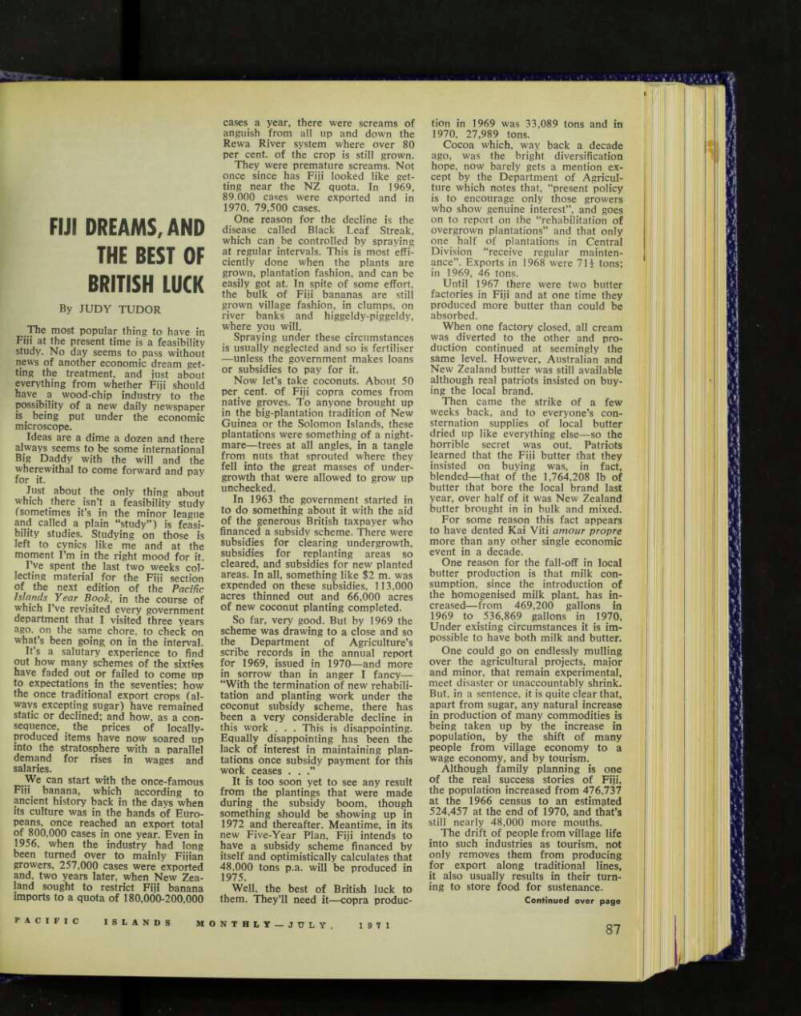
The most popular thing to have in Fiji at the present time is a feasibility study. No day seems to pass without news of another economic dream get ting the treatment, and just about everything from whether Fiji should have a wood-chip industry to the possibility of a new daily newspaper is . being put under the economic microscope.
Ideas are a dime a dozen and there always seems to be some international Big Daddy with the will and the wherewithal to come forward and pay for it.
Just about the only thing about which there isn’t a feasibility study (sometimes it’s in the minor league and called a plain “study”) is feasi bility studies. Studying on those is left to cynics like me and at the moment I’m in the right mood for it.
I’ve spent the last two weeks col lecting material for the Fiji section of the next edition of the Pacific Islands Year Book, in the course of which I’ve revisited every government department that I visited three years ago. on the same chore, to check on what’s been going on in the interval.
It’s a salutary experience to find out how many schemes of the sixties have faded out or failed to come up to expectations in the seventies; how the once traditional export crops (al ways excepting sugar) have remained static or declined; and how, as a con sequence, the prices of locally produced items have now soared up into the stratosphere with a parallel demand for rises in wages and salaries. .We can start with the once-famous Fiji banana, which according to ancient history back in the days when its culture was in the hands of Euro peans, once reached an export total of 800,000 cases in one year. Even in 1956, when the industry had long been turned over to mainly Fijian growers, 257,000 cases were exported and, two years later, when New Zea land sought to restrict Fiji banana imports to a quota of 180,000-200,000
cases a year, there were screams of anguish from all up and down the Rewa River system where over 80 per cent, of the crop is still grown.
They were premature screams. Not once since has Fiji looked like get ting near the NZ quota. In 1969, 89.000 cases were exported and in 1970, 79,500 cases.
One reason for the decline is the disease called Black Leaf Streak, which can be controlled by spraying at regular intervals. This is most effi ciently done when the plants are grown, plantation fashion, and can be easily got at. In spite of some effort, the bulk of Fiji bananas are still grown village fashion, in clumps, on river banks and higgeldy-piggeldy, where you will.
Spraying under these circumstances is usually neglected and so is fertiliser —unless the government makes loans or subsidies to pay for it.
Now let’s take coconuts. About 50 per cent, of Fiji copra comes from native groves. To anyone brought up in the big-plantation tradition of New Guinea or the Solomon Islands, these plantations were something of a night mare—trees at all angles, in a tangle frorn nuts that sprouted where they fell into the great masses of under growth that were allowed to grow up unchecked.
In 1963 the government started in to do something about it with the aid of the generous British taxpayer who financed a subsidy scheme. There were subsidies for clearing undergrowth, subsidies for replanting areas so cleared, and subsidies for new planted areas. In all, something like $2 m. was expended on these subsidies, 113,000 acres thinned out and 66,000 acres of new coconut planting completed.
So far, very good. But by 1969 the scheme was drawing to a close and so the Department of Agriculture’s scribe records in the annual report for 1969, issued m 1970—and more in sorrow than in anger I fancy— “ With the termination of new rehabili tation and planting work under the coconut subsidy scheme, there has been a very considerable decline in this work . . . This is disappointing.
Equally disappointing has been the lack of interest in maintaining plan tations once subsidy payment for this ceases . . .”
It is too soon yet to see any result from the plantings that were made during the subsidy boom, though something should be showing up in 1972 and thereafter. Meantime, in its new Five-Year Plan, Fiji intends to have a subsidy scheme financed by itself and optimistically calculates that 48.000 tons p.a. will be produced in 1975.
Well, the best of British luck to them. They’ll need it—copra produc
tion in 1969 was 33,089 tons and in 1970, 27,989 tons.
Cocoa which, way back a decade ago, was the bright diversification hope, now barely gets a mention ex cept by the Department of Agricul ture which notes that, “present policy is to encourage only those growers who show genuine interest”, and goes on to report on the “rehabilitation of overgrown plantations” and that only one half of plantations in Central Division “receive regular mainten ance”. Exports in 1968 were I\\ tons; in 1969, 46 tons.
Until 1967 there were two butter factories in Fiji and at one time they produced more butter than could be absorbed.
When one factory closed, all cream was diverted to the other and pro duction continued at seemingly the same level. However, Australian and New Zealand butter was still available although real patriots insisted on buy ing the local brand.
Then came the strike of a few weeks back, and to everyone’s con sternation supplies of local butter dried up like everything else—so the horrible secret was out. Patriots learned that the Fiji butter that they insisted on buying was, in fact, blended—that of the 1,764,208 lb of butter that bore the local brand last year, over half of it was New Zealand butter brought in in bulk and mixed.
For some reason this fact appears to have dented Kai Viti amour propre more than any other single economic event in a decade.
One reason for the fall-off in local butter production is that milk con sumption, since the introduction of the homogenised milk plant, has in creased—from 469,200 gallons in 1969 to 536,869 gallons in 1970.
Under existing circumstances it is im possible to have both milk and butter.
One could go on endlessly mulling over the agricultural projects, major and minor, that remain experimental, meet disaster or unaccountably shrink.
But, in a sentence, it is quite clear that, apart from sugar, any natural increase in production of many commodities is being taken up by the increase in population, by the shift of many people from village economy to a wage economy, and by tourism.
Although family planning is one of the real success stories of Fiji, the population increased from 476,737 at the 1966 census to an estimated 524,457 at the end of 1970, and that’s still nearly 48,000 more mouths.
The drift of people from village life into such industries as tourism, not only removes them from producing for export along traditional lines, it also usually results in their turn ing to store food for sustenance.
Continued over page
Along this gimmicky-named Coral Coast where tourism has boomed, the villagers, who once spent a lot of their time fishing and gardening, now find easier ways of earning cash with the result that they too go to Sigatoka market for fruit, vegetables and fish and to the stores for imported items.
The dock strike did more than show people where the butter came from; it showed just how much this small country depends on outside countries for its food, food moreover that is grown and produced by European high-cost labour.
The government, in a panic and quite unnecessarily, hopped in and slapped price control on such basic items as flour, sharps and rice.
No effort was made to control the prices of much of the locally-produced food and even on Sydney standards these are astronomical.
Eggs, for example, were selling in the Sigatoka market for $1 a dozen; BPs had a few at 85c a dozen and there were queues for those.
The story here is that during the strike supplies of imported poultry mash dried up and the hens refused to do their stuff on anything grown locally. With all due respect to inter national economists and local egg pro ducers, it seems to me that if the whole egg production business of Fiji depends on importing laying mash from Australia and New Zealand, it would be better to import the eggs from NZ, where local farmers can produce cheaper than anywhere else in the world, and let the people in Fiji who now tend hens be employed growing something like dalo which is currently selling at from 40c to 50c for three.
On the sunny side of the gloomy agriculture picture there is always sugar. Sugar, to the people who grow it, still mostly Indians, is a way of life as much as a crop. There is no problem in getting it grown, it is in grained in them, to the extent that no other crop is of interest —as was proved some years back when CSR Co. shut down its Nausori mill. It was hoped then that the people who had been growing sugar for the mill would grow rice instead. They didn’t. They either went elsewhere and grew sugar or went to Suva and worked for wages. .
But right now Fiji is right up to its international quota of of 341,000 tons p.a. and there is little room for manoeuvre. At the same time there are so many question marks about Fiji’s sugar in particular and Commonwealth sugar in general that it deserves a story on its own.
On the credit side of the general Fiji economy are the many small and a few large secondary industries that
have sprung up in recent years; and, lastly, but most important of all, that glamorous milch cow that gives golden liquid in the form of tourist dollars.
I have never understood how tour ist profitability is calculated, but I am assured that, in 1970, tourism con tributed S23m. to Fiji’s economy— which makes it more profitable than copra, coconut oil, bananas, fish and gold combined.
In the last few years dozens of small industries and some large ones have started in Fiji. Aluminium doors and screens, plastic clothes pegs, barbed wire, umbrellas, matches—the list is endless and is being added to each week, all with the idea of cutting down on imports.
But has it? The total tentative im ports bill for 1970 is sBBm. —which means that it has increased over 75 per cent, since 1966. In the same period, the population has increased only 10 per cent., so obviously the rest must be going on more luxuries for everyone, a higher standard of living, inflation, or on tourism— —building materials for hotels, special food, goods to pamper tourist, like duty-free radios, cameras, watches, etc. In the same period exports have risen, in value, by 50 per cent., all of the increase accounted for by sugar and frozen fish from the Levuka depot of an Asian-manned tuna-fishing en terprise.
Balancing plans and performances against each other, many people wonder whether Fiji has its priorities right. Whether it mightn’t be better to let Australia go on supplying the plas tic clothes pegs, Hong Kong the umbrellas, Bryant and May the matches, and other industrialised nations a dozen other commodities, while Fiji gets back to producing more for export or simply in order to eat cheaper at home.
It can be said, of course, that the people who make pegs or matches iren’t likely to be planting coconuts inyhow; that the import bill would be ligher without their efforts; and that many young Fijians—and who can Plame them—find it infinitely more to heir taste to play a guitar in a band >r work as a waiter or bartender in i hotel than slave in the village garden
Wanting tapioca.
But that isn’t the argument. The irgument is that imports are increas ng so much faster than exports and hat even when the invisible export )f tourism is added to the actual exports, there still is a trade deficit.
The businesses of trade and produc ion for home consumption are inter ocking items, part of an array of undamental problems that are too fequently blanketed from view by
a whole flock of new plans, new studies and grandiose dreams.
Certainly, since independence, Fiji has been pushed into a political lifestyle more fitting for a country 20 times its size and 10 times its efficiency and while outside capital keeps coming in to build new hotels and new resorts, this artificial level of circulating money appears to support it.
But should the tourist industry reach a point where it becomes static or no fresh infusions of funds are made, it is anyone’s guess what fiscal measures in new taxes, restrictions and penalties might then present them selves as the only way out.
Right now, Fiji has three big fin-
ance problems coming up—the Nadi- Suva road, the sixth Five-Year Plan and purchase of the sugar industry, The Minister for Finance is at pre sent in the United States with his en tourage arranging for a World Bank loan to seal and rebuild the two end sections of the road (the middle, and worst section, Korotogo to Deuba, must await another day); he will then go on to Europe to arrange loans in connection with the new Five-Year Plan. j n 1973 the government must start paying the Cofonial Suear Refining was handed to them on a platter, at bargain rates, but it still runs into
millions of dollars.
Fiji’s independent and feeling her oats and I wished her the best of British luck some time back. I amend that—the best of any kind of luck. I think she’s going to need it.
FOOTNOTE; The most going con cern that I’ve found in Fiji is the National Provident Fund. It got go ing only in 1966 and is financed by a compulsory levy of 10c on each dollar of wages or salary earned —contributed on a 50-50 basis by employer and employee. It is primarily designed to give workers a lump sum at retire ment aged 55.
The fund has built itself elegant offices on the outskirts of Suva and has in its kitty as of now $l4 million, which it invests in Fiji. Naturally it is
the very favourite step-child of gov ernment which makes full use of this facility; and of those private interests who are also in the market for money and who are able to convince the Fund’s Board that they are worthy of assistance. • Five new companies were registered in Fiji at the end of May.
They were, Navava Properties Inc., of Tacoma, Washington, real estate; Western Tobacco Co. Ltd., producers and manufacturers of tobacco pro ducts; Ba Rock and Concrete Pro duction Ltd., manufacurers of con crete blocks; Asha Investments Ltd., of Lautoka; Monier Tiles Ltd., manu facturer and supplier of concrete roofing and floor tiles.