Business and Development
p. 91 · Read in the full issue
Localisation
Too Fast
For Comfort
By a staff reporter
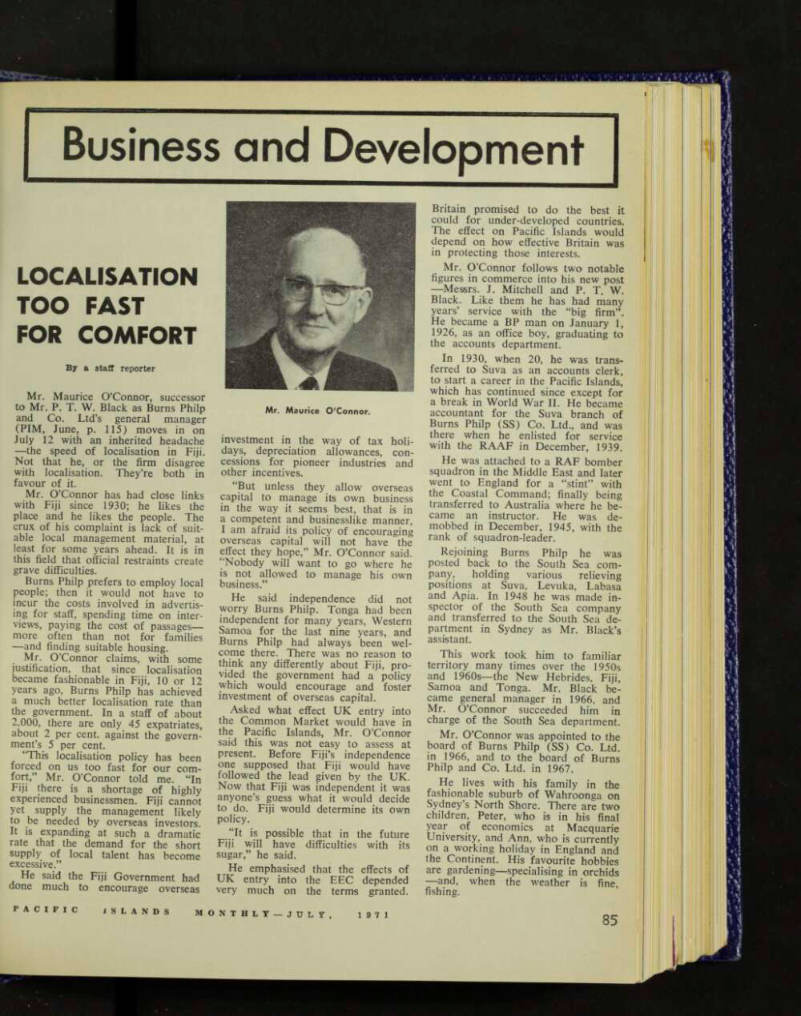
Mr. Maurice O’Connor, successor to Mr. P. T. W. Black as Burns Philp and Co. Ltd’s general manager (PIM, June, p. 115) moves in on July 12 with an inherited headache —the speed of localisation in Fiji.
Not that he, or the firm disagree with localisation. They’re both in favour of it.
Mr. O’Connor has had close links with Fiji since 1930; he likes the place and he likes the people. The crux of his complaint is lack of suit able local management material, at least for some years ahead. It is in this field that official restraints create grave difficulties.
Burns Philp prefers to employ local people; then it would not have to incur the costs involved in advertis ing for staff, spending time on inter views, paying the cost of passages— more often than not for families —and finding suitable housing.
Mr. O’Connor claims, with some justification, that since localisation became fashionable in Fiji, 10 or 12 years ago. Burns Philp has achieved a much better localisation rate than the government. In a staff of about 2,000, there are only 45 expatriates, about 2 per cent, against the govern ment’s 5 per cent.
“This localisation policy has been forced on us too fast for our com fort,” Mr. O’Connor told me. “In Fiji there is a shortage of highly experienced businessmen. Fiji cannot yet supply the management likely to be needed by overseas investors.
It is expanding at such a dramatic rate that the demand for the short supply of local talent has become excessive.”
He said the Fiji Government had done much to encourage overseas
investment in the way of tax holi days, depreciation allowances, con cessions for pioneer industries and other incentives.
“But unless they allow overseas capital to manage its own business in the way it seems best, that is in a competent and businesslike manner, I am afraid its policy of encouraging overseas capital will not have the effect they hope,” Mr. O’Connor said.
“Nobody will want to go where he is not allowed to manage his own business.”
He said independence did not worry Burns Philp. Tonga had been independent for many years, Western Samoa for the last nine years, and Burns Philp had always been wel come there. There was no reason to think any differently about Fiji, pro vided the government had a policy which would encourage and foster investment of overseas capital.
Asked what effect UK entry into the Common Market would have in the Pacific Islands, Mr. O’Connor said this was not easy to assess at present. Before Fiji’s independence one supposed that Fiji would have followed the lead given by the UK.
Now that Fiji was independent it was anyone’s guess what it would decide to do. Fiji would determine its own policy.
“It is possible that in the future Fiji will have difficulties with its sugar,” he said.
He emphasised that the effects of UK entry into the EEC depended very much on the terms granted.
Britain promised to do the best it could for under-developed countries.
The effect on Pacific Islands would depend on how effective Britain was in protecting those interests.
Mr. O’Connor follows two notable figures in commerce into his new post —Messrs. J. Mitchell and P. T. W.
Black. Like them he has had many years’ service with the “big firm”.
He became a BP man on January 1, 1926, as an office boy, graduating to the accounts department.
In 1930, when 20, he was trans ferred to Suva as an accounts clerk, to start a career in the Pacific Islands, which has continued since except for a break in World War 11. He became accountant for the Suva branch of Burns Philp (SS) Co. Ltd., and was there when he enlisted for service with the RAAF in December, 1939.
He was attached to a RAF bomber squadron in the Middle East and later went to England for a “stint” with the Coastal Command; finally being transferred to Australia where he be came an instructor. He was de mobbed in December, 1945, with the rank of squadron-leader.
Rejoining Burns Philp he was posted back to the South Sea com pany, holding various relieving positions at Suva, Levuka, Labasa and Apia. In 1948 he was made in spector of the South Sea company and transferred to the South Sea de partment in Sydney as Mr. Black’s assistant.
This work took him to familiar territory many times over the 1950 s and 1960 s—the New Hebrides, Fiji, Samoa and Tonga. Mr. Black be came general manager in 1966, and Mr. O’Connor succeeded him in charge of the South Sea department.
Mr. O’Connor was appointed to the board of Burns Philp (SS) Co. Ltd. in 1966, and to the board of Burns Philp and Co. Ltd. in 1967.
He lives with his family in the fashionable suburb of Wahroonga on Sydney’s North Shore. There are two children, Peter, who is in his final year of economics at Macquarie University, and Ann, who is currently on a working holiday in England and the Continent. His favourite hobbies are gardening—specialising in orchids —and, when the weather is fine, fishing.
Mr. Maurice O'Connor.