The story of Willie Coe
p. 71 · Read in the full issue
From fugitive to governor: The story of Willie Coe
IN a new semi-official brochure about the Governors of Guam there is a line which ties in with a bit of Western Samoan and New Guinea history.
It says that William Coe was the first Governor of Guam (acting, from April until August, 1899), after the United States took over Guam from Spain, following the Spanish-American war.
When writing the book Queen Emma of New Guinea a few years ago, I searched unsuccessfully for something authentic about the fate of Willie Coe after he got away from the German Police in New Guinea in the late 1890 s. Now I have it.
William Pritchard Coe, born in 1857, was the son of Jonas M. Coe, first American Agent in Samoa, around 1860-70. He was full brother of Emma Coe, afterwards known as “Queen” Emma of New Guinea. He was a married man of 32, with six children, in 1889, when Britain, Ger many and United States were snarling at each other over their commercial and political rights in Samoa.
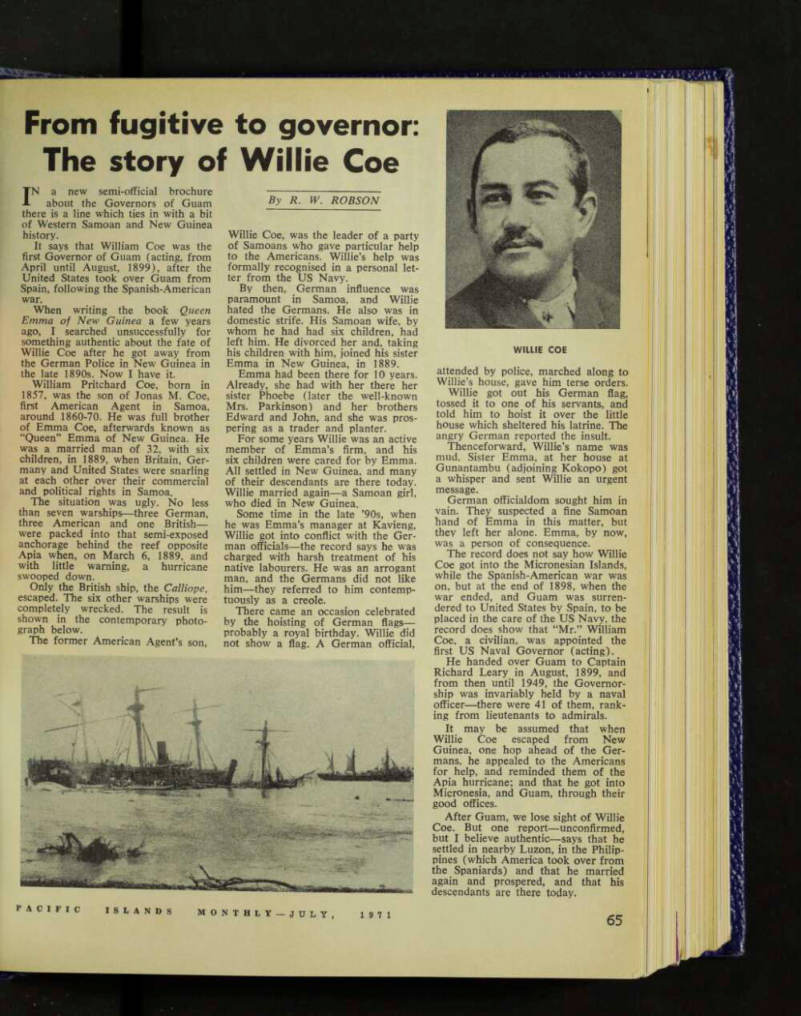
The situation was ugly. No less than seven warships—three German, three American and one British— were packed into that semi-exposed anchorage behind the reef opposite Apia when, on March 6, 1889, and with little warning, a hurricane swooped down.
Only the British ship, the Calliope, escaped. The six other warships were completely wrecked. The result is shown in the contemporary photo graph below.
The former American Agent’s son,
By R. W. Robson
Willie Coe, was the leader of a party of Samoans who gave particular help to the Americans. Willie’s help was formally recognised in a personal let ter from the US Navy.
By then, German influence was paramount in Samoa, and Willie hated the Germans. He also was in domestic strife. His Samoan wife, by whom he had had six children, had left him. He divorced her and, taking his children with him, joined his sister Emma in New Guinea, in 1889.
Emma had been there for 10 years.
Already, she had with her there her sister Phoebe (later the well-known Mrs. Parkinson) and her brothers Edward and John, and she was pros pering as a trader and planter.
For some years Willie was an active member of Emma’s firm, and his six children were cared for by Emma, All settled in New Guinea, and many of their descendants are there today, Willie married again—a Samoan girl, who died in New Guinea, Some time in the late ’9os, when he was Emma’s manager at Kavieng, Willie got into conflict with the Ger man officials—the record says he was charged with harsh treatment of his native labourers. He was an arrogant man, and the Germans did not like him—they referred to him contemp tuously as a creole, There came an occasion celebrated by the hoisting of German flags— probably a royal birthday. Willie did not show a flag. A German official,
attended by police, marched along to Willie’s house, gave him terse orders.
Willie got out his German flag, tossed it to one of his servants, and told him to hoist it over the little house which sheltered his latrine. The angry German reported the insult.
Thenceforward, Willie’s name was mud. Sister Emma, at her house at Gunantambu (adjoining Kokopo) got a whisper and sent Willie an urgent message.
German officialdom sought him in vain. They suspected a fine Samoan hand of Emma in this matter, but they left her alone. Emma, by now, was a person of consequence.
The record does not say how Willie Coe got into the Micronesian Islands, while the Spanish-American war was on, but at the end of 1898, when the war ended, and Guam was surren dered to United States by Spain, to be placed in the care of the US Navy, the record does show that “Mr.” William Coe, a civilian, was appointed the first US Naval Governor (acting).
He handed over Guam to Captain Richard Leary in August, 1899, and from then until 1949, the Governor ship was invariably held by a naval officer—there were 41 of them, rank ing from lieutenants to admirals.
It may be assumed that when Willie Coe escaped from New Guinea, one hop ahead of the Ger mans, he appealed to the Americans for help, and reminded them of the Apia hurricane; and that he got into Micronesia, and Guam, through their good offices.
After Guam, we lose sight of Willie Coe. But one report—unconfirmed, but I believe authentic—says that he settled in nearby Luzon, in the Philip pines (which America took over from the Spaniards) and that he married again and prospered, and that his descendants are there today.