Yesterday
p. 62 · Read in the full issue
Copra prices was one of the things which marred the celebrations 20 years ago, when PIM recorded that planters in New Guinea, Fiji and the Solomons were planning to take action over the price being paid to copra producers under the British Ministry of Food Contract and the high and increasing price of copra sacks. At that time the MOF price was about £5O a ton. What the row was about was that just after the contract had been negotiated Britain "devalued sterling by at least 30 per cent, in terms of world values," but continued to pay the planters in the depreciated currency, "although the world price of copra has been more than double the amount provided for in the MOF contract." Waxing wrathful, PIM said: "In other words, the British Government, by sheer trickery, has for a year or more been robbing the South Pacific planters of about £3O a ton". Today, 20 years later, when the price of most things has more than doubled, copra is round $l2O a ton.
The complaint PIM had at that time over prices of land in PNG was engendered by the purchase by the Administration of 321 acres of Kila Kila and Korobosea native land for £8,025. The land was for a new suburb of Boroko, Port Moresby. PlM's beef was that £25 an acre was too much to pay for land "in a muggy little valley" at the back of Port Moresby.
Round about this time, four Samoans broke gaol near Apia, shot and wounded a policeman and terrorised the citizens for three days before being rounded up.
Calling the whole thing "Official misjudgment", PIM suggested an inquiry into the "state of mind of the higher authorities who tried to put an end to the gaolbreakers' terrorism by making persuasive gestures and soft, cooing noises."
Immigration policies of governments often get a slating today but not many newspapers said much about that sort of thing 20 years ago when PIM was crusading for the removal of "restrictions placed by the Governments of Australia and New Zealand upon travel by persons of
Polynesian and part-Polynesian blood." Said PIM, "The position taken up by New Zealand especially is ridiculous. In her own Maoris, New Zealand has 100,000 Polynesian residents. Yet, if a Niuean, or Tongan, or Samoan, who is of exactly the same race, wants to live in New Zealand, he is barred by the immigration laws."
It was all "typical political silliness," said PIM. Today, of course —and maybe PIM can take some credit— New Zealand has some very large communities of Samoans, Tongans, Cook Islanders and the rest. But Australia hasn't!
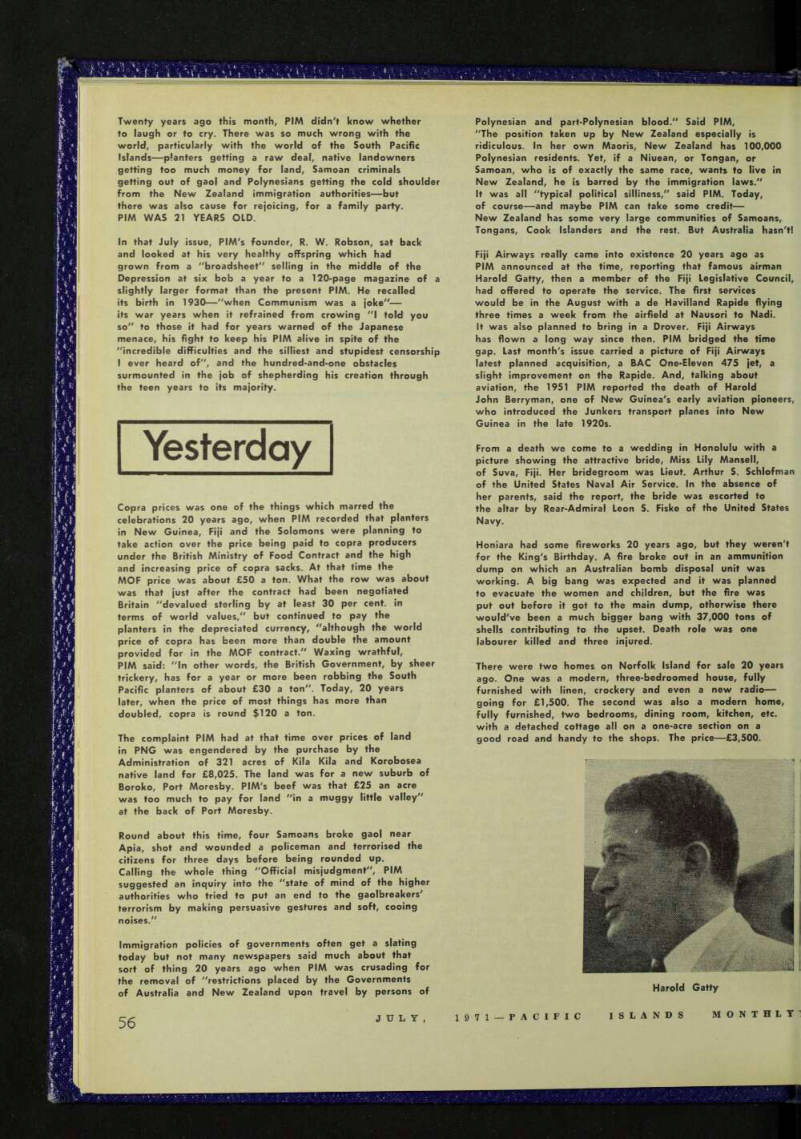
Fiji Airways really came into existence 20 years ago as PIM announced at the time, reporting that famous airman Harold Gatty, then a member of the Fiji Legislative Council, had offered to operate the service. The first services would be in the August with a de Havilland Rapide flying three times a week from the airfield at Nausori to Nadi.
It was also planned to bring in a Drover. Fiji Airways has flown a long way since then. PIM bridged the time gap. Last month's issue carried a picture of Fiji Airways latest planned acquisition, a BAC One-Eleven 475 jet, a slight improvement on the Rapide. And, talking about aviation, the 1951 PIM reported the death of Harold John Berryman, one of New Guinea's early aviation pioneers, who introduced the Junkers transport planes into New Guinea in the late 19205.
From a death we come to a wedding in Honolulu with a picture showing the attractive bride, Miss Lily Mansell, of Suva, Fiji. Her bridegroom was Lieut. Arthur S. Schlofman of the United States Naval Air Service. In the absence of her parents, said the report, the bride was escorted to the altar by Rear-Admiral Leon S. Fiske of the United States Navy.
Honiara had some fireworks 20 years ago, but they weren't for the King's Birthday. A fire broke out in an ammunition dump on which an Australian bomb disposal unit was working. A big bang was expected and it was planned to evacuate the women and children, but the fire was put out before it got to the main dump, otherwise there would've been a much bigger bang with 37,000 tons of shells contributing to the upset. Death role was one labourer killed and three injured.
There were two homes on Norfolk Island for sale 20 years ago. One was a modern, three-bedroomed house, fully furnished with linen, crockery and even a new radio— going for £1,500. The second was also a modern home, fully furnished, two bedrooms, dining room, kitchen, etc. with a detached cottage all on a one-acre section on a good road and handy to the shops. The price—£3,500.
Twenty years ago this month, PIM didn't know whether to laugh or to cry. There was so much wrong with the world, particularly with the world of the South Pacific Islands —planters getting a raw deal, native landowners getting too much money for land, Samoan criminals getting out of gaol and Polynesians getting the cold shoulder from the New Zealand immigration authorities —but there was also cause for rejoicing, for a family party.
Pim Was 21 Years Old.
In that July issue, PlM's founder, R. W. Robson, sat back and looked at his very healthy offspring which had grown from a "broadsheet" selling in the middle of the Depression at six bob a year to a 120-page magazine of a slightly larger format than the present PIM. He recalled its birth in 1930—" when Communism was a joke"— its war years when it refrained from crowing "I told you so" to those it had for years warned of the Japanese menace, his fight to keep his PIM alive in spite of the "incredible difficulties and the silliest and stupidest censorship I ever heard of", and the hundred-and-one obstacles surmounted in the job of shepherding his creation through the teen years to its majority.
Harold Gatty