most important conference
pp. 38-39 · Read in the full issue
Micronesia prepares for its most important conference
From F. T. ULUDONG, in Honolulu The Micronesians and their American administrators, are now gearing up for the third, and perhaps the most decisive, round of negotiations on the future political status of Micronesia.
The coming negotiations [probably to be held in August in one of Hawaii’s Neighbour Islands! may also prove to be the last efforts by the Micronesians to settle the issue through conven tional diplomacy.
Many Micronesian leaders feel that they have genuinely attempted to ac commodate the American interests in their islands, only to be rebuffed at the negotiation table. Any more re buffs by the US could spell an end to any future negotiations, and the possi bility of unilateral declaration of in dependence is assuming more mean ing.
Declared one of the Micronesian leaders, Sen. Petrus Tun, from the culture-conscious Yap district, who advocated continued negotiations with the United States after both America and Micronesia reached a deadlock during the May, 1970, negotiations in Saipan; “If in the end the worst comes to the worst, we must then go for independence ... It is then and only then that I may go so far as to say, ‘Give me death or absolute free dom’.”
What is happening in Micronesia is a hardening of political attitudes against the United States on the part of Micronesian leaders and the American-educated elite, and a realis ation that the United States, contrary to its preachings about democracy, will never allow the Micronesians to exercise their right to self-determina tion if such an exercise is deemed as a danger to the American interests, real and psychological.
And while anti-Americanism is still publicly absent in Micronesia, America is now being portrayed by some young Micronesians, especially students, as a racist and imperialistic country whose only interests in Micro nesia are her own selfish interests.
“Micronesia Belongs to the Micro nesians” and “Brown is Beautiful” are fast becoming the expressions of the sentiment. And it may not be long before this sentiment turns into anti- Americanism, peaceful or otherwise.
The cause of this changing mood is not limited only to the desire for more self-government or independence for the islands. There is also a deep seated conviction among many Micro
nesians that the United States has be trayed its ideals in Micronesia, and has instead chosen, in the words of Sen. Lazarus Salii, to make Micro nesia “the newest, the smallest and the remotest minority within the United States political family”.
The more outspoken Micronesian leaders charge that the United States is, deliberately and without the con sent of the people of Micronesia, mak ing Micronesia a small replica of all that is America, thereby raising ex pectations unattainable in island com munities.
The charge, which self-righteous Americans would readily dismiss as untrue, is not without historical and concrete justifications. The Micro nesians have only to point to the Solo mon Mission which went to Micro nesia during the last year of Ken nedy’s administration and proposed a plan to bring about Micronesia’s an nexation by Americanising the Micro nesians to the point that, out of necessity, they would choose to be part of the United States in a pre planned plebiscite in 1968.
To show that the plan has not been a complete failure, they contend that the Marianas’ desire to be American is a direct result of the vigorous im plementation of the Solomon plan in that district.
Apart from the Micronesians in the Marianas, who are by no means blind lovers of America (they want Japan ese businessmen to develop Marianas’ potential for tourism), the rest of Micronesia, as far as can be deter mined, wants as much loose associ ation as possible with the United States as the Congress of Micronesia asked for in proposing free associ ation last year.
But, as stated, the mood is chang ing in such a direction that the United States, whose psychological and mili tary interests in Micronesia would have been assured had it not rejected the free association offer last year, may find the Micronesians demanding more in the coming negotiations.
Some Micronesians even feel that Micronesia should not negotiate its right to self-determination, and, in stead, should notify the United Nations and the United States of the
year it wants to be independent an begin now working for it.
The Independence Coalition trie to do just that during last month’ session of the Congress of Micrc nesia, but discovering that it lacke the vote to carry it through, droppe its plan. Its spokesman, howevei promised to press for it during neJ January’s session.
Students here and in Guam, wh have organised chapters of the Micro nesian Independence Advocates, hav also demanded that the negotiatior be abandoned. The Young Micrc nesian, a monthly magazine publishe by local Micronesian students, in recent editorial entitled, “Indepei dence: The Only Remaining Course’ had this to say about the free assoc ation proposal and any future negot ations: “When some of our leaders in yeai past dreamed of free association wit the United States, they sincerely hope that it would readily see the righteoui ness of their position and accept th arrangement. Their hope was at be; a naive one and at worst wishfi thinking. There is, however, som consolation in their try. We now kno 1 the futility of negotiating wit America . . . Any giving-in on the: part would gradually have led to th
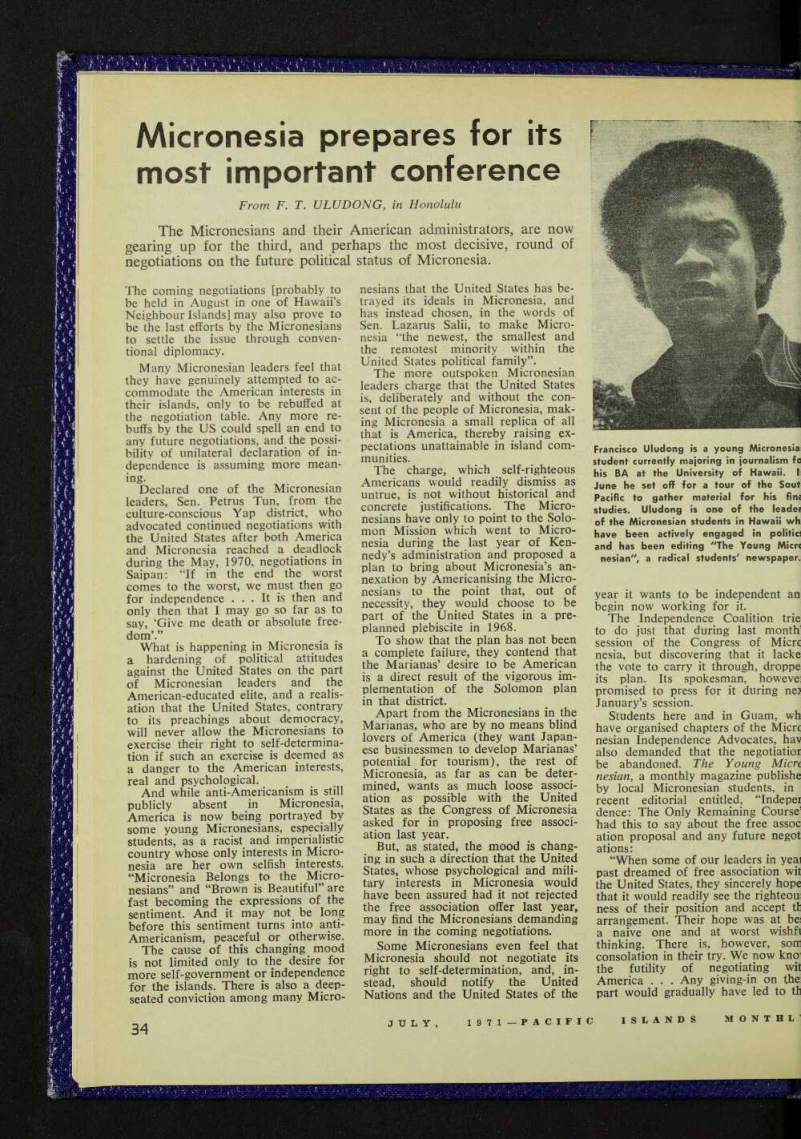
Francisco Uludong is a young Micronesia student currently majoring in journalism f[?] his BA at the University of Hawaii. [?] June he set off for a tour of the Sout[?] Pacific to gather material for his fina[?] studies. Uludong is one of the leader[?] of the Micronesian students in Hawaii wh[?]
have been actively engaged in politic[?]
and has been editing "The Young Micr[?] nesian", a radical students' newspaper.
extinction of our cultures and tradi tions”.
Nevertheless, the Congress of Micronesia, in agreeing to further negotiations, is now playing all the cards that Micronesia presumably has in its hands. The UN Decolonisation Committee has been invited to visit Micronesia and a delegation headed by Sen. Lazarus Salii personally ap peared before its members and asked them to visit Micronesia if the negoti ations “failed”.
Another delegation has also gone to Japan to consult with the Japanese Government and business leaders for assistance in the future.
Although the appointment by Presi dent Nixon of Mr. F. Hayden Wil liams, president of Asia Foundation, with ambassador rank, as head of the American delegation to the politi cal status talks, is widely interpreted as a sign of Nixon’s personal in terest in the talks, many Micronesian leaders see the appointment as Nixon’s way of putting more emphasis on US military interests.
Williams was a former deputy as sistant Secretary of Defence during the Eisenhower Administration and his foundation has been used by the Defence Department and the CIA as a front for many of their activities in South-East Asia and in Micronesia.
Saipan was used in the 50s by the CIA for training Nationalist Chinese counter-insurgency forces.
What appears to have begun is what the Micronesian Future Political Status Commission, forerunner of the Status Delegation, correctly foresaw when it first proposed free associ ation in April, 1969: “But if these negotiations should fail, if it should not be possible to achieve the alterna tive we recommend, then we have only one remaining course . . . That alternative is independence”.
Prom a Saipan correspondent The UN Trusteeship Council con cluded on June 17 that “it would be desirable for the people of Micro nesia to determine their future status sooner than later”. It also said it hoped that separation of the Marianas wolud be considered only when “all other possibilities had been exhausted”, US Ambassador W. Tapley Ben nett had earlier told the council that the US was “not seeking to make Micronesia a military and strategic appendage of the US, nor are we attempting to impose any particular solution on the Micronesian people”.
The US was working with the Micro nesian status committee “to achieve a mutually agreed status of self government in association with the United States—which is the Micro nesian stated preference”.