Is Scrooge To
pp. 36-37 · Read in the full issue
Be Model Png
Businessman?
gard this attitude as very reprehensible and as an ill to be cured. Some of them were ready with remedies for curing it.
However, I got the impression that not all of the indigenous participants were prepared to accept this view unquestioningly, but were in clined to ask themselves, “If this is the price of progress, is it worth it?” It seems clear from the opposition to the Administration’s voluminous and arduously prepared new land legislation that some, at any rate, are prepared to answer “No”.
As paper followed paper at the seminar I fell to wondering what would happen if the seminar had appointed a sub-committee to reassess the works of Charles Dickens. Clearly the genial squire of Dingley Dell would get short shrift. The fellow was blatantly squandering the produce of his estates to build up his social prestige through lavish entertainment. The sub-committee’s favourite character would no doubt have been that nambawan man bilong bisnis, Ebenezer Scrooge.
Since the seminar ended I have been toying with the idea of writing a pepped-up version of A Christmas Carol and offering it to the De partment of Business Development for publica tion, perhaps as a text book for high schools.
It would have to be pretty extensively re written, of course. The ghosts could be retained, and could be used to give advice to Scrooge on how to effect further reductions in his overheads.
But all that nonsense about rushing round to Bob Cratchit’s place on Christmas morning with outsize turkeys would clearly have to go. Apart from its extravagance, it was plainly an attempt to placate the spirits and might easily have started a cargo cult.
However, as a concession to sentiment and an artistic way of rounding the story off, the last chapter might describe the initiation of Fellow Ebenezer into Rotary.
Are the tough liners right? Must kinship ties be broken, kinship obligations be repudiated and
an era of uninhibited individualism be ushered in before Papua New Guinea can, in the phrase be loved by our Highlanders, go ahead.
Must more and more land get into fewer and fewer hands? Must a growing army of landless flock to the towns seeking jobs and finding none?
Must a new breed of officials—adjudication officers, recording angels and what-have-you— batten on the public purse before land as yet uncultivated can be brought into production?
Or would it perhaps be better if the money were spent in providing better transport and marketing facilities for existing producers frus trated by the inadequacy of those at present available, and for other land-owners who might thereby be encouraged to develop their land?
In a paper read to the Papua and New Guinea Society a couple of years ago I described life in Hanuabada, the large Motu village on the shores of Port Moresby harbour, during the 1930 s as an “interlude between two worlds”—the world of subsistence economy and the world of cash economy, an interlude in which the people there lived in a basically subsistence economy with money as an optional extra.
“They had,” I wrote, “abandoned the worst of their own bad habits and had not yet adopted the worst of ours”. I went on, “It was perhaps a rather simple-minded, but essentially happy, interlude. It was doomed to end.”
In the case of the Hanuabadans it ended
abruptly with their evacuation from the village when Port Moresby became a military area in February, 1942. When they returned in 1946 it was to re-establish themselves in an almost completely cash economy. In their situation, close to Papua New Guinea’s largest town, they had no choice. The change would have come any way, though without the intervention of war it would have come more gradually. But what of the rest of Papua New Guinea?
Today, scattered through the length and breadth of the land, there are many communi ties which are still living in the interlude between two worlds. My advice to them is: Stay that way as long as you can; you’ll never be as happy again.
Indeed, need it be just an interlude?
Is there any reason why many Papuan and New Guinean communities far removed from the pressures of the urban centres should not stabi lise themselves in an economy in which sub
sistence gardening, hunting and fishing provide
the necessities of life while cash provides the optional extras.
They may have to do so, anyway. If they all take to cash cropping they could foul up the market. Better to grow sweet potatoes you can eat than coffee you can’t sell.
And by the way, what’s wrong with them run ning trade stores for prestige rather than for profit if that’s the way they like it? Hands off Dingley Dell.
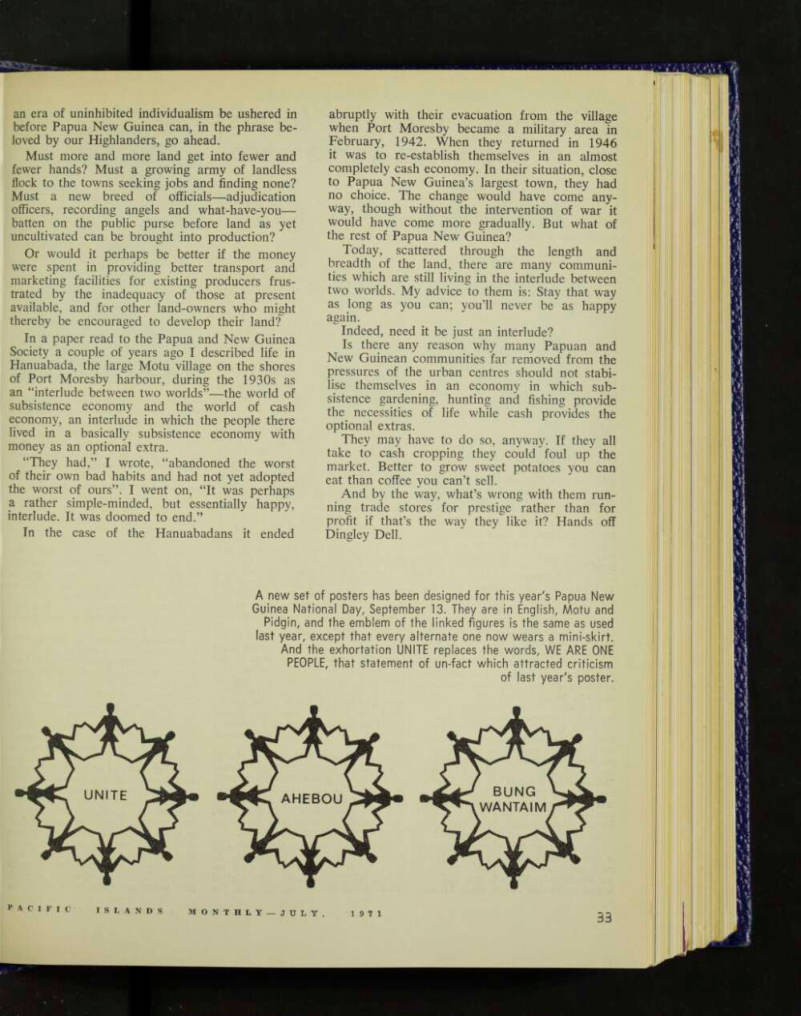
A new set of posters has been designed for this year's Papua New Guinea National Day, September 13. They are in English, Motu and Pidgin, and the emblem of the linked figures is the same as used last year, except that every alternate one now wears a mini-skirt.
And the exhortation UNITE replaces the words, WE ARE ONE PEOPLE, that statement of un-fact which attracted criticism of last year's poster.