Ballalae is back in the world
pp. 27-28 · Read in the full issue
From JUNE WOOD, in Honiara
Ballalae airfield in the Shortland Islands, nestled in one of the most beautiful parts of the Solomons, has come to life again after 25 years of neglect and disuse.
Ballalae, which name author James Michener has said to be the most beautiful he has ever heard, is popularly believed—along with many others!—to have been the inspiration for the island of Bali Ha’i in his Tales of the South Pacific.
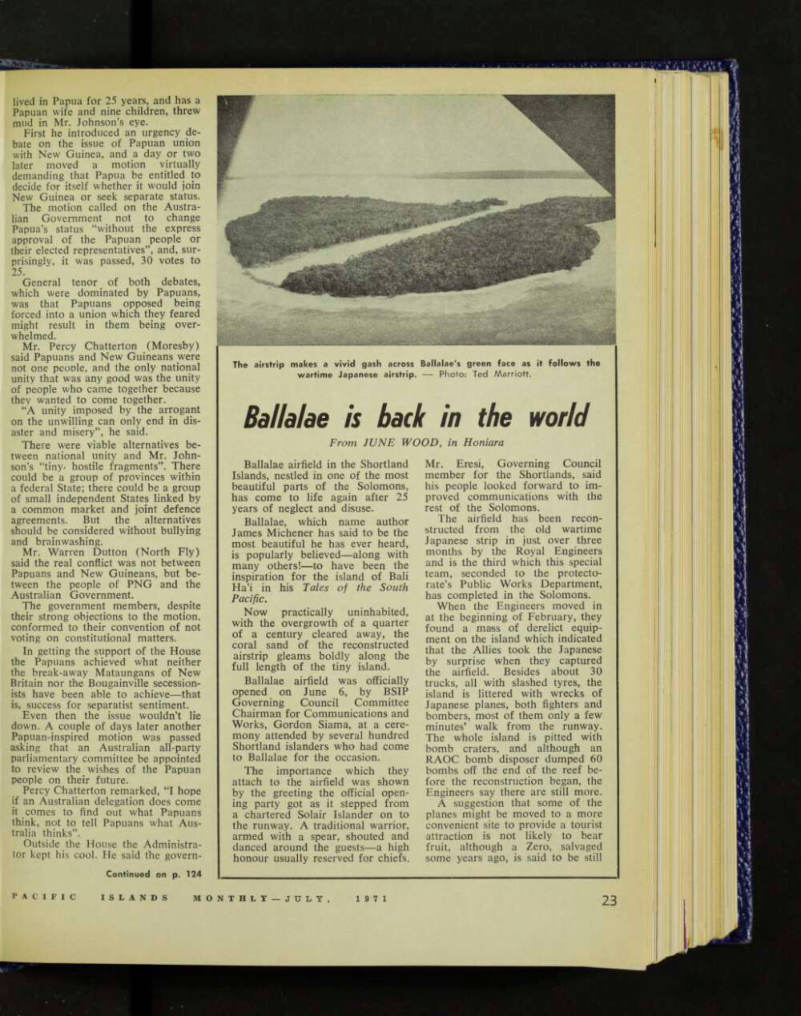
Now practically uninhabited, with the overgrowth of a quarter of a century cleared away, the coral sand of the reconstructed airstrip gleams boldly along the full length of the tiny island.
Ballalae airfield was officially opened on June 6, by BSIP Governing Council Committee Chairman for Communications and Works, Gordon Siama, at a cere mony attended by several hundred Shortland islanders who had come to Ballalae for the occasion.
The importance which they attach to the airfield was shown by the greeting the official open ing party got as it stepped from a chartered Solair Islander on to the runway. A traditional warrior, armed with a spear, shouted and danced around the guests—a high honour usually reserved for chiefs.
Mr. Eresi, Governing Council member for the Shortlands, said his people looked forward to im proved communications with the rest of the Solomons.
The airfield has been recon structed from the old wartime Japanese strip m just over three months by the Royal Engineers a °d is the third which this special team, seconded to the protecto rate s Public Works Department, has completed m the Solomons.
When the Engineers moved in h beginning of February, they f d a * mass s of derelict equip ment on the island which indicated h h A „ ies took he Japanese b rise when they captured th y e air P field , Besides y abo J t 30 trucks, all with slashed tyres, the island is littered with wrecks of Japanese planes, both fighters and bombers, most of them only a few minutes’ walk from the runway, The whole island is pitted with bomb craters, and although an RAOC bomb disposer dumped 60 bombs off the end of the reef be fore the reconstruction began, the Engineers say there are still more, A suggestion that some of the planes might be moved to a more convenient site to provide a tourist attraction is not likely to bear fruit, although a Zero, salvaged some years ago, is said to be still
The airstrip makes a vivid gash across Ballalae's green face as it follows the wartime Japanese airstrip. Photo: Ted Marriott.
flying in Canada. The Engineers believe the planes would break up in any attempt to tow them away, and so they remain, almost com plete, with trees and creepers growing over and through them, a stark reminder of the war.
The original Japanese strip was 1,300 metres and the Engineers have cleared, re - aligned and marked out 680 metres so far, sufficient for Solair’s Baron and Islander, but not long enough for any overseas aircraft.
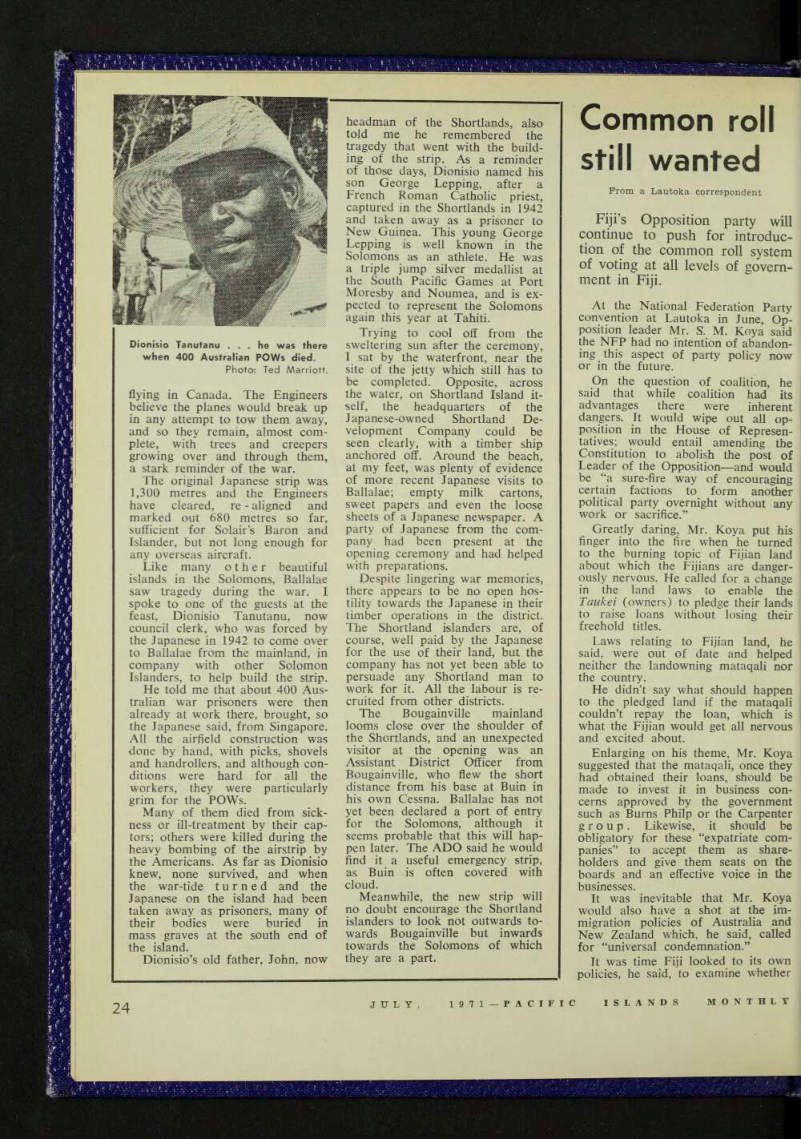
Like many other beautiful islands in the Solomons, Ballalae saw tragedy during the war. I spoke to one of the guests at the feast, Dionisio Tanutanu, now council clerk, who was forced by the Japanese in 1942 to come over to Ballalae from the mainland, in company with other Solomon Islanders, to help build the strip.
He told me that about 400 Aus tralian war prisoners were then already at work there, brought, so the Japanese said, from Singapore.
All the airfield construction was done by hand, with picks, shovels and handrollers, and although con ditions were hard for all the workers, they were particularly grim for the POWs.
Many of them died from sick ness or ill-treatment by their cap tors; others were killed during the heavy bombing of the airstrip by the Americans. As far as Dionisio knew, none survived, and when the war-tide turned and the Japanese on the island had been taken away as prisoners, many of their bodies were buried in mass graves at the south end of the island.
Dionisio’s old father, John, now
headman of the Shortlands, also told me he remembered the tragedy that went with the build ing of the strip. As a reminder of those days, Dionisio named his son George Lepping, after a French Roman Catholic priest, captured in the Shortlands in 1942 and taken away as a prisoner to New Guinea. This young George Lepping is well known in the Solomons as an athlete. He was a triple jump silver medallist at the South Pacific Games at Port Moresby and Noumea, and is ex pected to represent the Solomons again this year at Tahiti.
Trying to cool off from the sweltering sun after the ceremony, I sat by the waterfront, near the site of the jetty which still has to be completed. Opposite, across the water, on Shortland Island it self, the headquarters of the Japanese-owned Shortland De velopment Company could be seen clearly, with a timber ship anchored off. Around the beach, at my feet, was plenty of evidence of more recent Japanese visits to Ballalae; empty milk cartons, sweet papers and even the loose sheets of a Japanese newspaper. A party of Japanese from the com pany had been present at the opening ceremony and had helped with preparations.
Despite lingering war memories, there appears to be no open hos tility towards the Japanese in their timber operations in the district.
The Shortland islanders are, of course, well paid by the Japanese for the use of their land, but the company has not yet been able to persuade any Shortland man to work for it. All the labour is re cruited from other districts.
The Bougainville mainland looms close over the shoulder of the Shortlands, and an unexpected visitor at the opening was an Assistant District Officer from Bougainville, who flew the short distance from his base at Buin in his own Cessna. Ballalae has not yet been declared a port of entry for the Solomons, although it seems probable that this will hap pen later. The ADO said he would find it a useful emergency strip, as Buin is often covered with cloud.
Meanwhile, the new strip will no doubt encourage the Shortland islanders to look not outwards to wards Bougainville but inwards towards the Solomons of which they are a part.
Dionisio Tanutanu ... he was there when 400 Australian POWs died.
Photo; Ted Marriott.